Showing posts with label International Affairs. Show all posts

Wednesday, July 27, 2022

Putin, Erdogan and Raisi meeting raises concerns for German Foreign Minister

    Wednesday, July 27, 2022   No comments

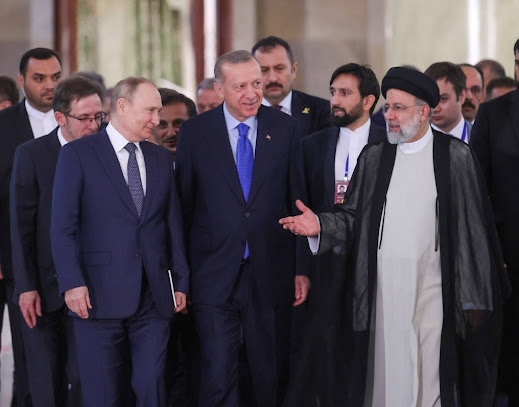
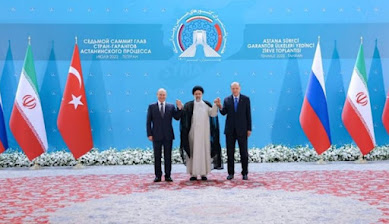
German Foreign Minister Annalina Birbock has criticized Turkish President Recep Tayyip Erdogan for posing for a photo with Russian and Iranian President Vladimir Putin and Ebrahim Raisi.


"The fact that the Turkish president is in this picture is a challenge to NATO," the German Foreign Minister said, in an interview with the newspaper "Bild", adding that this is "simply, incomprehensible."

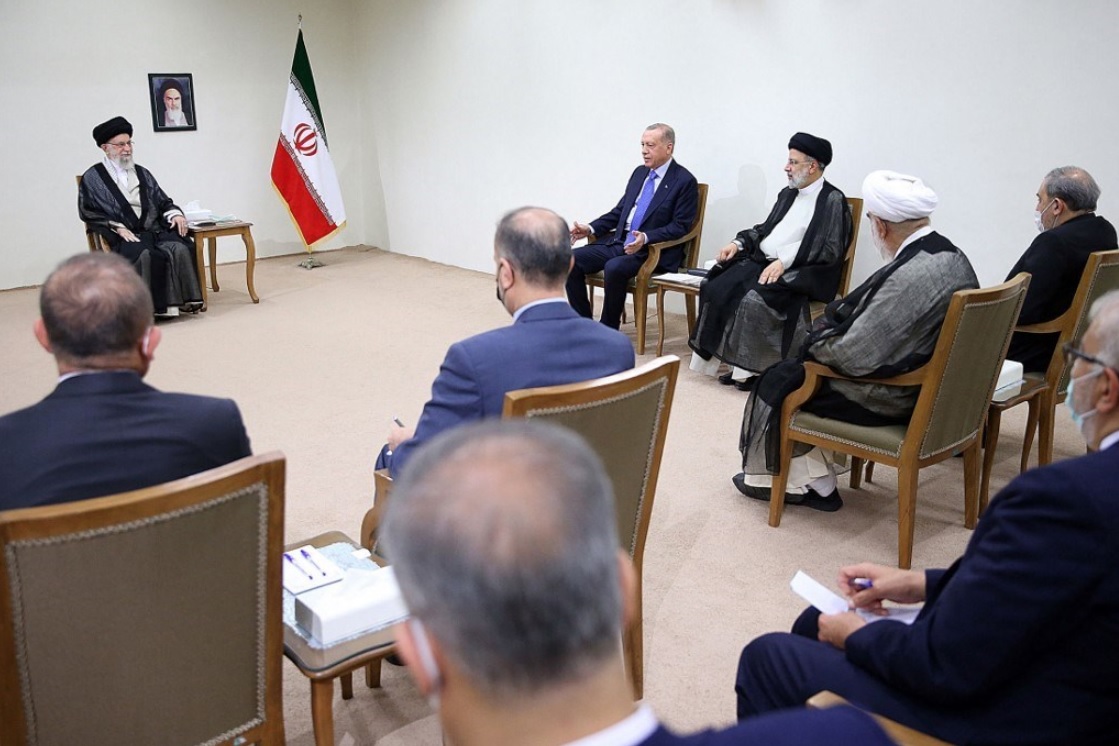
This week, the presidents of Russia, Turkey and Iran met in Tehran, where they held tripartite talks and took a joint photo at an extraordinary summit in light of the ongoing international conflict, with Syria being its most prominent focus. They also discussed joint relations, in addition to a number of files, including the Ukrainian grain export agreement.

Commenting on the German parliament's accusations about the "slowing down" of arms supplies to Kyiv, Bierbock said that the Federal Republic of Germany "has no aim to deceive its European neighbours."


"We can't deliver tanks with the tip of a finger," Birbock added.


The Ukrainian authorities appealed to Western countries to continue supplying them with weapons, while Kyiv accused Germany of being very slow in supplying them.



Monday, June 27, 2022

Media Review: The Causes and Consequences of the Ukraine Crisis

    Monday, June 27, 2022   No comments

With the Russian military operation in Ukraine entering its fifth month, voices against American policies began to rise, especially as the sanctions policy it imposed directly affected European countries and gave counterproductive effects that Washington has not succeeded in avoiding so far.

In a speech adapted into an article with the title, the Causes and Consequences of the Ukraine Crisis, University of Chicago political science professor John J. Mearsheimer has described the war in Ukraine as a multidimensional disaster, likely to get worse in the near future. "When a war is successful, no one cares much about its causes, but when its outcome is catastrophic, understanding how it happened becomes very important. Everyone would like to know how this horrific situation was reached," he said.

Mearsheimer believes that, "With regard to the Ukrainian war, the United States is primarily responsible for causing this crisis. This does not mean that Putin started the war and that he is responsible for Russia's conduct in the war. Nor does this mean denying that America's allies bear some responsibility, but they are to a large extent They are following Washington's example for Ukraine."

This came in a lecture delivered by Mearsheimer at the European University Institute (EUI) in Florence, Italy, last week, in which he spoke in detail about the causes and repercussions of the war in Ukraine, and was published by the American National Interest magazine. It can be argued that the United States has pushed policies toward Ukraine that Putin and other Russian leaders consider an existential threat, especially America's obsession with including Ukraine into NATO and making it a Western fortress on the Russian border. The Biden administration had no willingness to end this threat diplomatically, and recommitted in 2021 to bring Ukraine into NATO. Putin responded by invading Ukraine on February 24.

In Mearsheimer's words, the Biden administration's response to the outbreak of war was to increase pressure on Russia. Washington and its Western allies are resolutely committed to defeating Russia in Ukraine and using comprehensive sanctions to significantly weaken Russian power. And the United States is not seriously interested in finding a diplomatic solution to the war, which means that the war could last months, if not years.

There is no doubt that Ukraine, which has already suffered seriously, will suffer more damage during the war. There is a risk of an escalation of the war, with NATO likely to be drawn into the fight and the possible use of nuclear weapons. It can be said that we live in perilous times.

The war is likely to have catastrophic repercussions. For example, there is reason to believe that the war will lead to a global food crisis, with the death of many millions of people. World Bank President David Malpass said that if the Ukraine war continued, we would face a global food crisis that would be a "humanitarian catastrophe".

In addition, the relations between Russia and the West have been so poisoned that it will take many years to repair. At the same time, this intense hostility will fuel instability around the world, especially in Europe. Some would say that there is one thing that is positive: relations between the countries of the West have improved significantly due to the Ukraine war.

This may be true for now, but there are cracks deep beneath the surface. For example, relations between Eastern European countries and Western European countries are likely to deteriorate as the war continues because their interests and views on the war are not the same.

To be sure, the war has already mainly damaged the global economy, and this situation is likely to get worse with time.

At the conclusion of his lecture, Mearsheimer said that the current war in Ukraine is clearly a colossal catastrophe, which will cause everyone around the world to search for its causes. Those who believe in facts and logic will quickly discover that the United States and its allies are primarily responsible for this devastation. It was inevitable that the decision issued in April 2008 to annex Ukraine and Georgia to NATO would lead to war with Russia.


Quotes:

I have witnessed this phenomenon twice in my lifetime—first with the Vietnam war and second with the Iraq war. In both cases, Americans wanted to know how their country could have miscalculated so badly. Given that the United States and its NATO allies played a crucial role in the events that led to the Ukraine war—and are now playing a central role in the conduct of that war—it is appropriate to evaluate the West’s responsibility for this calamity.


One might argue that Putin was lying about his motives, that he was attempting to disguise his imperial ambitions. As it turns out, I have written a book about lying in international politics—Why Leaders Lie: The Truth about Lying in International Politics—and it is clear to me that Putin was not lying. For starters, one of my principal findings is that leaders do not lie much to each other; they lie more often to their own publics. Regarding Putin, whatever one thinks of him, he does not have a history of lying to other leaders. Although some assert that he frequently lies and cannot be trusted, there is little evidence of him lying to foreign audiences. Moreover, he has publicly spelled out his thinking about Ukraine on numerous occasions over the past two years and he has consistently emphasized that his principal concern is Ukraine’s relations with the West, especially NATO. He has never once hinted that he wants to make Ukraine part of Russia. If this behavior is all part of a giant deception campaign, it would be without precedent in recorded history.


Friday, June 17, 2022

Putin: Energy and food problems are the result of the West's wrong policies; All objectives of the Russian military operation in Ukraine will be achieved

    Friday, June 17, 2022   No comments

 Russian President Vladimir Putin stressed today, Friday, that "the world is diverse and one framework cannot be imposed on everyone from one center," adding: "The world is no longer the same as before."

In his speech at the Petersburg International Economic Forum, Putin said that "the United States of America announced that it had won the Cold War and considered itself descended from heaven."

He recalled what he said in Davos a year and a half ago that the "unipolar world has ended" and that there are strenuous attempts to try to restore it, noting that "it is no longer possible to ignore the interests of the new centers of power in the world."

"Outdated geopolitical illusions have undermined confidence in global currencies," Putin said.

The West expected the ruble to collapse, but what happened was the opposite

The Russian president pointed out that "the West's measures to destroy the Russian economy failed and did not bear fruit," explaining that "the reaction of the Russian people came against what the West wanted, as we have increased strength and cohesion."

Putin stressed that "the Russian financial system is stable," noting that "the West expected the ruble to collapse and reach 200 against the dollar, but what happened was the opposite and their expectations were not fulfilled."

"The goal of the sanctions was to bring down the Russian economy, but they did not succeed because the Russian economic sector worked efficiently," he said.

"The Russian people are a strong people who will deal with any problem, and this is evidenced by the thousand-year history of our country," Putin said.

He added that "European politicians have harmed their countries' economies," noting that "the consequences of sanctions imposed on Russia will be $400 billion on European economies."

He stressed that "sanctions can be imposed on any country, including European countries and any European companies."

The European Union has completely lost its sovereignty

During his speech, Putin saw that "the European Union has completely lost its sovereignty, is subject to external dictates, and implements everything that is dictated to it," noting that "inflation growth in some eurozone countries has now exceeded the level of 20%."

Considering that "the world has reached this situation as a result of the activities carried out by the seven major industrialized countries at the level of economy and politics."

There is a danger that Ukrainian wheat will go to finance arms deals

"The Russian military operation in Ukraine was an excuse to hold Russia responsible for all the mistakes," the Russian president said, stressing that "the special military operation in Donbas has nothing to do with the situation in Europe."

He pointed out that "the United States was at the forefront of exporters in the global market, but the US role has now changed."

Putin pointed out that "the West deliberately created a food crisis by buying foodstuffs in world markets above its actual needs," adding that "the United States was the main supplier of many food commodities, and today it has become an importer rather than an exporter."

He revealed that "Russia is interested in exporting 50 million tons of wheat, a priority for needy countries in the countries of the Middle East and Africa," explaining that "the West is pursuing the same old policy of plunder and imperialism, but in a new way."

He added, "Democratic procedures, elections in Europe sometimes look at what's going on there, what forces come to power. It all seems like a screen [to camouflage], because political parties are alike, like twins, superseding each other. However, the The essence of this does not change, the real interests of citizens, national business are being pushed more and more into the backyard, to the fringes.”

He stressed that Russia does not obstruct food exports from Ukraine and that it is not the one who planted mines in the ports, and said in this context, "We will secure the transportation of grain from the ports, but the Ukrainian side should secure the ports from what they planted of sea mines."

Putin warned that "there is a danger that Ukrainian wheat will go to finance arms deals."

Putin: All objectives of the Russian military operation will be achieved

Putin said that "the reason for the energy crisis in Europe lies in the wrong policy of the European Union and the unjustified dependence on alternative energy," stressing that "there was no escape from the decision to launch military currency, as the Donbas residents were subjected to abuse by the Western-backed Ukrainian regime."

Putin added that "all the objectives of the Russian military operation will be achieved," adding that "our soldiers are defending the homeland, the people and human values, and they are resisting extraneous values ​​and moral decay."

He pointed out that "sovereignty in the 21st century is indivisible."

He denounced Western actions, saying: "The West has always been generous in raising the level of hostility against Russia and creating a poisonous atmosphere of Russophobia."

Putin: Russia will not be isolated

Putin pointed out that "the change in the Russian economy and its ability to confront sanctions is what we have made over the past years," noting that "the structure of Western sanctions was based on a false belief that Russia is not a self-sufficient economy."

"The sanctions provide us with a great opportunity and impetus to move forward with regard to technological independence," he said, adding that "Russia will not undergo the process of isolation that the hostile countries thought we would submit to."

He added that "Russia will deal with leaders who want to deal with it, who are able to distinguish between the interests of their countries and foreign dictates."

Putin predicted that "the current situation in Europe will lead to an escalation of radicalism in the future to change the ruling elites," adding that "everyone working with Russia is under unprecedented pressure from the United States and the European Union."


Tuesday, May 10, 2022

Esper's diary: Trump relied on fabricated and misleading information to target Soleimani

    Tuesday, May 10, 2022   No comments

Former US Defense Secretary Mark Esper, in his memoirs, asserts that "Trump greatly exaggerates his statements, and often makes unreliable and fabricated statements."

Former US Defense Secretary Mark Esper confirmed that he "opposed" former US President Donald Trump's decision to target the commander of the Quds Force, the martyr Qassem Soleimani, after Trump claimed "Soleimani was involved in targeting 4 US diplomatic missions."


Esper's newly released memoirs, titled "A Sacred Oath: Memoirs of a Defense Secretary During Difficult Times", stated that "the daily intelligence briefings, which he reviewed, did not include any evidence to support the theory of accusing Soleimani of an attack on American embassies," adding that "Trump Adopt a pattern of behavior based on lying.

"Trump greatly exaggerates his statements, often making unreliable and fabricated statements," Esper wrote in his memoirs.

Esper was directly attacked by President Trump, who accused him of dishonesty, and was subsequently dismissed from office in November 2020.

Earlier, Esper revealed, in his memoirs, that Trump suggested shooting demonstrators who demanded racial justice, when the demonstrations approached the White House.

Redacted quotes in a new book by former US defence secretary Mark Esper suggest that former Israeli Prime Minister Benjamin Netanyahu called on US President Donald Trump to take direct military action against Iran's nuclear programme. 

In the book, A Sacred Oath: Memoirs of a Secretary of Defense During Extraordinary Times, Esper notes that Trump seemed firm in his commitment not to enter a war with Iran, the Haaretz newspaper reported on Tuesday.

He writes: "The president often had others in the room, and foreign leaders like Israeli Prime Minister Benjamin Netanyahu, telling him [REDACTED]."

Esper wrote that Milley told him that Robert O'Brien, Trump's national security adviser, had called to say that "the president wanted to strike a senior military officer who was operating outside of Iran".

"But why now? What was new? Was there an imminent threat? What about gathering the national security team to discuss this?

"Milley said he was 'stunned' by the call, and he sensed that O'Brien 'put the president up to this,' trying to create news that would help Trump's re-election."


Wednesday, August 22, 2018

German Foreign Minister calls for economic system independent of US: Maas wants EU own SWIFT system

    Wednesday, August 22, 2018   No comments
...

It is also important to correct fake news because it can quickly result in the wrong policies. As Europeans, we have made it clear to the Americans that we consider the withdrawal from the nuclear agreement with Iran to be a mistake. Meanwhile, the first US sanctions have come back into force.

In this situation, it is of strategic importance that we make it clear to Washington that we want to work together. But also: That we will not allow you to go over our heads, and at our expense. That is why it was right to protect European companies legally from sanctions. It is therefore essential that we strengthen European autonomy by establishing payment channels independent of the US, a European monetary fund and an independent SWIFT [payments] system. The devil is in thousands of details. But every day that the Iran agreement lasts, is better than the potentially explosive crisis that threatens the Middle East otherwise.

Wednesday, July 11, 2018

Is the the presence of and military operations of Russia, the United States and Israel in Syria Legal?

    Wednesday, July 11, 2018   No comments

That question was asked The scientific in the German Bundestag. The answer was released and found that, while Russia's presence may be legal because it was operating per request of the Syrian government, the presence of and operations carried out by others is illegal. 

The 13-page report was released Tuesday as reported by Germany based AWDNEWS. The summary and the report are made available below.


English summary as provided by AWDNEWS:

Thursday, December 14, 2017

Who armed ISIS? A three year study provides some answers

    Thursday, December 14, 2017   No comments

Supplies of materiel, including advanced light weapons systems the U.S. military, from foreign parties — notably the United States and Saudi Arabia, ended up in the hands of ISIS fighters.

Sunday, June 18, 2017

Facts and Biases: "Mass shootings are terrorism when perpetrated by Muslims"

    Sunday, June 18, 2017   No comments
...
Legally and morally, we see intent as the best way to distinguish terrorism from mass murder. Federal law defines terrorism as certain violent acts “that appear to be intended to intimidate or coerce a civilian population; to influence the policy of a government by intimidation or coercion; or to affect the conduct of a government.”

But because Hodgkinson is dead and did not declare an aim to dethrone the House majority to which his victims belong, we can only speculate about his motives. Like so many other killers in recent years, it’s impossible to know what his specific goals were, because he didn’t tell anyone. We know that these people intended to commit murder, but not why. And if we assume we know — as in the case of Syed Rizwan Farook in San Bernadino or Jared Lee Loughner in Tucson — it’s probably because of our preexisting stereotypes or our partisanship. Mass killings look the most like terrorism when their perpetrators seem the most alien from the Judeo-Christian, white majority. That’s no way to judge a crime. We need a new way to classify these attacks.
...
This discrepancy poses two dangers. First, the assumption that mass shootings are terrorism when perpetrated by Muslims but not by others may lead law enforcement and the public to overlook threats posed by non-Muslims. For instance, civil rights lawyer and former FBI agent Mike German, who infiltrated white supremacist groups, has argued that the domestic threat posed by right-wing extremist groups is as great as, if not greater than, that posed by Arab or Muslim terrorists, and yet has been largely ignored by the FBI. A report by the Government Accountability Office tallied 106 killings perpetrated by right-wing extremists in the United States from Sept. 12, 2001, to the end of 2016, more or less equal to the 119 by Muslim extremists in that time. While the exact number in each category may change slightly depending on how we classify individual attacks, the point is that there’s close to parity in the danger posed by each group.

Second, it’s possible that law enforcement and other decision-makers will acknowledge and respond to this singular focus on Muslims by overcompensating in the opposite manner so as to appear nondiscriminatory. The Fort Hood shooter, for example, had repeatedly drawn complaints from fellow soldiers for appearing to justify terrorist attacks against Americans in the Middle East. The FBI was even aware that Hasan had been in email contact with al-Qaeda provocateur Anwar al-Awlaki. It is one thing to avoid racial or religious stereotyping but another to ignore red flags for fear of being perceived as bigoted, as appears to be the case with Hasan. Yet this tension is inherent in stereotype-based law enforcement.

One first step toward resolving the question of “what is terrorism?” — at least in the colloquial sense — is to stop focusing so much on the perpetrator’s perceived intent and to look more at the effects of the violent act. Today, attackers such as Hodgkinson, Hasan, Rizwan, Malik, Loughner and Roof have one thing clearly in common: Even if it’s not clear why, they want to kill as many people as possible. That should be enough to call them all terrorists.

source
James T. Hodgkinson, the man who shot five people at a Republican baseball practice Wednesday, including a member of Congress, harbored ill will toward President Trump and the GOP. So was Hodgkinson a terrorist?

Monday, May 22, 2017

Trump's Sword dancing and saber rattling in Saudi Arabia, homeland of nearly all of the 9/11 attackers

    Monday, May 22, 2017   No comments
The contrast couldn't be greater: In Saudi Arabia, Donald Trump joined in the sword dance - a dance of war, as King Salman explained to his American guest. And in Iran, the people were dancing in the streets to celebrate the landslide victory of moderate reformer Hassan Rouhani in the presidential election, and the rejection of hardliner Ebrahim Raisi.

Despite, or maybe even because of the war dance, the mood in Saudi Arabia is also one of joy and celebration. Trump's speech on Sunday has been seen as turning the page on US relations with the Arab world generally, and Saudi Arabia in particular. It didn't just mark the end of the Obama administration's critical stance on the kingdom, it also declared its geostrategic adversary, Iran, to be the biggest villain in the region - one best left in isolation, as it was during the George W. Bush era. And because isolation alone might not have been enough, Trump arrived bearing arms contracts worth some $110 billion (98 billion euros) for his hosts - a deal of historic proportions.

No vision of peace

It's a bitter irony that, while visiting the homeland of nearly all of the 9/11 attackers, Trump singled out Iran alone for supporting terrorism. He made no mention of the fact that Riyadh has been supporting the so-called "Islamic State" and other jihadist groups with money and arms, as former US Vice President Joe Biden made clear in a speech he gave at Harvard University in the fall of 2014.
... source

*****


WaPo

Thursday, May 18, 2017

Saudi Arabia working to impress Donald Trump on his first overseas visit

    Thursday, May 18, 2017   No comments
Trump’s decision to make Saudi Arabia his first overseas stop sends a powerful message to the kingdom: the strained ties that marked U.S.-Saudi relations under President Barack Obama are over.

Saudi Arabia is making every effort to dazzle and impress President Donald Trump on his first overseas trip, seizing on the visit to cement itself as a major player on the world stage and shove aside rival Iran.

The kingdom has arranged a dizzying schedule of events for the two days Trump will be in town — inviting figures as varied as Sudanese President Omar al-Bashir, who has been indicted for war crimes by the International Criminal Court, Bret Baier, a host on the Fox News Channel that is popular with Trump and his supporters, and American country singer Toby Keith who is to perform for a male-only crowd in the Saudi capital, Riyadh.

Trump’s decision to make Saudi Arabia his first overseas stop sends a powerful message to the kingdom: the strained ties that marked U.S.-Saudi relations under President Barack Obama are over.

The kingdom wants Trump to align U.S. interests with Saudi Arabia’s — and is literally counting down the seconds until Trump starts his meetings Saturday. A website for the visit was launched in English, Arabic and French, featuring a countdown clock under the banner: “Together We Prevail.”

“The foundation will be laid for a new beginning” to confront extremist ideology, the website declares, while also touting Saudi Arabia’s Vision 2030 a wide-reaching reform plan launched by King Salman’s ambitious son, Deputy Crown Prince Mohammed bin Salman, to overhaul the economy and restyle the country through greater openings for investment and entertainment. source

Wednesday, May 3, 2017

Here is why no government should ever be trusted with human rights protection: governments are always the culprit when it comes to HR abuses

    Wednesday, May 03, 2017   No comments
The Geneva-based human rights group UN Watch condemned the U.N.’s election of Saudi Arabia, “the world’s most misogynistic regime,” to a 2018-2022 term on its Commission on the Status of Women, the U.N. agency “exclusively dedicated to the promotion of gender equality and the empowerment of women.”

“Electing Saudi Arabia to protect women’s rights is like making an arsonist into the town fire chief,” said Hillel Neuer, executive director of UN Watch. “It’s absurd — and morally reprehensible.”

“This is a black day for women’s rights, and for all human rights,” said Neuer. Interview: Why Saudis Joined Women’s Rights Body

“Saudi discrimination against women is gross and systematic in law and in practice. Every Saudi woman,” said Neuer, “must have a male guardian who makes all critical decisions on her behalf, controlling a woman’s life from her birth until death. Saudi Arabia bans women from driving cars. Why did the U.N. choose the world’s leading oppressor of women to promote gender equality and the empowerment of women?”


Saudi women feel betrayed by the UN. “I wish I could find the words to express how I feel right know. I’m ‘saudi’ and this feels like betrayal,” tweeted a self-described Saudi woman pursuing a doctorate in international human rights law in Australia.

“Today the UN sent a message that women’s rights can be sold out for petro-dollars and politics,” said Neuer, “and it let down millions of female victims worldwide who look to the world body for protection.”

sources: UN Watch, WashPost...

Friday, April 28, 2017

Trump: Saudi Arabia must pay for US protection... Saudi Arabia has not treated us fairly

    Friday, April 28, 2017   No comments
Pro-regime propaganda in Saudi Arabia
President Donald Trump complained on Thursday that U.S. ally Saudi Arabia was not treating the United States fairly and Washington was losing a “tremendous amount of money” defending the kingdom.

In an interview with Reuters, Trump confirmed his administration was in talks about possible visits to Saudi Arabia and Israel in the second half of May. He is due to make his first trip abroad as president for a May 25 NATO summit in Brussels and could add other stops.

"Frankly, Saudi Arabia has not treated us fairly, because we are losing a tremendous amount of money in defending Saudi Arabia,” he said.

Trump’s criticism of Riyadh was a return to his 2016 election campaign rhetoric when he accused the kingdom of not pulling its weight in paying for the U.S. security umbrella.

"Nobody’s going to mess with Saudi Arabia because we’re watching them," Trump told a campaign rally in Wisconsin a year ago. “They’re not paying us a fair price. We’re losing our shirt.”  source

Wednesday, April 12, 2017

How Al Qaeda Played Donald Trump And The American Media

    Wednesday, April 12, 2017   No comments
Scott Ritter, Contributor

For the first time since President Obama, in August 2011, articulated regime change in Damascus as a precondition for the cessation of the civil conflict that had been raging since April 2011, American government officials articulated that this was no longer the case.  “You pick and choose your battles,” the American Ambassador to the United Nations, Nikki Haley, told reporters on March 30, 2017.  “And when we’re looking at this, it’s about changing up priorities and our priority is no longer to sit and focus on getting Assad out.”  Haley’s words were echoed by Secretary of State Rex Tillerson, who observed that same day, while on an official visit to Turkey, “I think the… longer-term status of President Assad will be decided by the Syrian people.”

This new policy direction lasted barely five days. Sometime in the early afternoon of April 4, 2017, troubling images and video clips began to be transmitted out of the Syrian province of Idlib by anti-government activists, including members of the so-called “White Helmets,” a volunteer rescue team whose work was captured in an eponymously-named Academy Award-winning documentary film. These images showed victims in various stages of symptomatic distress, including death, from what the activists said was exposure to chemical weapons dropped by the Syrian air force on the town of Khan Sheikhoun that very morning.

Images of these tragic deaths were immediately broadcast on American media outlets, with pundits decrying the horrific and heinous nature of the chemical attack, which was nearly unanimously attributed to the Syrian government, even though the only evidence provided was the imagery and testimony of the anti-Assad activists who, just days before, were decrying the shift in American policy regarding regime change in Syria. President Trump viewed these images, and was deeply troubled by what he saw, especially the depictions of dead and suffering children.

The images were used as exhibits in a passionate speech by Haley during a speech at the Security Council on April 5, 2017, where she confronted Russia and threatened unilateral American military action if the Council failed to respond to the alleged Syrian chemical attack. “Yesterday morning, we awoke to pictures, to children foaming at the mouth, suffering convulsions, being carried in the arms of desperate parents,” Haley said, holding up two examples of the images provided by the anti-Assad activists. “We saw rows of lifeless bodies, some still in diapers…we cannot close our eyes to those pictures.  We cannot close our minds of the responsibility to act.”  If the Security Council refused to take action against the Syrian government, Haley said, then “there are times in the life of states that we are compelled to take our own action.”

...

Al Nusra has a long history of manufacturing and employing crude chemical weapons; the 2013 chemical attack on Ghouta made use of low-grade Sarin nerve agent locally synthesized, while attacks in and around Aleppo in 2016 made use of a chlorine/white phosphorous blend.  If the Russians are correct, and the building bombed in Khan Sheikhoun on the morning of April 4, 2017 was producing and/or storing chemical weapons, the probability that viable agent and other toxic contaminants were dispersed into the surrounding neighborhood, and further disseminated by the prevailing wind, is high.

The counter-narrative offered by the Russians and Syrians, however, has been minimized, mocked and ignored by both the American media and the Trump administration. So, too, has the very illogic of the premise being put forward to answer the question of why President Assad would risk everything by using chemical weapons against a target of zero military value, at a time when the strategic balance of power had shifted strongly in his favor. Likewise, why would Russia, which had invested considerable political capital in the disarmament of Syria’s chemical weapons capability after 2013, stand by idly while the Syrian air force carried out such an attack, especially when their was such a heavy Russian military presence at the base in question at the time of the attack?
...
Source

Tuesday, March 21, 2017

Families of 9/11 victims sue Saudi Arabia for complicity in terror attacks

    Tuesday, March 21, 2017   No comments
 Saudi Arabia knowingly provided material support to Al Qaeda — including funding, training and passports — in order to facilitate the terror attacks that killed nearly 3,000 people on 9/11, according to a new federal lawsuit filed Monday.

Outraged families of Sept. 11 victims did what two presidential administrations would not — compile what they deem to be extensive evidence holding the Saudi’s responsible for the attacks on the World Trade Center, Pentagon and Pennsylvania.

Thursday, October 20, 2016

Full text of Syrian President's interview with Swiss TV journalist

    Thursday, October 20, 2016   No comments
Journalist: Mr. President, thank you very much for having welcomed Swiss Television and our program Rundschau here in Damascus.

President Assad: You are most welcome in Syria.

Question 1: First, please, allow me to clarify one thing: may I ask you every question?

President Assad: Every question, without exception.

Question 2: I’m asking because one of your conditions is that interview is being broadcast in its full version. Are you afraid that we might manipulate your statements?

President Assad: You should answer that question, but I think we should build this relation upon the trust, and I think you are worried about the trust of your audience, so I don’t think so. I think you have good reputation in conveying the truth in every subject you try to cover.

Question 3: Do you see it as a lie, that the world considers you as to be a war criminal?

President Assad: That depends on what the reference in defining that word. Is it the international law, or is it the Western agenda or the Western political mood, let’s say, that’s being defined by vested-interests politicians in the West? According to the international law, as a President and as government and as Syrian Army, we are defending our country against the terrorists that have been invading Syria as proxies to other countries. So, if you want to go back to that word, the “war criminal,” I think the first one who should be tried under that title are the Western officials; starting with George Bush who invaded Iraq without any mandate from the Security Council. Second, Cameron and Sarkozy who invaded and destroyed Libya without mandate from the Security Council. Third, the Western officials who are supporting the terrorists during the last five years in Syria, either by providing them with political umbrella, or supporting them directly with armaments, or implementing embargo on the Syrian people that has led to the killing of thousands of Syrian civilians.

Question 4: But we are here to talk about your role in this war, and the US

Secretary of State John Kerry called you “Adolf Hitler” and “Saddam Hussein” in the same breath. Does it bother you?

President Assad: No, because they don’t have credibility. This is first of all. Second, for me as President, what I care about first and foremost is how the Syrian people look at me; second, my friends around the world – not my personal friends as President, I mean our friends as Syrians, like Russia, like Iran, like China, like the rest of the world – not the West, the West always tried to personalize things, just to cover the real goals which is about deposing government and getting rid of a certain president just to bring puppets to suit their agenda. So, going back to the beginning, no I don’t care about what Kerry said, at all. It has no influence on me.

Question 5: You’re the President of a country whose citizens are fleeing, half of your fellow citizens. The people are not only fleeing because of the terrorists, of ISIS, or the rebels, but also because of you.

President Assad: What do you mean by me? I’m not asking people to leave Syria, I’m not attacking people; I’m defending the people. Actually, the people are leaving Syria for two reasons: first reason is the action of the terrorists, direct action in killing the people. The second one is the action of the terrorists in order to paralyze the life in Syria; attacking schools, destroying infrastructure in every sector. Third, the embargo of the West that pressed many Syrians to find their livelihood outside Syria. These are the main reasons. If you can see that the second factor and the third factor are related, I mean the role of the terrorists and the West in undermining and hurting the livelihoods of the Syrians, is one and, let’s say, is commonality between the terrorists and Europe.

Question 6: When you speak of terrorists, who do you mean by that? Surely ISIS, but also the “Free Syrian Army” or the Kurds?

3

President Assad: What I mean is like what you mean as a Swiss citizen, if you have anyone who carries machineguns or armaments and killing people under any titles, and committed vandalism, destroying public or private properties; this is a terrorist. Anyone who adopts a political way in order to make any change he wants, this is not a terrorist. You can call him opposition. But you cannot call somebody who is killing people or holding armaments, you cannot call him opposition, in your country, in my country as well.

Question 7: Well, you don’t have any free opposition in your country.

President Assad: Of course we have, of course we have. We have real opposition, we have people who live in Syria, whom their grassroots are the Syrian people, they’re not opposition who were forged in other countries like France or UK or Saudi Arabia or Turkey. We have them, and you can go and meet them and deal with them with your camera. You can do that yourself.

Question 8: How do you explain to your three children what is happening in

Aleppo? I’m sure that you are discussing about it at the family table.

President Assad: Yeah, of course if I’m going to explain to them, I’m going to explain about what is happening in Syria, not only in Aleppo, taking into consideration that my children are full-grown now, they understand what is going on Syria. But if you want to explain to them or to any other child what is happening, I’m going to explain about the role of the terrorists, about the role of Qatar, Turkey, Saudi Arabia in supporting those terrorists with money, with logistic support, and the role of the West in supporting those terrorists either through armament or through helping them with the propaganda and the publicity. I’m going to explain to them in full what’s going on.

Question 9: Do you, as a father, also say that you have nothing to do with the bombardments of the hospitals in Aleppo?

President Assad: Look, when they say that we are bombarding the hospitals, it means that we are killing civilians. That is the meaning of the word. The question is why would the government kill civilians, whether in hospitals or in streets or schools or anywhere? You are talking about killing Syrians. When we kill Syrians, as a government, or as army, the biggest part of the Syrian society will be against us. You cannot succeed in your war if you are killing civilians. So, this story, and this narrative, is a mendacious narrative, to be frank with you. Of course, unfortunately, every war is a bad war, in every war you have innocent victims, whether children, women, elderly, any other civilian, any other innocent who is not part of this war, he could pay the price, this is unfortunately. That’s why we have to fight terrorism. When we don’t say that, it’s like saying – according to that question or that narrative, that you may reflect in your question – that the terrorists, Al Qaeda, al-Nusra, ISIS, are protecting the civilians, and we as government are killing the civilians. Who can believe that story? No one.

Question 10: But who else got airplanes or bunker-busting bombs besides your army?

President Assad: It’s like you’re saying that everyone who is killed in Syria was killed by the airplanes or aircrafts, military aircrafts! The majority of the people were killed by mortars shelled by the terrorists on them while they’re at schools, in their hospitals, in the streets, anywhere. It’s not related to the aerial bombardment. Sometimes you have aerial bombardment against the terrorists, but that doesn’t mean that every bomb that fell somewhere was by airplane or by the Syrian Army. If you are talking about a specific incident, let’s say, we have to verify that specific incident, but I’m answering you in general now.

Question 11: But you have the power to change the situation also for the children in Aleppo.

President Assad: Of course, that’s why-

Journalist: Will you do that?

President Assad: Exactly, that’s our mission, according to the constitution, according to the law; that we have to protect the people, that we have to get rid of those terrorists from Aleppo. This is where we can protect the civilians. How can you protect them while they are under the control of the terrorists? They’ve been killed by them, and they’ve been controlled fully by the terrorists. Is it our role to sit aside and watch? Is that how we can protect the Syrian people? We need to attack the terrorists, that’s self-evident.

Question 12: May I show you a picture?

President Assad: Of course.

Journalist: This young boy has become the symbol of the war. I think that you know this picture.

President Assad: Of course I saw it.

Journalist: His name is Omran. Five years old.

President Assad: Yeah.

Journalist: Covered with blood, scared, traumatized. Is there anything you would like to say to Omran and his family?

President Assad: There’s something I would like to say to you first of all, because I want you to go back after my interview, and go to the internet to see the same picture of the same child, with his sister, both were rescued by what they call them in the West “White Helmets” which is a facelift of al-Nusra in Aleppo. They were rescued twice, each one in a different incident, and just as part of the publicity of those White Helmets. None of these incidents were true. You can have it manipulated, and it is manipulated. I’m going to send you those two pictures, and they are on the internet, just to see that this is a forged picture, not a real one. We have real pictures of children being harmed, but this one in specific is a forged one.

Question 13: But it’s true that innocent civilians are dying, in Aleppo.

President Assad: Of course, not only in Aleppo; in Syria. But now you are talking about Aleppo, because the whole hysteria in the West about Aleppo, for one reason; not because Aleppo is under siege, because Aleppo has been under siege for the last four years by the terrorists, and we haven’t heard a question by Western journalists about what’s happening in

Aleppo that time, and we haven’t heard a single statement by Western officials regarding the children of Aleppo. Now, they are talking about Aleppo recently just because the terrorists are in a bad shape. This is the only reason, because the Syrian Army are making advancement, and the Western countries – mainly the United States and its allies like UK and France – feeling that they are losing the last cards of terrorism in Syria, and the main bastion of that terrorism today is Aleppo.

Question 14: Everything is allowed in this war for you.

President Assad: No, of course, you have the international law, you have the human rights charter, you have to obey. But in every war, every war in the world during the history, you cannot make sure a hundred percent that you can control everything in that direction. You always have flaws, that’s why I said every war is a bad war. But there’s difference between individual mistakes and the policy of the government. The policy of the government, to say that we are attacking civilians, we are attacking hospitals, we are attacking schools, we are doing all these atrocities, that’s not possible, because you cannot work or go against your interests. You cannot go against your duty toward the people, otherwise you are going to lose the war as a government. You cannot withstand such a ferocious war for five years and a half while you are killing your own people. That’s impossible. But you always have mistakes, whether it’s about crossfire, it’s about individual mistakes… bring me a war, a single war in the recent history, that it was a clean war. You don’t have.

Question 15: Do you have made any mistakes too in this war?

President Assad: As President I define the policy of the country, according to our policy, the main pillars of this policy during the crisis is to fight terrorism, which I think is correct and we will not going to change it, of course, to make dialogue between the Syrians, and I think which is correct, the third one which is proven to be effective during the last two years is the reconciliations; local reconciliations with the militants who have been holding machineguns against the people and against the government and against the army, and this one has, again, proven that it’s a good step. So, these are the pillars of this policy. You cannot talk about mistakes in this policy. You can talk about mistakes in the implementation of the policy, that could be related to the individuals.

Question 16: You still believe in a diplomatic solution?

President Assad: Definitely, but you don’t have something called diplomatic solution or military solution; you have solution, but every conflict has many aspects, one of them is the security, like our situation, and the other one is in the political aspect of this solution. For example, if you ask me about how can you deal with Al Qaeda, with al-Nusra, with ISIS? Is it possible to make negotiations with them? They won’t make, they’re not ready to, they wouldn’t. They have their own ideology, repugnant ideology, so you cannot make political solution with this party; you have to fight them, you have to get rid of them. While if you talk about dialogue, you can make dialogue with two entities; the first one, political entities, any political entities, whether with or against or in the middle, and with every militant who is ready to give in his armament for the sake of the security or stability in Syria. Of course we believe in it.

Question 17: There are news from Russia about a short humanitarian pause in Aleppo on Thursday, what does it mean this humanitarian pause, can you explain?

President Assad: It’s a short halting of operations in order to allow the humanitarian supply to get into different areas in Aleppo, and at the same time to allow the civilians who wanted to leave the terrorist-held areas to move to the government-controlled area.

Question 18: This is really a step, an important step?

President Assad: Of course, it is an important step as a beginning, but it’s not enough. It’s about the continuation; how can you allow those civilians to leave. The majority of them wanted to leave the area held by the terrorists, but they won’t allow them. They either shoot them or they kill their families if they leave that area.

Question 19: Russia is on your side, what does it mean for you?

President Assad: No, it’s not on my side. It’s on the international law’s side.

It’s on the other side which is opposite to the terrorists’ side. This is the position of Russia, because they wanted to make sure that the international law prevails, not the Western agenda in toppling every government that doesn’t fit with their agendas. They wanted to make sure that the terrorism doesn’t prevail in that area, that would affect negatively the Russians themselves, Russia itself as a country, and Europe and the rest of the world. That’s what it means for Russia to stand beside the legitimate Syrian government and the Syrian people.

Question 20: Mr. President, you use chemical weapons and barrel bombs in Syria against your own population, these are UN reports, you can’t ignore it.

President Assad: You are talking about two different issues. The chemical issue, it was proven to be false, and they haven’t a shred of evidence about the Syrian Army using chemical weapons, particularly before we give up our arsenal in 2013, now we don’t have it anyway. Before that, it was fiction because if you want to use such mass destruction armaments, you’re going to kill thousands of people in one incident, and we didn’t have such incidents. Beside that, we wouldn’t use it because you’re going to kill your own people, and that’s against your interest. So, this is a false allegation. We don’t have to waste our time with it. You live in Syria, there is a traditional war, but there is nothing related to mass destruction armaments.

Journalist: But the UN report is not a fiction.

President Assad: The UN report never has been credible, never, and because they put reports based on allegations, based on other reports, on forged reports, and they say this is a report. Did they send a delegation to make investigation? They sent one in 2013, and it couldn’t prove at all that the Syrian Army used chemical weapons. This is first. The second, which is more important, the first incident happened at the beginning of 2013 in

Aleppo, when we said that the terrorists used chemical weapons against our army, and we invited the United Nations to send a delegation. We, we did, and at that time, the United States opposed that delegation because they already knew that this investigation – of course if it’s impartial – is going to prove that those terrorists, their proxies, used chemical armaments against the Syrian Army. Regarding the barrel bombs, I want to ask you: what is the definition of barrel bomb? If you go to our army, you don’t have in our records something called “barrel bomb,” so how do you understand – just to know how I can answer you – what a barrel bomb is? We have bombs.

Journalist: The destruction… it’s the destruction, and it is against humanitarian law.

President Assad: Every bomb can make destruction, every bomb, so you don’t have bomb to make nothing. So, this is a word that has been used in West as part of the Western narrative in order to show that there is an indiscriminate bomb that has been killing civilians indiscriminately and that opposes the Western narrative, I’ll show you the contradiction: in other areas they say that we are bombarding intentionally the hospitals, and you mentioned that, and they are targeting intentionally the schools, and we targeted intentionally the convoys to Aleppo last month, those targets need high-precision missiles. So, they have to choose which part of the narrative; we either have indiscriminate bombs or we have high-precision bombs. They keep contradicting in the same narrative, this is the Western reality now. So, which one to choose? I can answer you, but again, we don’t have any indiscriminate bombs. If we kill people indiscriminately, it means we are losing the war because people will be against us; I cannot kill the Syrian people, either morally or for my interest, because in that case I’m going to push the Syrian community and society towards the terrorists, not vice versa.

Question 21: I would like to mention the subject of torture prisons, Mr. President. Amnesty speaks of seventeen thousands dead. Regarding the prison of Saidnaya, there are still horrible reports. When will you allow an independent observer into that prison?

President Assad: Independent, and Amnesty International is not independent and it is not impartial.

Journalist: ICRC?

President Assad: We didn’t discuss it with the Red Cross, we didn’t discuss it. It should be discussed in our institutions, if you want to allow… if there is allegation, it could be discussed. We don’t say yes or no, but the report you have mentioned, it was a report made by Qatar, and financed by Qatar. You don’t know the source, you don’t know the names of those victims, nothing verified about that report. It was paid by Qatar directly in order to vilify and smear the Syrian government and the Syrian Army.

Journalist: But there are a lot of eyewitnesses.

President Assad: No one knows who are they. You don’t have anything clear about that. It’s not verified. So, no.

Journalist: Then open the door for organizations like Red Cross.

President Assad: It’s not my decision to tell you yes or no. We have institutions, if we need to discuss this part, we need to go back to the institutions before saying yes or no.

Question 22: Why are you sure that you are going to win this war?

President Assad: Because you have to defend your country, and you have to believe that you can win the war to defend your country. If you don’t have that belief, you will lose. You know, part of the war is what you believe in, so, it’s self-evident and very intuitive that you have to have that belief.

Question 23: If you walk through Damascus, your picture is everywhere, in every shop, in every restaurant, in every car, a symbol for a dictator, is this your way to fix your power?

President Assad: There is a difference between dictator and dictatorship.

Dictator is about the person. I didn’t ask anyone to put my picture in Syria, I never did it. This is first. Second, to describe someone as a dictator, you should ask his people, I mean only his people can say that he is a dictator or he is a good guy.

Journalist: Thank you Mr. President for having answered our questions for Swiss Television and the Rundschau.

President Assad: Thank you for coming to Syria.

_______________________________
Interview as released by the Syrian government:


 _______________________

Interview as released by the Swiss TV:


Saturday, September 10, 2016

Isis fighter reveals group's plan to spread even after defeat in Iraq and Syria and claims collusion with Turkey

    Saturday, September 10, 2016   No comments
Isis will flourish and survive even if it is defeated in the present battle for Syria and Iraq an Isis militant has told The Independent.

In an exclusive interview, Faraj, a 30-year-old veteran fighter from north east Syria, says that “when we say that the Islamic State [Isis] is everlasting and expanding, it is not a mere poetic or propaganda phrase”. He says the group intends to rebuild its strength in Saudi Arabia, Egypt, Libya and Tunisia, adding that “Isis has sleeper agents all over the world and their numbers are increasing”.

In his account of his life in Isis, Faraj makes plain that only a year after the caliphate was declared in the wake of the capture of Mosul in 2014, its leaders could foresee that it might be overrun militarily. He reveals hitherto unknown details of the apparent close cooperation between Isis and Turkey and the degree to which foreign fighters who flooded into Syria to fight for Isis alienated local people from the movement by ordering them about and interfering in their lives.  source

Thursday, June 30, 2016

Who killed 150 to 250 ISIS fighters and destroyed their vehicles near Fallujah?

    Thursday, June 30, 2016   No comments

It seems that the different players in the fight against ISIL are now competing for credit.

On Wednesday, Iraqi military released footage showing destroyed cars and trucks. Military officials claimed that the raid was carried out by Iraqi pilots who were using Russian made helicopters. It should be noted that it was reported that "Iraq has received their final batch of Russian Mi-28 NE Night Hunter military helicopters". The attack footage indicated that these helicopters were used. NBC News reported the same story.

Reuters, on the other hand, reported the following:

U.S.-led coalition aircraft waged a series of deadly strikes against Islamic State around the city of Falluja on Wednesday, U.S. officials told Reuters, with one citing a preliminary estimate of at least 250 suspected fighters killed and at least 40 vehicles destroyed.

Iraqi officials indicated that U.S. refused to assist with the attack they took credit for. These conflicting reports show that the U.S. led anti-ISIL coalition is not as unified behind the mission as they claim.

Video footage of the attack, one of the attacks, or something like that:


Meanwhile, more American weapons fell in the hands of ISIS when another so-called "moderate" Syrian rebel group attempted to push out ISIS from a town near the Iraqi border. According to reports, 40 of the rebel were killed and 15 taken prisoners by ISIS.

The Syrian Observatory for Human Rights said the group's offensive against ISIS was being mounted with the backing of Western special forces and US-led air strikes.


Wednesday, January 20, 2016

Showing the growing strategic difference with the US and converging interests with Saudi Arabia: Israeli DM declares that he prefers ISIS to Iran

    Wednesday, January 20, 2016   No comments
Evidence is mounting that the Middle East is entering a new era. Days after the Iran Deal, which mainly ended the US-Iran nuclear dispute, Israeli leaders are now taking public steps to align themselves with Saudi Arabia and the groups that country supports and distancing itself from the U.S. 
Speaking today at a security conference in Tel Aviv, Israeli Defense Minister Moshe Ya’alon declared that he “prefers ISIS” over Iran, and does not consider ISIS to pose a serious threat to the Israeli state, saying Iran will always remain “the main enemy.”

Ya’alon insisted that he believes ISIS will be defeated at any rate, what with the US launching strikes on their oil supplies, but that he’d much rather see ISIS rule all of Syria, and consequently be directly on Israel’s border, than have the pro-Iran government remain in power.

Sunday, January 17, 2016

U.S. and Iran release Iranian and American prisoners, Obama pardons Iranians charged with sanctions violations

    Sunday, January 17, 2016   No comments
An Iranian analyst said the US was mainly seeking to free Jason Rezaian through its Saturday prisoners swap deal with Iran that also included freedom of three other US citizens in Iran and 7 Iranian inmates in the United States.

Mehdi Mohammadi wrote on his Instagram page on Sunday that 4 US inmates were freed yesterday in exchange for a package of concessions by the American side.

According to him, Jason Rezaian was the main person who was freed on Saturday and the US agreed to make the concessions for his sake and not the three other inmates.

Wednesday, October 28, 2015

Iran Confirms Participation in Syrian Crisis Talks in Vienna

    Wednesday, October 28, 2015   No comments

"We have reviewed the invitation, and it was decided that the foreign minister would attend the talks," Foreign Ministry Spokeswoman Marzieh Afkham said on Wednesday.

Iranian Foreign Minister Mohammad Javad Zarif and his deputies will attend the Syria peace talks in Vienna on Friday.

"Deputy Foreign Ministers Hossein Amir Abdollahian, Seyed Abbas Araqchi and Majid Takht Ravanchi will accompany Foreign Minister on this trip," Afkham said.

According to latest reports, the top diplomats from Russia, the United States, France, Saudi Arabia, Lebanon, Iraq, Egypt and Turkey will also convene in Vienna, Austria, on Friday to discuss the Syrian crisis.

It comes after Washington reversed its opposition to Tehran's participation in talks to end the Syrian civil war.

Islamic Societies Review WEEKLY updates

AdSpace - 2

AdSpace - 2
Books

ISR+


Now reading...


Frequently Used Labels and Topics


Search for old news

AdSpace-1

AdSpace-1
Buy Books

Find Articles by year, month hierarchy


Copyright © Islamic Societies Review. All rights reserved.
