The War in Ukraine creates new tends: Proliferation of weapons and widening of conflict areas


Turkish media revealed that President Erdogan and his Syrian counterpart, Bashar al-Assad, may hold a phone call, during the coming period, at the suggestion of Putin.
And the newspaper "Turkey" published a report, in which it was based on private sources, that Erdogan, who recently visited Sochi, Russia, exchanged views on Syria with President Putin, and the Russian President suggested that he meet Assad and Erdogan, in order to solve the problem of terrorism in Syria.
But Ankara made it clear that it is "too early" for a meeting between the two presidents, while a phone call is still possible.
The newspaper pointed out that there are diplomatic contacts from a Gulf country and an African one with Syria and Turkey, in order to arrange a meeting between Presidents Assad and Erdogan.
During their bilateral summit in Sochi, Putin and Erdogan confirmed their support for preserving the unity of Syria.
During this meeting in Sochi, Putin was accompanied by the president of the Chechen Republic, R. Kadyrov, who might be called upon to nudge Turkey further in the direction of Russia.
Erdogan announced, earlier, that his country intends to launch a military operation inside Syrian territory to combat “terrorism” and establish what he described as a “safe zone,” noting that his country “will not ask permission before launching a military operation in Syria.”
While Ankara says that its military presence in Syria aims to prevent the threat from the Kurdish factions, Damascus considers the Turkish military presence in the country an occupation and a threat to regional and international peace.
In a letter sent by the Ministry of Foreign Affairs to both United Nations Secretary-General Antonio Guterres and the Security Council, Syria protested Turkey's intention to launch a military operation inside its territory.
Last May, an official source at the Ministry of Foreign Affairs and Expatriates confirmed that "Syria's sovereignty, independence, and territorial integrity will not be the object of blackmail or bargaining by the Turkish regime."
Reacting to the latest media report about possible talks between the Syrian President Bashar al-Assad and his Turkish counterpart, Recep Tayyip Erdogan, is Syrian sources, off the record, rejected the the idea of such event happening, characterizing it as "totally incorrect."
...
Meanwhile, US media sources highlight another aspect of Turkish involment in matters of concern to Russia.
The American "Newsweek" magazine said today, Tuesday, that the Turkish company "Baykar", which produces the "Bayraktar" unmanned combat aircraft, is currently building a factory on Ukrainian soil.
The magazine quoted Ukraine's ambassador to Turkey, Vasyl Bodnar, as saying that the Turkish company had already purchased a plot of land in Ukraine and developed the station project. Bodnar added that "Baykar" intends to build the plant in fulfillment of the personal commitment of the company's owners to make this production in Ukraine.
The magazine pointed out that the Bayraktar TB2 drones were considered one of the most valuable weapons for Ukraine in the first months of the war, especially before the arrival of the American "HIMARS" missiles.
She noted that Ukraine had more than 20 unmanned aircraft produced by the "Baykar" company when the war began, and acquired them during the past two years.
Because Kyiv currently has a limited supply of these planes, and given that Russia has learned a lesson from weakness during the first phase of the war, it is unlikely that Ukrainian forces would risk losing their TB2s from unmanned aerial vehicles, by pushing them forward in areas where Russian air defenses could easily fall."
She added that "a TP2 aircraft factory can fundamentally change the situation in Ukraine," noting that the time required for the construction of the factory is still unclear.
...
Editors' Note: This story was updated to include the Syrian government's rection to the news about the phone call between the two presidents.

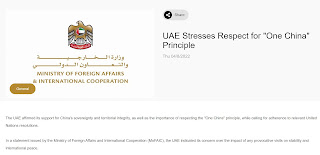
A day after Pelosi's trip, on Thursday, the influential GCC state, UAE, reiterated its support for China's "sovereignty" over Taiwan and condemned "provocative visits" after US House of Representatives Speaker Nancy Pelosi landed on the island earlier this week.
"The UAE affirmed its support for China's sovereignty and territorial integrity, as well as the importance of respecting the 'One China' principle... the UAE indicated its concern over the impact of any provocative visits on stability and international peace," the Emirati foreign ministry said in a statement.
Pelosi landed in Taiwan as part of a wider Indo-Pacific tour on Tuesday - enraging China, which regards Taiwan as a breakaway province.
The UAE is a key US ally in the Middle East, but also has burgeoning ties with China. It has previously expressed strong support for China's sovereignty over Taiwan.
A Sky News investigation found earlier this year that the UAE was providing China with "black sites" to detain and forcibly disappear Uighur activists.
Abu Dhabi and Washington have taken differing stances on some key global issues, including Russia's invasion of Ukraine - with the UAE failing to follow the US in condemning Moscow for its actions.
The US reportedly intervened last year in Beijing's construction of a Chinese military base in the UAE.

Action is the most powerful language, said the Chinese Defense Ministry on Thursday as its spokesperson stressed the sensitivity of the Taiwan question again after China issued six warnings against US House Speaker Nancy Pelosi's potential visit to Taiwan island over the past few days.
The frequency of Chinese warnings and the remarks different departments use fully demonstrate China's determination to take any necessary military measures to counter US provocations and safeguard national sovereignty and territorial integrity, analysts said.
The People's Liberation Army (PLA) will not tolerate any "Taiwan independence" moves or interference from external forces, and will resolutely stop such attempts, Wu Qian, spokesperson for the Defense Ministry, said at Thursday's press briefing.
The root cause of a turbulent Taiwan Straits is the collusion between "Taiwan independence" forces and external interfering forces, Wu said, urging relevant parties to learn to adapt to the new reality (PLA operations near the Straits), to reflect on their own deeds and "most importantly, to pull back from the brink."
Though Wu was responding to a question about PLA operations on the Taiwan Straits, analysts interpreted Wu's words as another stern warning against the US government and some US politicians who are pushing Pelosi's possible visit to Taiwan island. [Read GT story here].
China main English language media also added its view warning of serious consequences in an editorial titled, US better clear the ‘mine’ of Pelosi’s Taiwan trip beforehand: Global Times editorial.
US House Speaker Nancy Pelosi has laid a mine where China-US relations and the situation around the Taiwan Straits converge. She lit the match, but it remains uncertain whether she will truly ignite the mine. According to the itinerary of Pelosi's Asia trip as reported by US media, her trip includes Japan, South Korea, Malaysia and Singapore, and the island of Taiwan was listed as "tentative." Many believe this is a trick by Pelosi, who is very likely to fly to Taiwan island from Japan and make a sudden visit.
This kind of sneaky trick is indeed difficult to predict, but one thing is certain: China will take strong measures to resolutely respond and counteract, and it will let the huge risk created by Pelosi have an impact on herself. This is not only a firm and clear attitude, but will certainly be accompanied by a strong and concrete course of action plan.
China's response has been clear, as always. "Those who play with fire will perish by it." This was said to Pelosi and the Taiwan secessionist forces that support her. A White House official called it a metaphor that China regularly tends to use. He completely misread and misjudged the essence and weight of this sentence. Any act of stepping on the red line will surely hit the iron wall of China's counterattack. China's repeated public warnings are by no means jokes. Washington should turn to history to see that China has always kept its word.
No matter from the perspective of international law or international morality, it is legitimate and necessary for China to safeguard its national sovereignty and territorial integrity from provocation. Today, China's will and ability in this regard is without doubt. US President Joe Biden has reiterated that he adheres to the one-China policy and does not support "Taiwan independence." What kind of behavior is a visit to Taiwan island by Washington's "No.3 figure"? If you come to offend me, I will make you bear the consequences. This is not China threatening or intimidating anyone, but safeguarding and defending its own core interests. [read the editorial here].
In Sunday, Chinese intelligence said it has information that US House of Representatives Speaker Nancy Pelosi will visit Taiwan on August 4 and meet with Taiwan's president in the capital, Taipei.
This Chinese announcement comes after a statement issued by Pelosi about her Asian tour that includes Asian countries, from which her visit to Taiwan was dropped.
China had warned America against Pelosi's visit to Taiwan, and said that the completion of the visit means a violation of its national sovereignty, and requires a firm response. Chinese government media said that it may reach a military response in response to the American insistence on this provocative visit.
Meanwhile, Chinese national media outlets appear to be preparing for war, replaying videos like this one:

Russia's Foreign Minister Sergey Lavrov has had a very busy month in July. He has visited a number of Asian and African countries mainly to explain Russia's position on the war in Ukraine and to thank some states for not joining the sanctions imposed against his country. It would seem that his trip was successful to the extent that he was able to even revise the mission of Russia's special military operation in Ukraine, it is now about more than the Donbass region. Here is a rundown of key events and statements.
___________________________
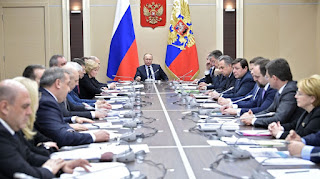
On Friday, Russian President Vladimir Putin asked Foreign Minister Sergey Lavrov to report on his recent foreign tour.
During his meeting with members of the Russian Security Council, Putin said: "Today, we will discuss some issues on the international agenda, and I ask the Minister of Foreign Affairs to talk about the results of his foreign tour. I have read his written reports, but I would like to share these results and impressions from your tour with colleagues." .
Besides Lavrov, the meeting was attended by Russian Prime Minister Mikhail Mishusti, Federation Council Speaker Valentina Matvienko, Russian Security Council Deputy Chairman Dmitry Medvedev, Presidential Administration Head Anton Vaino, Federal Security Service Director Alexander Bortnikov, as well as Special Presidential Envoy for Environmental Protection and Transport Sergei Ivanov .
Lavrov recently completed a foreign tour that included Mongolia and Vietnam, as well as Indonesia, where he participated in the meeting of foreign ministers of the "Group of Twenty", and met a number of its foreign ministers, with the exception of foreign ministers of Western countries and the United States.
The "Group of Twenty" meeting represents a prelude to the Summit of Heads of State and Government of the Group of Twenty to be held next November in Indonesia, which it invited Russian President Vladimir Putin to attend.
Next week, Lavrov will tour a number of African countries, starting next Sunday in Egypt, where he will deliver a speech before the League of Arab States.
Earlier, the Russian Foreign Minister noted that "Russia and African partners are constantly working to reduce the dollar and euro shares in their mutual trade."
*****
Russian Foreign Minister Sergei Lavrov start an African tour, starting with a visit to Egypt, on Sunday, in an effort to benefit from the desire of some countries to join non-Western alliances.
In Egypt, Lavrov would meet officials who are trying to raise the level of strong relations with Russia to the level of their close relationship with the United States, which sought with other Western powers to isolate Russia by imposing severe sanctions on it, after its military operation in Ukraine, on February 24.
After meeting with members of the Arab League in Cairo, Lavrov is heading to Ethiopia and Uganda, the two countries whose relations with the West have recently been strained, and then to the Republic of the Congo.
Russian Foreign Minister Sergey Lavrov said that "Russia and African partners are constantly working to reduce the shares of the dollar and the euro in their mutual trade."
"The current geopolitical situation requires a certain adjustment of our interaction mechanisms, first of all, we are talking about the need to ensure uninterrupted logistics and the creation of financial settlement systems that are protected from external interference," added Lavrov.
"Russia, in cooperation with partners, is taking steps to expand the use of national currencies and payment systems, and is constantly working to reduce the share of the dollar and the euro in mutual trade," Lavrov said.
The minister noted that Russia "supports the creation of an independent and efficient financial system that is not vulnerable to possible influence from unfriendly countries."
He added, "Developing a comprehensive partnership with African countries remains among the important priorities of Russia's foreign policy. We are open to its further construction in line with the strategic decisions taken at the first Russia-Africa Summit at the end of October 2019 in Sochi."
The Minister stressed that Russia is open to building a comprehensive partnership with African countries, and will continue to fulfill its obligations to provide these countries with food, fertilizers and energy carriers, noting at the same time that Western sanctions against Russia have exacerbated the difficult situation in the food market.
In a related context, the Russian Foreign Minister expressed his country's appreciation for the balanced position of Africans regarding what is happening in and around Ukraine. "We know that African colleagues do not agree with the overt attempts of the United States and its European subordinates to dictate their will to everyone, to impose a unipolar model of world order on the international community," he said. "We appreciate the balanced position of Africans."
"Despite unprecedented external pressure, our (African) friends did not join the sanctions against Russia. Such an independent line deserves deep respect," he added.
*****
On Wednesday, Russian Foreign Minister Sergey Lavrov confirmed that Russian President Vladimir Putin has repeatedly talked about sanctions on "North Stream-2" and reducing the share of gas supplies through "North Stream-1" to reach 50% of its capacity, considering that "therefore, Europe is responsible for the energy crisis, not Russia."
In an exclusive interview with "Sputnik" and "RT", Lavrov said that "in principle, his country will not abandon the old economic chains, and will work to build new, more reliable chains, and this is what Russia is doing in the current circumstances."
Lavrov noted that "there are a number of new economic initiatives, including the "North-South" corridor extending from St. Petersburg to the Indian Ocean and from India to Vladivostok, adding that "there are a whole number of projects, which are now at a high degree of implementation." ".
He pointed out that Russia has "excellent and distinguished relations with Africa since the era of the Soviet Union," adding: "We participated in the construction of giant industrial projects on the African continent, in addition to the role of the Soviet Union in liberating many African countries from colonialism."
Lavrov revealed the expected visits to Africa this year, explaining that "it will include Africa, Egypt, Ethiopia, Uganda and Congo. He considered Africa, India and China as very promising markets."
Since the launch of the Russian special military operation on February 24, Western countries have imposed severe and unprecedented economic and financial sanctions on Russia.
Russian President Vladimir Putin stressed that "Russia does not plan to occupy Ukrainian territory," explaining that "Russia's goal is to protect people who, for 8 years, have been subjected to persecution and genocide by the Kyiv regime."
The sanctions range from banning oil exports, tying up the banking sector, and preventing companies from major countries from dealing with the Russian market, in addition to banning dealing through the “Swift” system for international banking transactions, freezing the assets of the Russian Central Bank in Western countries, as well as closing the airspace to Russian aircraft. And he imposed direct sanctions on deputies and the circle surrounding the Kremlin, right up to Russian President Vladimir Putin personally.
On the other hand, the sanctions imposed on Russia cast a shadow on international supply and supply chains, and confused the European economy first, especially in the sectors of energy, trade, manufacturing, banking and markets, in addition to their repercussions on global food prices.
*****
Russian Foreign Minister Sergei Lavrov said on Wednesday that Moscow's military missions in Ukraine have gone beyond the eastern Donbass region.
Lavrov: "The facts of geography have changed since officials from Russia and Ukraine held negotiations in Turkey in late March that failed to achieve any breakthrough."
"Now the geography has changed, and it is no longer related to the two republics, but also to the Kherson and Zaporizhzh regions and a number of other regions," Lavrov added, referring to lands outside the two republics that were completely or partially controlled by Russia.
"The process continues in a logical and diligent manner," he added, noting that "Russia may need to go deeper."
At the beginning of this month, the Russian Ministry of Defense announced "the liberation of the territory of the Lugansk People's Republic", and Russian forces took control of areas outside Donbass, especially in the southern regions of Zaporizhia and Kherson.
Lavrov: Peace talks with Ukraine are useless
With regard to peace talks with Ukraine, Lavrov said that it was "useless to conduct them" for the time being. Lavrov noted that the first rounds of talks with Ukraine proved that Kyiv "does not want to discuss any issue seriously."
"They will not be able to formulate anything that deserves serious attention from serious people," the Russian foreign minister added, "and we have already realized that."
Talks between Russia and Ukraine stalled in mid-April, Lavrov said, explaining that Western arms supplies to Ukraine had altered the Kremlin's calculations.
Lavrov also stated that the United States of America and the United Kingdom want to push Russia to confront Europe, by providing them with arms to Ukraine.
It is noteworthy that the Russian President, Vladimir Putin, had confirmed, last June, that "the Russian air defense systems will break down the weapons obtained by Ukraine from the West like nuts."

Former British Prime Minister, Tony Blair, pointed out that the world is on the verge of geopolitical changes, pointing out that the era of Western hegemony is nearing its end, and is moving towards multipolarity.
"The biggest geopolitical changes of this century will be provoked by China, not Russia," Blair said, in a lecture at a symposium organized by the British-American "Ditchley" Foundation.
He added that "the world will become, at least, bipolar, or perhaps multipolar, and we are approaching the end of Western hegemony in politics and economics."
He continued, "For the first time in modern history, the East can be on an equal footing with the West."
He added that China "is the second superpower in the world, and its economic potential and degree of participation in the global economy is higher than that of Russia."
He believed that "China has caught up with the United States in many technological fields, and is threatening to overtake the United States."
He pointed out that "the Chinese leadership is behaving more and more aggressively, and does not hide that it treats the West with contempt and is getting close to Russia, and it wants to solve the Taiwan problem at last."
"Don't get me wrong, I'm not saying that China will try to take Taiwan by force any time soon, however, we can no longer base our policy on the certainty that it won't," Blair said. China in the near future.
He described the differences in the positions of the Group of Twenty countries on the Ukrainian issue as a warning to the West, calling for building relations with China on the basis of the principle of strength and participation.
He called on the West to "increase military spending and remain strong enough to resist China in any future scenario, while maintaining relations with Beijing, acting in a pragmatic rather than aggressive manner, and demonstrating a willingness to mutual respect."
The former US Secretary of State, Henry Kissinger, had confirmed, earlier, that the global geopolitical situation "will witness changes after the end of the war in Ukraine. It is natural that the interests of Russia and China will not be identical on all issues."
French President Emmanuel Macron also emphasized that the world is no longer bipolar, but rather multipolar.

In a speech adapted into an article with the title, the Causes and Consequences of the Ukraine Crisis, University of Chicago political science professor John J. Mearsheimer has described the war in Ukraine as a multidimensional disaster, likely to get worse in the near future. "When a war is successful, no one cares much about its causes, but when its outcome is catastrophic, understanding how it happened becomes very important. Everyone would like to know how this horrific situation was reached," he said.
Mearsheimer believes that, "With regard to the Ukrainian war, the United States is primarily responsible for causing this crisis. This does not mean that Putin started the war and that he is responsible for Russia's conduct in the war. Nor does this mean denying that America's allies bear some responsibility, but they are to a large extent They are following Washington's example for Ukraine."
This came in a lecture delivered by Mearsheimer at the European University Institute (EUI) in Florence, Italy, last week, in which he spoke in detail about the causes and repercussions of the war in Ukraine, and was published by the American National Interest magazine. It can be argued that the United States has pushed policies toward Ukraine that Putin and other Russian leaders consider an existential threat, especially America's obsession with including Ukraine into NATO and making it a Western fortress on the Russian border. The Biden administration had no willingness to end this threat diplomatically, and recommitted in 2021 to bring Ukraine into NATO. Putin responded by invading Ukraine on February 24.
In Mearsheimer's words, the Biden administration's response to the outbreak of war was to increase pressure on Russia. Washington and its Western allies are resolutely committed to defeating Russia in Ukraine and using comprehensive sanctions to significantly weaken Russian power. And the United States is not seriously interested in finding a diplomatic solution to the war, which means that the war could last months, if not years.
There is no doubt that Ukraine, which has already suffered seriously, will suffer more damage during the war. There is a risk of an escalation of the war, with NATO likely to be drawn into the fight and the possible use of nuclear weapons. It can be said that we live in perilous times.
The war is likely to have catastrophic repercussions. For example, there is reason to believe that the war will lead to a global food crisis, with the death of many millions of people. World Bank President David Malpass said that if the Ukraine war continued, we would face a global food crisis that would be a "humanitarian catastrophe".
In addition, the relations between Russia and the West have been so poisoned that it will take many years to repair. At the same time, this intense hostility will fuel instability around the world, especially in Europe. Some would say that there is one thing that is positive: relations between the countries of the West have improved significantly due to the Ukraine war.
This may be true for now, but there are cracks deep beneath the surface. For example, relations between Eastern European countries and Western European countries are likely to deteriorate as the war continues because their interests and views on the war are not the same.
To be sure, the war has already mainly damaged the global economy, and this situation is likely to get worse with time.
At the conclusion of his lecture, Mearsheimer said that the current war in Ukraine is clearly a colossal catastrophe, which will cause everyone around the world to search for its causes. Those who believe in facts and logic will quickly discover that the United States and its allies are primarily responsible for this devastation. It was inevitable that the decision issued in April 2008 to annex Ukraine and Georgia to NATO would lead to war with Russia.
Quotes:
I have witnessed this phenomenon twice in my lifetime—first with the Vietnam war and second with the Iraq war. In both cases, Americans wanted to know how their country could have miscalculated so badly. Given that the United States and its NATO allies played a crucial role in the events that led to the Ukraine war—and are now playing a central role in the conduct of that war—it is appropriate to evaluate the West’s responsibility for this calamity.
One might argue that Putin was lying about his motives, that he was attempting to disguise his imperial ambitions. As it turns out, I have written a book about lying in international politics—Why Leaders Lie: The Truth about Lying in International Politics—and it is clear to me that Putin was not lying. For starters, one of my principal findings is that leaders do not lie much to each other; they lie more often to their own publics. Regarding Putin, whatever one thinks of him, he does not have a history of lying to other leaders. Although some assert that he frequently lies and cannot be trusted, there is little evidence of him lying to foreign audiences. Moreover, he has publicly spelled out his thinking about Ukraine on numerous occasions over the past two years and he has consistently emphasized that his principal concern is Ukraine’s relations with the West, especially NATO. He has never once hinted that he wants to make Ukraine part of Russia. If this behavior is all part of a giant deception campaign, it would be without precedent in recorded history.

To understand why the conflict in Ukraine will drag on for years, not months, a look at the tactics used in battles by both sides could help.
Over the past 8 years, Ukrainian forces in the east have worked continuously to establish fighting positions and defensive positions against the forces fighting for autonomy in the east. With Russia now directly involved, on the ground, those tactical measures are falling apart.
Russian forces are using modern technologies to dismantle these military positions. To do that, they are turning to highly mobile units to move quickly, eliminate the threat, and move on to the next target.
These methods have been used in Syria, and Russia’s experience in that war is being used to fight this war.
This means that the war will go on for years.

The captured fighters of the Armed Forces of Ukraine spoke about the low staffing of the units, the poor provision of the group that ended up in the "Mountain boiler", the flight of the commanders and the lack of communication with them. They call captivity the only chance to stay alive and call on their colleagues for this.
Ukrainian soldiers: “...Our only way to stay alive is to lay down our arms. We were in full view, and if we hadn’t laid down our arms, we would have died.”
Video posted on Russia's MoD video showing Ukrainian POWs

Erdogan vows a decisive response and a Greek general threatens to bomb Istanbul .. The "Aegean" crisis raises the tension between Ankara and Athens to its most dangerous stage
Tensions are escalating between the two NATO allies, Turkey and Greece, after Ankara accused Athens of arming 12 islands in the Aegean Sea near Turkish territory, in addition to the chronic dispute over the file of natural gas exploration in the eastern Mediterranean.
The tension reached the point where the retired Greek general, Yiannis Egolfopoulos, threatened to bomb the vital bridges of Istanbul, which was met with Turkish criticism, most notably by the leader of the Nationalist Movement Party, Devlet Bahçeli, who said, “It seems that the Greeks forgot the fate of their ancestors who were buried at the bottom of a sea Aegean.”
The escalation reached its climax after the Greek Prime Minister, Kyriakos Mitsotakis, accused Turkey of destabilizing the island of Cyprus in front of members of the US Congress recently, and demanded Washington not to sell Ankara F-16 fighters.
Erdogan: decisive response
Turkish President Recep Tayyip Erdogan responded to him, during his participation in the "Efes 2022" military maneuvers, that his country is serious about responding decisively to Greece, and that the latter should realize its borders and abide by them.
As a result of these statements, the military clash became the talk of the street and the media on both sides.
Military option
In light of the escalation of statements, the retired Turkish general, Erdogan Karagosh, said that a war between Turkey and Greece was inevitable, calling for the need to strengthen the strength of the Turkish Air Force.
“We have to get new F-16 fighters by any means, and maintain the ones we have,” Qaragosh said, in an interview with one of the private Turkish channels, according to the Al-Jazeera report.
He added that Turkey has no problem with its land and naval forces, "but we must strengthen the strength of our air force, because in the event of any military conflict between the two countries, the air force will resolve the situation, and in the event that we do not obtain new fighters, the balance will tip in favor of Greece." .
In turn, the Turkish expert in military and security affairs, Mateh Yarar, ruled out the outbreak of any direct military clash between the two countries, indicating that Athens relies in its verbal escalation on the West's support for it, and that it will not be able to engage in a military confrontation against Turkey, given "the disparity in the balance of power between the two sides." ”
Yarar pointed out - in a statement to the Turkish newspaper Milliyet - that Ankara calls on Greece to abide by the Lausanne agreements in 1923 and Paris in 1947, which stipulate keeping the mentioned islands demilitarized, referring to Athens' pledge before the major powers at the time to abide by this condition.
sovereign right
On the other hand, the Greek political analyst, Taki Barbarakis, said in an interview with the Turkish "Khabar Turk" channel, that talk about the possibility of a military clash between Ankara and Athens has increased recently among Greek politicians and even among the general public.
He pointed out that there is great popular support for the Greek government regarding the issue of arming the Aegean islands, and that public opinion in Greece believes that arming the islands is a sovereign right of Athens stemming from the Charter of the United Nations.
According to the Greek analyst, Athens relies on arming the Aegean islands on Article 51 of the United Nations Charter, which provides for the “right of self-defense”; Her government has repeatedly announced that it has taken this step in order to counter any potential threat from Turkey. She pointed out that the "Aegean Sea" army, which Turkey formed outside the NATO command, has a landing fleet on the coasts near the islands.
Turkish opposition
In parallel with the debate between Ankara and Athens, the Turkish opposition entered the line, accusing the ruling Justice and Development Party governments of neglecting the issue of the Aegean islands, and went on to consider that President Erdogan and his governments did not take the necessary measures in time, and that Greece intensified its arming of the islands after the arrival of Justice and Development to power in the country in 2002.
In this context, the former deputy of the opposition Republican People's Party, Mustafa Balbay, says that Greece has begun to intensify arming the islands near the Turkish shores since 2004, and has also settled civilians on these islands.
"Where were the justice and development governments at that time?" Balpay asked. Why did Erdogan’s governments not take deterrent measures at that time?”
In his opinion, President Erdogan's recent statements regarding Greece's arming of the Aegean islands are nothing but "media propaganda, in preparation for the upcoming presidential elections" scheduled for June 2023.
real occupation
Balpay sees Greece's arming the Aegean islands as a real occupation, especially with Athens also housing civilians on these islands, and called on President Erdogan to focus on the issue of "occupation" during his talks with the leaders of the countries concerned with this issue.
The former deputy called for taking more necessary measures and preparing for all possibilities, including the military option, indicating that in the event of any armed conflict, Turkey will not only face Greece, but will also face major global powers, led by the United States of America, which recently began establishing bases Large military in the Greek islands near Turkey.
NATO and Other Security Structures
Finnish President Sauli Niinisto expressed hope on Tuesday that progress will be made in the ongoing talks with Turkey on Helsinki's accession to the North Atlantic Treaty Organization (NATO).
Niinistö said during a press conference with the President of the European Parliament, Roberta Mitsola, that "Finland continues talks with Turkey about joining NATO, and we hope to make progress in those negotiations."
"I think it will be difficult to reach an agreement before the Madrid [NATO summit]," he added.
The Finnish president indicated that he does not believe that his country's accession procedures to NATO can be completed by next September.
And the Finnish presidency announced yesterday that "a new round of negotiations conducted by Finland and Sweden with Turkey will be held in Brussels," against the backdrop of Ankara's objection to the two countries' request to join NATO.
Turkish presidential spokesman Ibrahim Kalin confirmed yesterday that the progress of Sweden and Finland's accession to NATO is linked to the steps that these two countries will take, in line with the words of Turkish President Recep Tayyip Erdogan a few days ago.
Last Wednesday, Turkish Foreign Minister Mevlut Cavusoglu announced that "Turkey will send a document to Sweden and Finland to form the basis for negotiating the two countries' accession to the North Atlantic Treaty Organization (NATO)," adding during a press conference with the Foreign Ministers of Ireland and Norway in Ankara: "We must Reaching an understanding with Sweden and Finland on how to meet our demands."
Erdogan also stressed during the meeting of the parliamentary bloc of the "Justice and Development Party", Wednesday, that his country "will not change its position regarding the accession of Sweden and Finland to NATO until they take clear and tangible steps towards combating terrorism." "We will not forgive any countries that support terrorist organizations that threaten Turkey," he added.
And last May, talks were held in Turkey between Turkish officials and delegations from Sweden and Finland. Sources told "Reuters" that "the talks made little progress in addressing the motives behind Ankara's objection to the two countries joining NATO."
Turkey, the conflict of NATO and the Collective Security Organization
Turkey has tended to sell arms to Central Asian countries, to perpetuate the idea that it is able to guarantee the defense capacity of countries that revolve in its ideological, social, economic and military orbit.
The North Atlantic Treaty Organization cannot be seen as the only military bloc and force in the world. It is possible to rely on the assessment of the CSTO’s bloc as an almost parallel bloc, as it includes countries that enjoy an important military power, such as Russia, Belarus and Armenia, in addition to Tajikistan, Kyrgyzstan and Kazakhstan; Countries considered full members, some members as observers, and others as potential candidates, such as Iran.At a meeting of the Parliamentary Assembly of the Collective Security Treaty Organization in the Armenian capital recently, the speaker of the Kyrgyz parliament indicated that the organization’s crisis response system and confronting escalating security challenges and threats constitutes an essential element of its activity, including the fight against international terrorism and extremism.

Also, he noted the need for Member States to deepen interaction to ensure a timely response, and stressed the need to focus the organization's efforts, not only on confronting challenges and security threats, but also on "eliminating the causes of their occurrence", and suggested the establishment of an entire military-political structure on the basis of a treaty organization. collective security.
The Russian Foreign Minister also noted that NATO countries are concerned about the growing importance of the Collective Security Treaty Organization, and stressed the need for it to play the role of "a guarantor of balance in the Euro-Atlantic region" and the indivisibility of security.
On May 16, a meeting of the heads of state of the Collective Security Treaty Organization was held in Moscow, during which the Russian president indicated that “NATO expansion is artificial, and goes beyond its geographical objective,” in an attempt to influence other regions, and noted that the CSTO “plays a role extremely important in stabilizing the former Soviet Union,” which encourages other countries to “consider joining the CSTO, which has sufficient capabilities to respond to the challenges of NATO expansion.”
However, the "Western European flock" continues its attempts to counter the influence of the organization, by preoccupying its members with their security, as well as by turning Turkey, as the spearhead of NATO, into a lever for anti-Russian influence, through escalation in Nagorno-Karabakh. At the request of Brussels and Washington, Ankara tried to play an active role in resolving this conflict, by exploiting Moscow’s lukewarm intervention in its results, and tried to offer a trade-off for the military alliance of the countries of the region with it, in exchange for accepting its membership in the Collective Security Treaty Organization.
With the aim of enhancing its importance in the region, Turkey pumped its investments, sent preachers, opened centers for educational programs in the Central Asian region, and circulated the terms and concepts of "Uzbek Turks", "Tatar Turks" and "Kyrgyz Turks" in its media, and began talking about the "Turkish world" And it established the “Turkish Council”, in parallel with the intensification of its activity in spreading the ideas of Turkish nationalism, as it seeks to create a new and alternative ethnic national identity for the post-Soviet republics, and to replace the region’s original society with a new fake one under Turkish leadership.
Turkey has also tended to sell arms to Central Asian countries, to perpetuate the idea that it is able to guarantee the defense capacity of countries that revolve in its ideological, social, economic and military orbit. Thus, it is trying to open the way towards Erdogan's project known as the "Great Turan" to restore the lands of the Ottoman Empire, by focusing on Kyrgyzstan and Tajikistan, to create a unified army for the Turan project, with the aim of extricating these countries and withdrawing them from the Collective Security Organization, and weakening the Eurasian Union militarily and economically.
As in the past, in order to create a permanent and constant threat to Russia, Britain created the Ottoman Empire. Today, both London and Washington are using Turkey as a member of NATO to confront Russia, especially in the Central Asian region, by proposing Erdogan the idea of "the Great Turan", which is supposed to be able to bring about a radical change in the international balance of power.
For these purposes, the Westerners bear the filth of dealing with the Turkish president and his government, and suffer to see an “Asian NATO” under the Turkish leadership. The hostility of the Russian state makes them unable to determine the interests of their peoples, and unable to guarantee the Turkish-Erdogan fulfillment of their plans, amid the Turks’ dissatisfaction with their presence in NATO. In light of the mutual distrust between the two parties.
In the midst of this atmosphere, we are hearing some of Ankara’s Atlantic allies talking about the need to exclude it from the alliance, and they are closely following its positive contacts with Russia, which contributes to pushing Turkey to abandon its historical anti-Russian role, with the Turkish President’s assertion and his recent statements about Turkey’s unwillingness To participate in the anti-Russian sanctions policy imposed by Washington.

Officials reported that China's defense minister warned his US counterpart Friday that if Taiwan declares independence, Beijing will "not hesitate to start a war."
Wu Qian, the spokesperson of the Information Bureau of the Ministry of National Defense of the People's Republic of China, quoted defense minister Wei Fenghe saying "If anyone dares to split Taiwan from China, the Chinese army will definitely not hesitate to start a war no matter the cost," during a meeting with Lloyd Austin.
The meeting is Austin and Wei's first since they spoke on the phone on April 20, which was the first such call since the Biden administration took office.
According to the Chinese defense ministry, the Chinese minister also promised to "smash to smithereens any 'Taiwan independence' plot and resolutely uphold the unification of the motherland."
He stressed that "Taiwan is China's Taiwan... Using Taiwan to contain China will never prevail."
Austin told Fenghe during the talks that Beijing must "refrain from further destabilizing actions toward Taiwan", the US Department of Defense said.
In related news, China on Friday formally launched its third aircraft carrier during a ceremony marking the landing of the ship at a shipyard in Shanghai, CCTV reported.

Russian President Vladimir Putin stressed today, Friday, that "the world is diverse and one framework cannot be imposed on everyone from one center," adding: "The world is no longer the same as before."
In his speech at the Petersburg International Economic Forum, Putin said that "the United States of America announced that it had won the Cold War and considered itself descended from heaven."
He recalled what he said in Davos a year and a half ago that the "unipolar world has ended" and that there are strenuous attempts to try to restore it, noting that "it is no longer possible to ignore the interests of the new centers of power in the world."
"Outdated geopolitical illusions have undermined confidence in global currencies," Putin said.
The West expected the ruble to collapse, but what happened was the opposite
The Russian president pointed out that "the West's measures to destroy the Russian economy failed and did not bear fruit," explaining that "the reaction of the Russian people came against what the West wanted, as we have increased strength and cohesion."
Putin stressed that "the Russian financial system is stable," noting that "the West expected the ruble to collapse and reach 200 against the dollar, but what happened was the opposite and their expectations were not fulfilled."
"The goal of the sanctions was to bring down the Russian economy, but they did not succeed because the Russian economic sector worked efficiently," he said.
"The Russian people are a strong people who will deal with any problem, and this is evidenced by the thousand-year history of our country," Putin said.
He added that "European politicians have harmed their countries' economies," noting that "the consequences of sanctions imposed on Russia will be $400 billion on European economies."
He stressed that "sanctions can be imposed on any country, including European countries and any European companies."
The European Union has completely lost its sovereignty
During his speech, Putin saw that "the European Union has completely lost its sovereignty, is subject to external dictates, and implements everything that is dictated to it," noting that "inflation growth in some eurozone countries has now exceeded the level of 20%."
Considering that "the world has reached this situation as a result of the activities carried out by the seven major industrialized countries at the level of economy and politics."
There is a danger that Ukrainian wheat will go to finance arms deals
"The Russian military operation in Ukraine was an excuse to hold Russia responsible for all the mistakes," the Russian president said, stressing that "the special military operation in Donbas has nothing to do with the situation in Europe."
He pointed out that "the United States was at the forefront of exporters in the global market, but the US role has now changed."
Putin pointed out that "the West deliberately created a food crisis by buying foodstuffs in world markets above its actual needs," adding that "the United States was the main supplier of many food commodities, and today it has become an importer rather than an exporter."
He revealed that "Russia is interested in exporting 50 million tons of wheat, a priority for needy countries in the countries of the Middle East and Africa," explaining that "the West is pursuing the same old policy of plunder and imperialism, but in a new way."
He added, "Democratic procedures, elections in Europe sometimes look at what's going on there, what forces come to power. It all seems like a screen [to camouflage], because political parties are alike, like twins, superseding each other. However, the The essence of this does not change, the real interests of citizens, national business are being pushed more and more into the backyard, to the fringes.”
He stressed that Russia does not obstruct food exports from Ukraine and that it is not the one who planted mines in the ports, and said in this context, "We will secure the transportation of grain from the ports, but the Ukrainian side should secure the ports from what they planted of sea mines."
Putin warned that "there is a danger that Ukrainian wheat will go to finance arms deals."
Putin: All objectives of the Russian military operation will be achieved
Putin said that "the reason for the energy crisis in Europe lies in the wrong policy of the European Union and the unjustified dependence on alternative energy," stressing that "there was no escape from the decision to launch military currency, as the Donbas residents were subjected to abuse by the Western-backed Ukrainian regime."
Putin added that "all the objectives of the Russian military operation will be achieved," adding that "our soldiers are defending the homeland, the people and human values, and they are resisting extraneous values and moral decay."
He pointed out that "sovereignty in the 21st century is indivisible."
He denounced Western actions, saying: "The West has always been generous in raising the level of hostility against Russia and creating a poisonous atmosphere of Russophobia."
Putin: Russia will not be isolated
Putin pointed out that "the change in the Russian economy and its ability to confront sanctions is what we have made over the past years," noting that "the structure of Western sanctions was based on a false belief that Russia is not a self-sufficient economy."
"The sanctions provide us with a great opportunity and impetus to move forward with regard to technological independence," he said, adding that "Russia will not undergo the process of isolation that the hostile countries thought we would submit to."
He added that "Russia will deal with leaders who want to deal with it, who are able to distinguish between the interests of their countries and foreign dictates."
Putin predicted that "the current situation in Europe will lead to an escalation of radicalism in the future to change the ruling elites," adding that "everyone working with Russia is under unprecedented pressure from the United States and the European Union."

More Chechen fighters are flying out of Grozny Akhmat-Khadzhi Kadyrov International Airport heading for the Donbass region, Ukraine.
These are recent graduates of the Russian University of Special Forces in Gudermes.
Chairman of the Parliament of the Chechen Republic Magomed Daudov and Minister of the Interior for the Chechen Republic Ruslan Alkhanov offered parting words.

Former US Defense Secretary Mark Esper, in his memoirs, asserts that "Trump greatly exaggerates his statements, and often makes unreliable and fabricated statements."
Former US Defense Secretary Mark Esper confirmed that he "opposed" former US President Donald Trump's decision to target the commander of the Quds Force, the martyr Qassem Soleimani, after Trump claimed "Soleimani was involved in targeting 4 US diplomatic missions."Esper's newly released memoirs, titled "A Sacred Oath: Memoirs of a Defense Secretary During Difficult Times", stated that "the daily intelligence briefings, which he reviewed, did not include any evidence to support the theory of accusing Soleimani of an attack on American embassies," adding that "Trump Adopt a pattern of behavior based on lying.
"Trump greatly exaggerates his statements, often making unreliable and fabricated statements," Esper wrote in his memoirs.
Esper was directly attacked by President Trump, who accused him of dishonesty, and was subsequently dismissed from office in November 2020.
Earlier, Esper revealed, in his memoirs, that Trump suggested shooting demonstrators who demanded racial justice, when the demonstrations approached the White House.
Redacted quotes in a new book by former US defence secretary Mark Esper suggest that former Israeli Prime Minister Benjamin Netanyahu called on US President Donald Trump to take direct military action against Iran's nuclear programme.
In the book, A Sacred Oath: Memoirs of a Secretary of Defense During Extraordinary Times, Esper notes that Trump seemed firm in his commitment not to enter a war with Iran, the Haaretz newspaper reported on Tuesday.
He writes: "The president often had others in the room, and foreign leaders like Israeli Prime Minister Benjamin Netanyahu, telling him [REDACTED]."
Esper wrote that Milley told him that Robert O'Brien, Trump's national security adviser, had called to say that "the president wanted to strike a senior military officer who was operating outside of Iran".
"But why now? What was new? Was there an imminent threat? What about gathering the national security team to discuss this?
"Milley said he was 'stunned' by the call, and he sensed that O'Brien 'put the president up to this,' trying to create news that would help Trump's re-election."