Showing posts with label Iran. Show all posts

Sunday, August 28, 2022

Damascus breaks its silence: This is our plan for normalization with Ankara

    Sunday, August 28, 2022   No comments

 by Alaa Halabi

Damascus broke its silence over the “slithering” messages coming to it from Ankara, declaring from the pulpit of Moscow, which is engaged in a difficult mediation with Tehran, between the Turkish and Syrian neighbors, that it does not mind restoring relations with Turkey on a solid and clear basis, which guarantees it the restoration of its control over its entire territory, and paves the way for the start of a real Syrian-Syrian dialogue. Despite the diplomatic and media rush shown by Turkey towards Syria, the normalization path, which is currently managed by the intelligence agencies in both countries, seems to take time, unless Ankara takes dramatic steps, through which it can accelerate this path, in which investment seems a priority. For Recep Tayyip Erdogan


Following a long meeting in Moscow, the day before yesterday, Syrian Foreign Minister Faisal Miqdad and his Russian counterpart, Sergei Lavrov, made compatible statements focused on the two issues of Syrian refugees and the US presence in Syria. The last title, with its accompanying emphasis on the necessity of the exit of US forces as a necessary condition for resolving the Syrian crisis, has become the backbone of the efforts of the guarantor states of the “Astana track” (RussiaIran and Turkey), in addition to forming a suitable ground to open the closed doors between Ankara and Damascus. From here, the two ministers recalled the sabotage role of the American forces that seize most of the Syrian oil regions, as well as their support for the Kurdish separatist project, which represents one of the most prominent obstacles to reaching a political settlement in accordance with United Nations resolutions, as well as threatening the territorial integrity of Syria, and impeding the return process. Refugees return to their homes due to the living and economic pressures imposed by Washington on Damascus. This position, and before it the statements of Turkish President Recep Tayyip Erdogan against the policies of the United States, foretells the existence of a preliminary agreement between Turkey and Syria from which to proceed towards political talks that are working to develop those currently being waged by Syrian and Turkish intelligence services, according to what Ankara announced.

In what could be considered the first official Syrian statement in this regard, after a long period of silence, which seems to have been deliberate, Miqdad, in his response to journalists, denied the existence of conditions for normalizing relations, adding that there are fundamental issues that must be addressed “on the basis of respect for the sovereignty of states,” adding The first entitlements before the two countries are “ending the occupation, stopping support for terrorism, non-interference in internal affairs, and solving water problems.” Reiterating that Damascus does not trust “those who sponsor and support terrorism,” he considered that “when we reach such a solution, it will be in the interest of Syria and Turkey, and it will be a prelude to restoring relations to what they were before the war began.” Al-Miqdad’s words draw clear signs of what Syria aspires to, whether in terms of ending the Turkish military presence on its lands, or in terms of stopping Ankara’s support for the opposition groups, which Damascus sees as emptying the “Syrian solution” project of its content. It appears that Syria is receiving support, in this vision, from its Russian and Iranian allies, especially in light of the latter's continued rejection of any new Turkish military attack on Syrian regions, which was explicitly expressed by Lavrov at the same conference, recalling the existence of agreements between Damascus and Ankara (Adana Agreement). Security Treaty signed in 1998) through which Turkish security concerns can be removed through diplomatic means.


As a result, the current situation can be summarized as the beginning of a Turkish turn towards Syria, through which Ankara is rushing to achieve gains, whether in the form of finding a solution to the refugee problem, or by reaping field and political gains that Erdogan can spend in the presidential election race in Turkey, which will intensify as the date approaches. In June of next year. On the other hand, Damascus wants a clear road map, which guarantees the restoration of its control over all parts of the country, and the transformation of Turkey from a party to the conflict to an auxiliary element in the solution. Both demands represent part of a long path that requires consensus on many overlapping and intertwined points, in light of the complex situation in northern Syria, where Ankara, through its affiliated factions, controls the countryside of Aleppo and Raqqa, at a time when Hayat Tahrir al-Sham (Al-Nusra Front) is unique. , which has also become affiliated with Turkey, by controlling Idlib, which is the largest stronghold of the "jihadist" groups.

In the face of the field, political and even economic equation (in view of the increasing pressure on Ankara, its desire to play a greater role in energy-related projects in the region, and the conditions that must be present to ensure the return of Syrian refugees), it seems that Russian and Iranian efforts have managed, so far, to open a window of During which, continuous security talks were held between Syria and Turkey, aimed at finding solutions to field issues in a sequential manner, and paving the ground for the transition to political action. This means that the normalization process will take a long time, unless Ankara, which wants to speed up its pace, takes the initiative to translate its diplomatic rush into similar operational steps on the ground.


Monday, August 22, 2022

Who is Alexander Dugin, who is described as Putin's brain, and whose daughter Daria was killed by Car Bomb in Moscow?

    Monday, August 22, 2022   No comments

Aleksandr Gelyevich Dugin is said to have great influence on Russian politicians including the current president, Vladimir Putin. His daughter killed by a car bomb. The Russian authorities announced the killing by detonating her car with an explosive device planted under the driver’s seat in a suburb of the capital, Moscow. Daria Dugin worked as a press secretary for her father, who is described as "Putin's brain", a nationalist and one of the most prominent theorists of the Kremlin's ideology who predicted the end of the era of Western liberalism.

To learn more about Dugin, we provide a summary of his ideas that he shared with Aljazeera network in an extended set of interviews (See interview1, and interview 2; Arabic) in which he talked about Russia, the West, Christianity, Islam, Chechnya, Sunnism, and other topics.


Russian identity and change

On the other hand, Dugin spoke to Al Jazeera about the Russian identity and the radical change that he said had affected it over the course of one century, as the country was an empire with its faith and perception, and after the Bolshevik Revolution, perceptions changed dramatically, and in 1991 the Russian identity changed again and Russia became part of The Western world, then Putin, changed identity again and Russia became a powerful country that defends its own conservative values, according to what the Russian philosopher says.


On Russian identity, "Putin's mind" says that his country is changing its position and "we are in a spiritual search for ourselves", and it is sensitive to changes.


However, Dugin confirms - in the first part of his meeting in the episode (14/11/2021) of the "The Interview" program - that Western tendency is still largely present within Russia, and there is a liberal elite and strong resistance to President Putin's reforms on the part of liberal intellectuals, and that This Western tendency hinders the special orientation of Russia.


He also believes that other civilizations have the right to rely on their own political teachings that are based on their own values, not on Western values.


He indicated in the context of his review of his identical vision with his president's on the Chechen issue, which he said Putin had found a solution for, as well as with regard to Georgia and Ukraine and the annexation of the Crimea in 2014.


Fourth political theory

The Russian thinker Alexander Dugin focused in the second part of his interview with the "The Interview" program on the fourth political theory, which he said is an anti-capitalist tendency, and talked about his vision of terrorism and its relations with Iran and Turkey.


Dugin described the fourth political theory as the theory of revolution and decolonization for Russian society, and it defends the originality of Russian civilization and human rights, but not according to Western values, which he said are not totalitarian and are unacceptable neither in Russia, nor in the Islamic world, nor in China.


Definition of terrorism

In the interview, Ali Al-Dhafiri's guest linked the issue of defining terrorism to the interests of states, and gave an example of Russian President Vladimir Putin, who said that he supported Washington's position after the September 11, 2001 attacks, and in return was waiting for the US administration to classify those he called the Chechen separatists in the category of Terrorists, which did not happen, and the Russian thinker says that Putin understood at that time the meaning of geopolitical considerations.


In another context, Dugin - one of the most prominent political theorists in Russia - saw that Iran is an ally of Russia and is one of the opponents of globalization and American leadership, and that radical Sunni Islam in the Arab world had supported the American strategy in the MiddleEast, but the new generation of leaders - continues the speaker - In SaudiArabia, Qatar and Egypt, he is looking for a new approach to Arab Sunni Islam, and he believes that staying in the orbit of American policy is bad for the Islamic world.
 

He also talked about his ideas, and said that he is a supporter of Islamic traditional values ​​in Iran, but nevertheless he has strong relations with Turkey, noting in his touch on Russia's future that Russia is Putin and he determines everything in politics, to conclude his speech by saying that in his country "the law does not something and rule everything."


It is noteworthy that after Putin took power in Russia, a new phase began in Dugin's political activity when he moved from the radical opposition camp to the pro-power camp.


European Union's foreign policy chief: Iran's response to the European proposal on the nuclear deal "reasonable"

    Monday, August 22, 2022   No comments

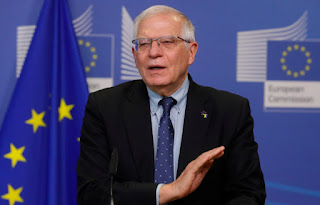
The European Union's foreign policy chief, Josep Borrell, considered today that Iran's response to the bloc's recent proposal for a nuclear agreement with the United States is "reasonable."

He added during an event at a university in the city of Santander in northern Spain: "I presented a proposal in my capacity as the coordinator of the negotiations ... and there is a response from Iran, which I considered reasonable. He was transferred to the United States, which has not yet officially responded.


Borrell was referring to a response Iran sent last week to the European Union's latest proposal to update the 2015 nuclear deal, following 16 months of indirect talks between the United States and Tehran.


For his part, the Russian envoy to the Vienna negotiations, Mikhail Ulyanov, said that he met the new permanent representative of Iran to international organizations in Vienna, Mohsen Naziri, and they discussed a number of issues related to the final stage of the Vienna negotiations on the nuclear agreement.


He added that Iran had made reasonable proposals regarding the nuclear agreement, and the Russian official expressed his hope that Washington would not delay in responding to the Iranian proposals, as he put it.


Friday, August 12, 2022

Mass demonstrations in northern Syria condemning Ankara's call for "reconciliation" between the government and the opposition

    Friday, August 12, 2022   No comments

Thousands protested across parts of rebel-held northern Syria [See locations in attached pam] on Friday after Turkey's foreign minister called for reconciliation between Ankara-backed Syrian opposition groups and the government of President Bashar al-Assad.

More than 11 years after the outbreak of the civil war in Syria, the northwestern region near the Turkish border is the last stronghold still under the control of fighters seeking to overthrow Assad, with control divided between militant groups and other fighters backed by Turkey.

The Turkish government maintains thousands of troops in the area and supports an alliance of anti-Assad armed groups under the banner of the Syrian National Army.

"We need to bring the opposition and the regime together in order to somehow reconcile, otherwise there will be no lasting peace," Turkish Foreign Minister Mevlut Cavusoglu told reporters in Ankara on Thursday.

After he spoke, protests began in areas of Syria controlled by opposition forces, with people waving opposition flags in the streets on Thursday night and pulling Turkish flags from buildings including police stations and local administration offices.

"We have suffered from this criminal for 11 years and we will continue our revolution," teacher Mahmoud Salo, 45, told Reuters during a protest in Azaz, Idlib, on Friday.

About three thousand people gathered in Azaz on Friday, while protests erupted in other areas of the northwestern Idlib province and in the northern areas of the neighboring province of Aleppo.

A Reuters reporter in the region said many Turkish consultants who work in a number of local institutions did not come to work on Friday.

Ahmet Shobak, a refugee from Aleppo who works as an engineer in Azaz, said Cavusoglu's comments were unacceptable.

"If Turkey wants to stand with the world that is already against us, so be it, it won't change anything much," he added. But we hope that Turkey's position will become more positive."


Yesterday, the cities and towns under the control of the Syrian opposition, in the north of the country, witnessed protests against Çavuşoğlu’s statements. The cities and towns of Al-Bab, Azaz, Sego, Jarabulus, Al-Ra’i and Marea in the countryside of Aleppo, Salqin and Idlib witnessed demonstrations during which protesters burned the Turkish flag and raised slogans condemning the statements of the Turkish Foreign Minister, calling To the continuation of the protests, the reactions of the Syrian opposition, through its statements and the positions of its leaders, varied, between those who aligned with the demonstrations and denounced the new Turkish position, and the opposition forces that refused to offend Turkey and denounced the burning of the Turkish flag.

Turkish Foreign Minister Mevlut Cavusoglu revealed a meeting he had with Syrian Foreign Minister Faisal Miqdad on the sidelines of the Non-Aligned Conference in Belgrade months ago, declaring that Turkey was seeking reconciliation between the regime and the opposition for the sake of Syria's stability and territorial integrity.

Organizations and figures in the Syrian opposition denounced Çavuşoğlu’s statements, and the so-called Department of Political Affairs in the opposition Salvation Government in northern Syria, where Turkish influence areas, said, “We followed up with strong condemnation these statements that offended the Syrian people and their great revolution, as well as the positions of the countries that sympathized, supported and supported this blessed revolution, Proceeding from its moral and humanitarian principles, foremost of which is the Republic of Turkey and its generous government, these statements come in a context of interest that is not befitting the principles of Turkish policy that is biased towards the just causes of oppressed peoples.

Fahim Issa, the commander-in-chief of the "Revolutionary" movement, one of the largest armed groups in the north, said, "There is no reconciliation with Assad, no reconciliation with terrorism and killers. There is no place for Assad or the regime in the future of Syria." "We will not betray the blood of our martyrs, and we will not betray the country's revolution," he added.

Meanwhile, the Defense Minister of the so-called Syrian Interim Government, Hassan Hamadeh, said: “At the first cry of the people wanting to overthrow the regime, it was the point of no return. It's over, there is no alternative to toppling Assad."

Opposition figures praised the movements and demonstrations denouncing the statements of the Turkish Foreign Minister. While others denounced the demonstration and burning of the Turkish flag.

The so-called Syrian National Army confirmed in a statement that “the flag of the Turkish Republic, as the flag of the Syrian revolution, is a source of pride, a title for victory, and a emblem for a great people, and its place is above the heads of the brave and the bodies of the martyrs.”

The statement stressed the need to hold accountable those who crossed their borders by insulting the Turkish flag.

As for the Ministry of Defense in the opposition’s interim government, it retracted in a statement, describing the Turkish flag as “sacred for the people for those who shed their blood on Syrian lands from the Turkish army and people.”

She vowed to hold accountable those she called "ignorant people" who do not represent the constants of the revolution.

She explained that some parties in Syria aim to "destabilize the relations of brotherhood and blood between the Turkish and Syrian peoples, to serve the enemies."

As for the National Coalition of Revolutionary and Opposition Forces, it stressed its refusal to burn the flag of the Turkish people, which hosts 4 million Syrians, and indicated that the blood of the Turkish people was mixed with the blood of the Syrians.

The Turkish Foreign Ministry clarified the Turkish position on the situation in Syria, and said in a statement issued by the ministry’s spokesman: “Turkey, since the beginning of the crisis in Syria, has been the country that has worked the most to support solutions to the crisis based on achieving the legitimate demands of the people.”

He added: “In this context, Turkey was at the forefront of the parties that worked to consolidate the ceasefire on the ground, and contributed to the Astana and Geneva tracks, building the Constitutional Committee and providing full support to the opposition and the negotiating body. And it is working on a solution in Syria in accordance with Security Council Resolution 2254.


Tehran: EU proposal to revive nuclear talks may be 'acceptable'

    Friday, August 12, 2022   No comments

Today, the Islamic Republic of Iran news agency quoted a prominent Iranian diplomat as saying that the European Union's proposal to revive the 2015 nuclear agreement "could be acceptable, if it provides reassurance" on Tehran's main demands.


The European Union said on Monday it had submitted a "final" text after four days of indirect talks between US and Iranian officials in Vienna.


A senior EU official said no further changes could be made to the text, which has been under negotiation for 15 months. He said he expected a final decision from both parties within "very, very, very few weeks."


The news agency quoted the Iranian diplomat, who was not identified, as saying that Tehran is reviewing the proposal, adding, "The proposals of the European Union can be acceptable if they provide Iran with reassurance regarding protection (measures), sanctions and guarantees."


The Islamic Republic has sought guarantees that no future US president would withdraw from the deal if it was revived, as former President Donald Trump did in 2018 and reimposed US sanctions on Iran.


However, President Joe Biden cannot make such strong assurances, because the agreement is a political understanding rather than a legally binding treaty.


Washington has said it is ready to quickly reach an agreement to revive the nuclear deal, based on European Union proposals.


Iranian officials said they would pass on their "other views and opinions" to the European Union, which is coordinating the talks, after holding consultations in Tehran.


Assistant for Political Affairs in the Office of the Presidency of the Iranian Republic, Mohammad Beheshti, commented on the recent Western media leaks on issues related to the safeguards system in the nuclear agreement, saying that these leaks show which party is suffering from pressure and needs a quick agreement.


Jamshidi said that he did not want to comment on the content or authenticity of the text published in the media on issues related to the safeguards system at the IAEA, but these coordinated media leaks show which party is under pressure and needs an immediate agreement, and that the study of the issue is continuing.


It is noteworthy that some media outlets, as well as some social media, have published news on issues related to the safeguards system and the proposed text of the agreement between Iran and international powers on the nuclear deal.


The Wall Street Journal had claimed that it had seen the text and added that the European proposal included making major concessions to Iran aimed at ending the IAEA investigation.


The Wall Street Journal claimed on Thursday that the European Union had proposed making major concessions to Iran in order to revive the nuclear deal.


According to the newspaper, the proposal submitted by the European Union indicates that Iran is expected to answer the International Atomic Energy Agency's questions "with a view to clarifying them," and adds that if Tehran cooperates, the other parties in the talks will urge the agency to close the investigation.


An EU spokesman has previously stated that the text submitted after recent talks in Vienna is in keeping with the usual confidentiality in such diplomatic processes, he said.


Wednesday, July 27, 2022

Putin, Erdogan and Raisi meeting raises concerns for German Foreign Minister

    Wednesday, July 27, 2022   No comments

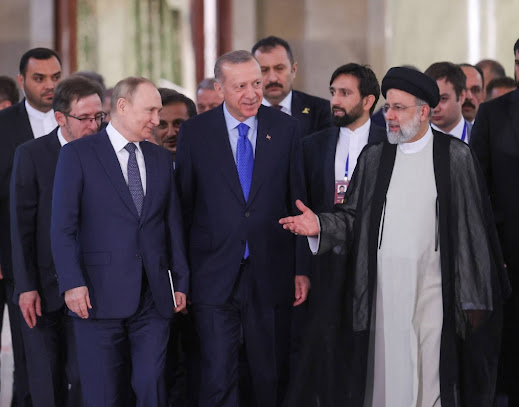
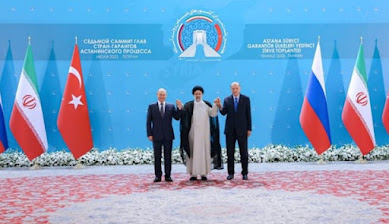
German Foreign Minister Annalina Birbock has criticized Turkish President Recep Tayyip Erdogan for posing for a photo with Russian and Iranian President Vladimir Putin and Ebrahim Raisi.


"The fact that the Turkish president is in this picture is a challenge to NATO," the German Foreign Minister said, in an interview with the newspaper "Bild", adding that this is "simply, incomprehensible."

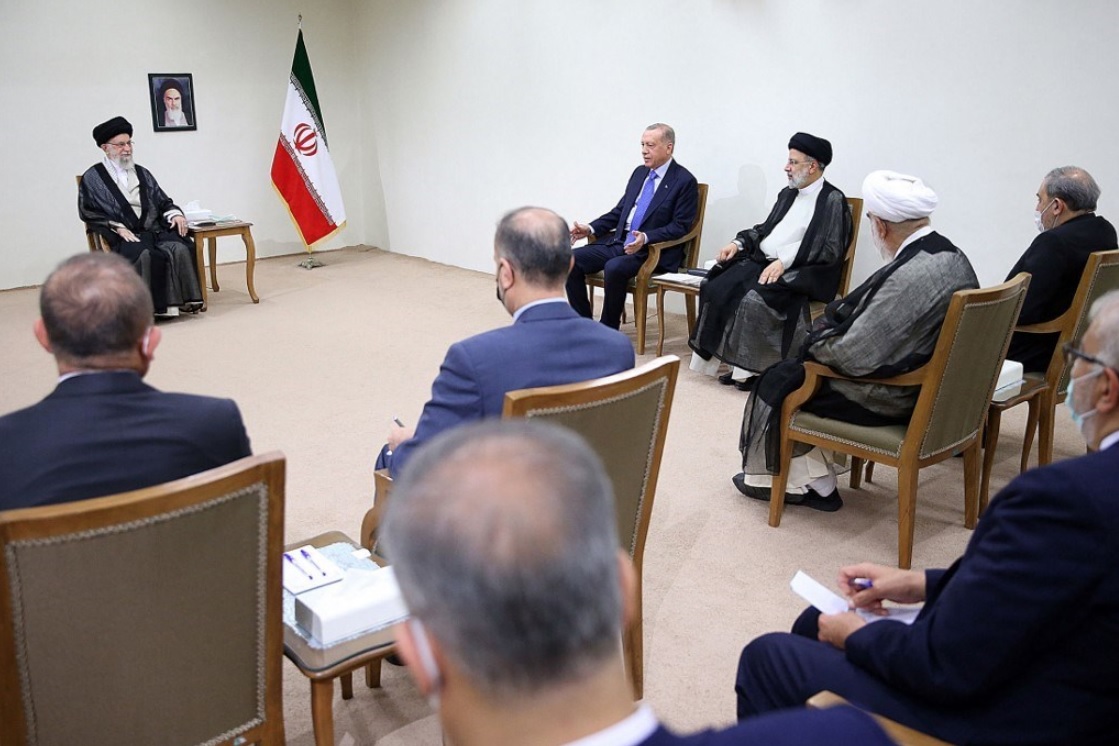
This week, the presidents of Russia, Turkey and Iran met in Tehran, where they held tripartite talks and took a joint photo at an extraordinary summit in light of the ongoing international conflict, with Syria being its most prominent focus. They also discussed joint relations, in addition to a number of files, including the Ukrainian grain export agreement.


Commenting on the German parliament's accusations about the "slowing down" of arms supplies to Kyiv, Bierbock said that the Federal Republic of Germany "has no aim to deceive its European neighbours."


"We can't deliver tanks with the tip of a finger," Birbock added.


The Ukrainian authorities appealed to Western countries to continue supplying them with weapons, while Kyiv accused Germany of being very slow in supplying them.


Thursday, July 14, 2022

Iran's President, Raisi: Iran's positions on the nuclear deal are right, and we will not retreat from them

    Thursday, July 14, 2022   No comments

Iranian President Ebrahim Raisi stressed that "the Islamic Republic of Iran will not retreat from its logical and correct positions" in the negotiations to revive the nuclear deal.


Raisi said, in his speech on Wednesday, "We recommend the Americans to adopt a realistic view, and to draw lessons from the past, instead of repeating the failed experiment of the policy of maximum pressure on the Iranian people."


The Iranian president added, during a cabinet meeting, that "those who violated the nuclear agreement should be vigilant and not think of repeating previous wrong experiences," noting that "the Islamic Republic of Iran did not present any demands outside the framework of the nuclear agreement, and practiced a rational approach in the negotiations."


Raisi reiterated that Iran's positions are "right and logical, and we will not retreat from them, and no party has the right to address us with the language of force," adding: "We recommend Washington to take a realistic view instead of repeating the failed experiment of the policy of maximum pressure," which it knew mainly during the rule of former President Donald Trump.


Raisi continued, "The Americans say that Iran must return to the nuclear agreement, while they are the ones who withdrew from it and violated their obligations, not us," referring to the "unjust US embargo imposed on the Iranian people."


"The United States has repeatedly declared that the pressure it is imposing on the Iranian people is unprecedented, but the Iranian Foreign Ministry has officially confirmed that these pressures have failed shamefully," he said.


Raisi noted, "The Americans must have realized over the past 43 years that they cannot speak to the Iranian people with the language of force, but they continue this approach, which will certainly not bring them any results."


Referring to the visit of the US President and other officials to the region, Raisi stressed that "if these visits aim to strengthen the position of the Zionist entity and normalize its relations with some countries, then Washington must know that its efforts in the region will not achieve security for the Zionist entity."


Addressing the US administration, Raisi said: "If you want to know the impact of your movements in the region, then look at the attitude of its peoples toward the Zionist entity, for the hatred against the Zionists and their crimes has increased in the hearts of the peoples of the region."


Raisi stressed that Iran "is closely monitoring developments in the region, and we will not lose sight of any movement in it," saying, "We have repeatedly told the Americans that we will respond firmly to the slightest move that affects Iran's territorial integrity."

Tehran denies selling drones to Moscow

In related news, on Wednesday, Iranian Foreign Minister Hossein Amir Abdollahian affirmed that his country "rejects America's allegations regarding Iran's sale of hundreds of drones to Russia."

In an interview with the Italian newspaper "La Repubblica", Amir Abdollahian added: "We have various types of cooperation with Russia, including defense cooperation, but we do not provide support to both conflicting parties, because we affirm the necessity of stopping the war, and we are working on that."


The Iranian foreign minister stressed that "Tehran is making efforts to stop the Ukrainian war," noting that "the problem lies elsewhere, as some Western countries, especially America, manufacture weapons and are trying to sell them."


Yesterday, Tuesday, Iranian Foreign Ministry spokesman, Nasser Kanaani, said that "the record of cooperation between Iran and the Russian Federation, in the field of modern technologies, dates back to the period before the Ukrainian war," noting that "no remarkable development occurred in this regard, during Recently".


"These allegations by US officials came at a time when America and Europe turned the occupying and aggressor countries, including in West Asia, into stockpiles of deadly weapons," the Iranian Foreign Ministry spokesman said.

Russia: The Iranian rallies deal with Russia is misleading the American media

In turn, the Russian Foreign Ministry commented on the matter, stressing that "the Iranian rallies deal to Russia is a US media misinformation that accompanies President Joe Biden's tour in the Middle East."


"This kind of disinformation by Washington has become commonplace," a State Department source said. "It's yet another baffling and ridiculous statement by a high-ranking American representative, but we're leaving it to Jake Sullivan (National Security Adviser)."


According to the source, "this statement was apparently timed to coincide with Biden's Middle East tour scheduled for July 13-16."


He noted that this disinformation "is aimed at further heating up anti-Iranian sentiment in Arab countries, through the deliberate dissemination of misinformation about cooperation between the Russian Federation and the Islamic Republic of Iran in the sensitive military-technical field."


The source added, "Although the official representative of the Iranian Ministry of Foreign Affairs, Nasser Kanaani, actually refuted this misinformation, it must be noted that the media event itself was chosen in vain, and that Jake Sullivan's logic is not convincing, and completely devoid of logic."


Moreover, the transfer of a large number of highly efficient Iranian-made drones to the Ukrainian theater of operations far from the Middle East, would significantly reduce the risks of their use directly in the region, and could not raise the concerns of the Arab countries.


And the US National Security Adviser, Jake Sullivan, had said, earlier, that his country had information that “Iran is preparing to supply Russia with hundreds of drones,” and “train Russian soldiers to use them in the Ukrainian war,” claiming that “Iran will begin this in current month".


Wednesday, July 13, 2022

Iran to obtain full membership in The Shanghai Cooperation Organisation (SCO)

    Wednesday, July 13, 2022   No comments

After signing its first memorandum of obligations in Uzbekistan at this year's Shanghai Cooperation Organisation (SCO) summit to be held in Samarkand in September, Iran's accession to the full membership of the Euroasia-spanning organization will be finalized by April 2023, the Iranian Embassy in China disclosed to the Global Times on Tuesday. 


Earlier, Russia media outlet Sputnik reported on Monday that Iran is slated to join the SCO as a full-pledged member state this year and a memorandum of Iran's obligations as a SCO member will also be signed in Samarkand, citing a foreign ministry statement of the organization's rotating chair Uzbekistan.


As a country that has been long sanctioned and isolated by the US-led West, Iran, by joining the SCO that accounts for 40 percent of the world's population and 28 percent of global GDP, could expect a breakthrough in its geopolitical and economic status quo, observers said. 


Iran has also approached the SCO with a proposal to create a new single currency for carrying out trade among SCO members, in a push to counter the increasing weaponization of the US dollar-dominated global financial system, CGTN reported in June.


Tehran has also officially submitted its application to become a member of the BRICS group as of late June, three members of which are also part of the SCO - China, Russia and India, following a similar move by Argentina


The Shanghai Cooperation Organisation (SCO) is a permanent intergovernmental international organisation, the creation of which was announced on 15 June 2001 in Shanghai (China) by the Republic of Kazakhstan, the People's Republic of China, the Kyrgyz Republic, the Russian Federation, the Republic of Tajikistan, and the Republic of Uzbekistan. It was preceded by the Shanghai Five mechanism.


The SCO's main goals are as follows: strengthening mutual trust and neighbourliness among the member states; promoting their effective cooperation in politics, trade, the economy, research, technology and culture, as well as in education, energy, transport, tourism, environmental protection, and other areas; making joint efforts to maintain and ensure peace, security and stability in the region; and moving towards the establishment of a democratic, fair and rational new international political and economic order.


The organisation has two permanent bodies — the SCO Secretariat based in Beijing and the Executive Committee of the Regional Anti-Terrorist Structure (RATS) based in Tashkent. The SCO Secretary-General and the Director of the Executive Committee of the SCO RATS are appointed by the Council of Heads of State for a term of three years. Vladimir Norov (Uzbekistan) and Jumakhon Giyosov (Tajikistan) have held these positions, respectively, since 1 January 2019.


Currently:


• the SCO comprises eight member states, namely the Republic of India, the Republic of Kazakhstan, the People's Republic of China, the Kyrgyz Republic, the Islamic Republic of Pakistan, the Russian Federation, the Republic of Tajikistan, and the Republic of Uzbekistan;


• the SCO counts four observer states, namely the Islamic Republic of Afghanistan, the Republic of Belarus, the Islamic Republic of Iran and Mongolia;


• the SCO has six dialogue partners, namely the Republic of Azerbaijan, the Republic of Armenia, the Kingdom of Cambodia, the Federal Democratic Republic of Nepal, the Republic of Turkey, and the Democratic Socialist Republic of Sri Lanka.


Tuesday, July 12, 2022

Days before Putin's visit to Tehran, Iran inaugurates the North-South International Corridor

    Tuesday, July 12, 2022   No comments


Days after India called on Iran to activate the road, rail, and sea transportation systems linking Mumbai to Saint-Petersburg and less than one week before Russia's president lands in Tehran, Iran runs train south inaugurating the transport systems that will link India to northern Europe.

The International North-South Transport Corridor (INSTC) is a 7,200-km-long multi-mode network of ship, rail, and road route for moving freight between India, Iran, Afghanistan, Azerbaijan, Russia, Central Asia and Europe. 

Last week, India urged Iran to activate the 7,200 km International North-South Transportation Corridor (INSTC), The Tribune newspaper reported.

With this development, India's trade with Russia is set to take a turn toward becoming much cheaper and faster as the two nations are planning to establish a corridor that passes through Iran and facilitates transport between them.

The INSTC is a transportation network that includes sea, road, and rail routes and links Russia and India, with Moscow and New Delhi seeking to activate the route due to them upping their bilateral trade by up to $13 billion in the last quarter of 2021. The trade even increased in terms of oil and other commodities.

Several central Asian countries will benefit from trade via the INSTC, such as Armenia, Azerbaijan, and Georgia.

Dry runs have shown transit time decreasing by up to 25 days from 40-45 days on this route, which would cut transportation costs by 30%. The INSTC is also not under any sanctions since it is an alternative to the Suez Canal, and it is not dominated by Western countries.

Iran declared on Thursday its readiness to employ its capacities to contribute to the establishment of sustainable peace in the South Caucasus region, which includes Armenia, Azerbaijan, and Georgia. 

The Secretary of Iran's Supreme National Security Council, Ali Shamkhani, called for establishing agreements that will lay down the groundwork for an increase in the volume of economic exchanges between the two neighboring countries considering their significant potential.

"Interestingly, all 18-odd countries touched by the INSTC route have never been active backers of unilateral sanctions announced periodically by the West," The Tribune reported. Trade links within the region have been disrupted due to the unilateral sanctions imposed on Russia and Iran.

Meanwhile, The Economic Times reported that Russia had started transporting container trains to India through the eastern branch of the INSTC.

The INSTC, if activated, could become an alternative to traditional routes such as the Suez Canal, the Mediterranean Sea, and the Bosporus strait.

India also called on Iran to include its Chabahar Port to be brought under the INSTC, which would provide sea access to Afghanistan and emerge as a commercial transit hub for the region.

India has highly close ties with Iran, mainly due to New Delhi's dependence on Iranian crude oil despite the US sanctions on Tehran. The Islamic Republic also enjoys pivotal geographic importance, as it provides an alternate route to Afghanistan and Central Asia without India having to resort to Pakistan, a nation whose ties with New Delhi are frayed.


Putin visits Iran to participate in a summit with Erdogan and President

    Tuesday, July 12, 2022   No comments

Kremlin spokesman Dmitry Peskov confirmed today, Tuesday, that Russian President Vladimir Putin will visit Tehran on July 19.

Peskov said that President Putin will hold talks with his Iranian counterpart, Ibrahim Raisi, and Turkish President Recep Tayyip Erdogan, within the framework of the meeting of leaders of the guarantor states of the Astana Process on the Syrian settlement.

He continued, "The president's trip to Tehran is already being prepared. There will be a meeting of the heads of the guarantor states of the Astana process to promote the Syrian settlement. In addition to the tripartite meeting, of course there will also be bilateral meetings and separate talks with the Turkish president," adding: "Yesterday we announced high-level contacts. The level between Putin and Erdogan, and the meeting will take place there."

The Iranian Mehr news agency had earlier quoted the head of the Iranian Parliament's Economy Committee, Mohammad Pour Ibrahimi, that President Putin would visit Iran next week.

"Potential consultations between Putin and my president are likely to focus on developing economic cooperation between Iran and Russia," Ebrahimi said.

The announcement of the visit coincides with US National Security Adviser Jake Sullivan saying that his country has information that Tehran is preparing to provide Moscow with hundreds of drones, and train Russian soldiers to use them.

In a meeting with his Iranian counterpart, on June 29, on the sidelines of the sixth summit meeting of the countries bordering the Caspian Sea, Putin confirmed that both countries are in constant communication on security issues, and that they have many things to talk about.

Raisi said, at the time, that Russian-Iranian trade relations are developing, and nothing will stop this development, commenting: "The agreements we reached are under implementation, and this indicates that the will of our two countries aims to develop trade and economic relations."


Wednesday, June 29, 2022

Heads of Caspian Sea states agree to use the sea for peaceful purposes; Putin: Joint exploitation of oil and gas fields in the Caspian Sea is already underway; Raisi: Cooperation between Caspian countries is of increasing importance due to international developments

    Wednesday, June 29, 2022   No comments

The Caspian Sea heads of state agreed, during their sixth summit, held in the Turkmen capital Ashgabat, today, Wednesday, to use the Caspian Sea for peaceful purposes and to provide security in the region.

In the statement of the summit, the presidents reaffirmed that the activities of the riparian states of the Caspian Sea will be carried out on the basis of the following principles: "Using the Caspian Sea for peaceful purposes, transforming it into an area of ​​peace, good neighbourliness, friendship and cooperation, and solving all issues related to the Caspian Sea by peaceful means."

An agreement was also reached on respect for sovereignty, territorial integrity, independence, sovereign equality of states, non-use of force or threat of force, mutual respect, cooperation and non-interference in each other's internal affairs, as well as on ensuring security and stability in the Caspian Sea region. .

In turn, Russian President Vladimir Putin, during his participation in the sixth summit of the countries bordering the Caspian Sea, referred to his country's call to deepen partnerships between the five Caspian countries, stressing that "the joint exploitation of oil and gas fields in the Caspian Sea is already being implemented." ".

Putin explained that "deepening partnerships between the five countries includes the policy and security sectors, and the five Caspian Sea regions should increase cooperation in rapid response to natural and other man-made emergencies," adding: "I propose to invite countries participating in the Tehran Agreement, which aims to to the protection of the Caspian Sea to the Conference".

Among Putin's proposals is the establishment of the Caspian Sea Film Festival.

Russian President Vladimir Putin is visiting Ashgabat to participate in the Sixth Caspian Sea Summit, at the invitation of the President of Turkmenistan, Sardar Berdymukhamedov.

Also participating in the summit are the presidents of the Republic of Azerbaijan Ilham Aliyev, Iran's Ibrahim Raisi, and the Republic of Kazakhstan Kassym-Jomart Tokayev. The meeting is held in accordance with the agreement, which was reached in light of the results of the previous summit in Aktau, Kazakhstan in August 2018.

On June 27, the Russian President's Assistant, Yuri Ushakov, announced that Russian President Vladimir Putin would meet with Iranian President Ibrahim Raisi, during their participation in the Caspian Sea Summit scheduled for June 29.

Iranian President Ebrahim Raisi welcomed the initiatives presented by the heads of states bordering the Caspian Sea, to develop economic cooperation in the fields of transportation, shipping, investment, tourism, and other economic activities, in particular, the need to strengthen cultural relations and protect the fragile environment of the Caspian Sea.

In his speech at the Sixth Summit of the Caspian Sea Countries, in Ashgabat, today, Wednesday, Raisi stressed that relations between Iran and Turkmenistan have always been expanding, pointing to the availability of opportunities and energies in order to raise the level of bilateral cooperation.

He declared his country's readiness for comprehensive cooperation on the basis of mutual respect and mutual benefit.


Tuesday, June 28, 2022

Iran, Argentina’s applications to BRICS will further define this block of nations

    Tuesday, June 28, 2022   No comments
Will BRICS become BRICSAI soon?
Iran's application to the BRICS, following a similar move by  Argentina,  are now formal. BRICS nation must decide.

China, this year's BRICS' chairmanship, actively supports the mechanism's expansion. China wants like-minded countries to join BRICS, that made Iran a very strong candidate. 

China also wanted a representative government of Muslims, so it approached Pakistan, mostly given its location and its role in the Road and Belt Initiative. India objected to including Pakistan. This strengethened Iran's position even more. 

Now BRICS nations need to decide on specific rules that will govern the expansion of the block of nations.

Being the host country, China engaged with Pakistan prior to the BRICS meetings, where decisions are taken after consultations with all BRICS members, the foreign ministry statement said. 

"We do hope that future engagement of the organization would be based on the principles of inclusivity keeping in view the overall interests of the developing world and in a manner that is devoid of narrow geopolitical considerations," said the statement.

"Regrettably one member blocked Pakistan's participation," The Hindu reported on Monday, citing Pakistan's Foreign Office. 

Friday, June 24, 2022

Russian Foreign Minister Sergey Lavrov meets Iranian President Ibrahim Raisi: Russian President Vladimir Putin is counting on holding new meetings with Raisi

    Friday, June 24, 2022   No comments


Russian Foreign Minister Sergei Lavrov said today, Wednesday, that Russian President Vladimir Putin is counting on holding new meetings with his Iranian counterpart, Ibrahim Raisi.

At the start of his meeting with the Iranian president in Tehran this evening, Lavrov said: "President Putin asked me to convey to you his warmest greetings and best wishes. He looks forward to new meetings with you."

He noted that the Russian president holds several meetings every day, and they are "primarily related to adapting the economic, social, banking and financial sphere to the realities that are now emerging as a result of the selfish and aggressive policy of the West."

"All countries that are negatively affected by the selfish approach of the United States and its orbiters have an objective need to reshape their economic relations in a way that does not depend on the whims and whims of our Western partners," Lavrov added.

This is Lavrov's first visit during the era of the new Iranian government that was formed last August. The Russian minister visited Tehran in April 2021 and held talks with his Iranian counterpart at the time, Mohammad Javad Zarif.

In related news; Iranian Foreign Minister Hossein Amir Abdollahian announced that President Ebrahim Raisi will participate in the BRICS summit, which will be held in China.

Amir Abdollahian wrote in a tweet on his Twitter account: "The BRICS group of countries promises their great potential and innovative vision to be an effective engine for global development and peace."

The Iranian minister added, "By accepting the invitation of the Chinese president to attend the BRICS Plus summit, Iranian President Ebrahim Raisi, during his participation in the summit, will explain Iran's views and capabilities," stressing that his country is taking advantage of any opportunity in the form of "dynamic diplomacy" to advance its national goals.

Yesterday, the Chinese Foreign Minister welcomed the Iranian President's attendance at the BRICS meeting, expressing his hope that the course of diplomacy and dialogue would lead to an agreement in the Vienna negotiations.

Iran's ambassador to Beijing, Mohammad Keshavarzzadeh, said that a phone call took place between the Foreign Minister and his Chinese counterpart, Wang Yi, indicating that the two sides discussed bilateral and international issues.

And the "BRICS" group saw the light of day in 2006, to form an international alliance in the face of Western domination of the world, and turned into an integrated political and economic group.

Its first summit was held on June 16, 2009, under the name "BRIC", in the Russian city of Yekaterinburg, with the participation of: Brazil, Russia, India and China first, then joined by South Africa in 2010, becoming the name of the International Alliance. BRICS, a word formed and derived from the initial letters of the name of each member state.

The population of the BRICS countries constitutes about 45% of the world's population, and the area of ​​its member states covers more than 39 million square kilometers, which is equivalent to 27% of the total land area.

The size of the BRICS economies exceeds the GDP of the Group of Seven major industrial countries (the United States, Britain, Germany, Japan, France, Canada and Italy).

According to Iranian media reports, Chinese President Xi Jinping as the host of BRICS Summit 2022, has invited President Rayeesi to attend the meeting and deliver a speech on Friday.

Rayeesi will discuss the Islamic Republic's viewpoints on international issues and the development of trade and economic cooperation with other countries at the event, which will be held on Friday.

The meeting will discuss "high-level talks for global development".  

Iran is the only country in West Asia region that has been invited to attend the BRICS+ summit.

BRICS expansion

China proposed expanding the BRICS grouping during a meeting of the bloc’s foreign ministers in May. Though the suggestion was welcomed by other member countries, there have been no official announcements of who the new members might be.

“We can get a sense of which countries might be invited by looking at their position on Ukraine and their voting behaviour regarding the conflict at the United Nations,” Huang said. “Those developing countries who abstained or supported Russia may be recruited to join.”


Tuesday, May 10, 2022

Esper's diary: Trump relied on fabricated and misleading information to target Soleimani

    Tuesday, May 10, 2022   No comments

Former US Defense Secretary Mark Esper, in his memoirs, asserts that "Trump greatly exaggerates his statements, and often makes unreliable and fabricated statements."

Former US Defense Secretary Mark Esper confirmed that he "opposed" former US President Donald Trump's decision to target the commander of the Quds Force, the martyr Qassem Soleimani, after Trump claimed "Soleimani was involved in targeting 4 US diplomatic missions."


Esper's newly released memoirs, titled "A Sacred Oath: Memoirs of a Defense Secretary During Difficult Times", stated that "the daily intelligence briefings, which he reviewed, did not include any evidence to support the theory of accusing Soleimani of an attack on American embassies," adding that "Trump Adopt a pattern of behavior based on lying.

"Trump greatly exaggerates his statements, often making unreliable and fabricated statements," Esper wrote in his memoirs.

Esper was directly attacked by President Trump, who accused him of dishonesty, and was subsequently dismissed from office in November 2020.

Earlier, Esper revealed, in his memoirs, that Trump suggested shooting demonstrators who demanded racial justice, when the demonstrations approached the White House.

Redacted quotes in a new book by former US defence secretary Mark Esper suggest that former Israeli Prime Minister Benjamin Netanyahu called on US President Donald Trump to take direct military action against Iran's nuclear programme. 

In the book, A Sacred Oath: Memoirs of a Secretary of Defense During Extraordinary Times, Esper notes that Trump seemed firm in his commitment not to enter a war with Iran, the Haaretz newspaper reported on Tuesday.

He writes: "The president often had others in the room, and foreign leaders like Israeli Prime Minister Benjamin Netanyahu, telling him [REDACTED]."

Esper wrote that Milley told him that Robert O'Brien, Trump's national security adviser, had called to say that "the president wanted to strike a senior military officer who was operating outside of Iran".

"But why now? What was new? Was there an imminent threat? What about gathering the national security team to discuss this?

"Milley said he was 'stunned' by the call, and he sensed that O'Brien 'put the president up to this,' trying to create news that would help Trump's re-election."


Friday, April 29, 2022

Moscow and Tehran sign a comprehensive agreement in the field of transport

    Friday, April 29, 2022   No comments

Iranian Minister of Roads Rostam Qasemi, who led a delegation to Moscow, concluded a comprehensive agreement on railway cooperation between Iran and Russia, at the conclusion of his talks with the Russian Minister of Transport.

During the talks, which were also attended by members of the delegations of the two countries, Russian Transport Minister Vitaly Soliev, referring to the expansion of relations between the two countries, expressed his hope that the signing of the agreement would further expand bilateral cooperation in the field of transportation.

He said that the north-south railway corridor can be the basis for expanding cooperation between Russia, Iran, Central Asia and the Caucasus, and there is a need to sign a contract to implement this huge project, expressing the hope that the Rasht-Astara railway section will be completed with joint cooperation.

Vitaly Soliev said: In addition to joint efforts in the construction of this section, we can cooperate in its use and exploitation, which is of particular importance along the North-South railway.

The Russian Minister of Transport indicated that his country views the Islamic Republic of Iran as a hub for trade and transit in the region, and said: With the completion of the railways, especially the Rasht-Astara section, northern Europe will be linked to the Indian subcontinent, which will lead to huge transit revenues for the countries. Located along the route, including Iran and Russia.

The Iranian Minister of Roads also said that Iran is interested in developing and expanding cooperation with its neighbors, explaining that Iran shares its borders with 15 countries, and in the meantime, Russia is important to us as an important neighbor with historical ties.

Qassemi added: If Iran and Russia work closely together, the US and Western sanctions against the two countries will have no effect, explaining that every trade needs to develop the transportation field, and it is possible that any agreement between the two countries will be signed in the transportation field.

The Minister of Roads said: The exports between the two countries and Russian exports to other countries via Iran can be agreed upon and implemented in the shortest possible time, explaining that among the railways, the Rasht-Astara railway is very short and economical, and if the two countries cooperate in completing this section. The volume of exchange and transit of goods between the two countries will increase significantly.

In conclusion, Rostami stressed the possibility of increasing cooperation between Tehran and Moscow in both Chabahar and Shahid Rajaei port.


Thursday, April 14, 2022

Tehran in response to an American report on human rights: Washington is the biggest violator of human rights

    Thursday, April 14, 2022   No comments

On Thursday, Iranian Foreign Ministry spokesman Saeed Khatibzadeh responded to what was stated in the annual report of the US State Department on Iran.

In its annual report on the human rights situation in the world, the US State Department accused Iran of "committing widespread violations of human rights."

The Iranian Foreign Ministry spokesman said: "It is clear that the US administration, which is addicted to lies, cannot be expected to clarify the existing facts and facts. Therefore, the biased, political and intrusive nature of this report is clear and consistent for all and for the Iranian people."

Khatibzadeh pointed out that the US administration, "with its history full of wars, coups, assaults, assassinations, kidnappings, economic blockades, and killing of innocents around the world, has been a major violator of human rights, and therefore it is not worthy in any way to talk about lofty concepts such as human rights."

He added that the United States "shed crocodile tears for the Iranian people, while its crimes against Iran, including downing a passenger plane and inciting its tails at home to assassinate the people and officials over the past decades, will remain forever alive in the minds of the Iranian people."

The spokesman described the US administration's allegations as "duplicity" and "aimed at achieving its illegitimate political goals," saying that "the US president's direct issuance of orders to assassinate Major General Qassem Soleimani, in a cowardly manner, well revealed the terrorist nature of the United States."

Khatibzadeh pointed out that the US administration "turned a blind eye to the blatant and systematic violations of human rights within its country and at its allies," noting that "everyone has repeatedly witnessed how racial discrimination against minorities and Black Americans occurs systematically and widely in America, which in turn led to protests by Black people and by the people of that country."

He stressed that "the excessive violence of the police and the killing of Black people in front of the eyes of citizens exposes the approach of the US administration against human rights."


Islamic Societies Review WEEKLY updates


ISR+


Now reading...


Frequently Used Labels and Topics


Search for old news

Find Articles by year, month hierarchy


Copyright © Islamic Societies Review. All rights reserved.