Showing posts with label Tunisia. Show all posts

Sunday, July 24, 2022

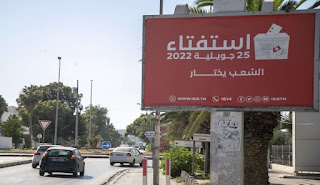
Prospects For The Referendum On The New Draft Constitution And Its Challenges In Tunisia

    Sunday, July 24, 2022   No comments


The last hours before the start of the referendum on the new draft constitution in Tunisia seem decisive and decisive.

It is expected that more than nine million registered voters will go to the polling stations to vote “yes” or “no” on a draft new constitution for the country, including more than eight million voters inside Tunisia and nearly 900,000 outside it.

The voting process abroad begins on Saturday and ends on Monday, July 25, which is the day on which the voting takes place at home and coincides with Tunisia’s commemoration of the Republic Day, as well as the first anniversary of the approval of the exceptional measures that allowed President Kais Saied to dismiss the government and freeze Parliament and then finally dissolve it permanently.

While about 160 participants in the campaign for the referendum, including parties, organizations and natural persons, conclude their activities in preparation for the day of silence and then the referendum day, the opposition moves its spectrum again in the street with calls for demonstrations launched by the parties of the national campaign to overthrow the referendum, which brings together the Democratic Current, the Republican Party, the Ettakatol Party and the Labor Party The Qutb Party, as well as the Civil Coalition for a Social Democratic Civil State on the one hand, and the National Salvation Front led by veteran lawyer and politician Ahmed Najib al-Shabbi, and in which ten political components are included, foremost of which is the Ennahda movement on the other.

read more...

Monday, July 26, 2021

What Authority Does The President Have Under Article 80 Of The 2014 Constitution Of Tunisia?

    Monday, July 26, 2021   No comments

On July 25, the president of Tunisia, Kais Saied, cited article 80 of the ratified 2014 constitution to declare a national emergency. The presidential order suspended the parliament for 30 days, dismissed the prime minister, and lifted immunity on parliamentarians. Here is a translation of the article that the president is relying on to justify and enforce his declaration.


Article 80 * Emergency provisions

In the event of imminent danger threatening the nation’s institutions or the security or independence of the country, and hampering the normal functioning of the state, the President of the Republic may take any measures necessitated by the exceptional circumstances, after consultation with the Head of Government and the Speaker of the Assembly of the Representatives of the People and informing the President of the Constitutional Court. The President shall announce the measures in a statement to the people. The measures shall guarantee, as soon as possible, a return to the normal functioning of state institutions and services. The Assembly of the Representatives of the People shall be deemed to be in a state of continuous session throughout such a period. In this situation, the President of the Republic cannot dissolve the Assembly of the Representatives of the People and a motion of censure against the government cannot...


read more ... 


Friday, October 9, 2015

Tunisian mediator group wins Nobel Peace Prize for aiding move to democracy

    Friday, October 09, 2015   No comments
Tunisia's National Dialogue Quartet won the Nobel Peace Prize on Friday for helping build democracy in the birthplace of the Arab Spring, an example of peaceful transition in a region otherwise struggling with violence and upheaval.

The quartet of the Tunisian General Labour Union (UGTT), the Tunisian Confederation of Industry, Trade and Handicrafts (UTICA), the Tunisian Human Rights League (LTDH), and the Tunisian Order of Lawyers was formed in the summer of 2013.

It helped support the democratisation process when it was in danger of collapsing, the Norwegian Nobel committee said in its citation.

"This is a great joy and pride for Tunisia, but also a hope for the Arab World," UGTT chief Hussein Abassi told Reuters.

"It's a message that dialogue can lead us on the right path. This prize is a message for our region to put down arms and sit and talk at the negotiation table."

With a new constitution, free elections and a compromise politics between Islamist and secular leaders, Tunisia has been held up as a model of how to make the transition to a democracy from dictatorship.

Thursday, March 19, 2015

Islamic State blamed for Tunisia attack after killing of Libyan cell leader

    Thursday, March 19, 2015   No comments
A total of 22 people, including South African, French, Spanish, Polish and Italian holidaymakers, were killed when gunmen disguised as soldiers stormed the museum in the capital, Tunis.

Armed with Kalashnikovs and grenades, the terrorists sprayed gunfire at tourists getting off buses outside the museum and then charged inside. The Western tourists had apparently got off cruise ship buses and were deliberately targeted.

Other people in the Bardo museum fled the scene in terror while some were taken hostage inside.

The building was then surrounded by heavily-armed security forces. After a two-hour stand-off, they attacked the gunmen and killed two of them, freeing the captives. At least two of the gang escaped and were being hunted by police on Wednesday night.

Wednesday, March 18, 2015

Instability in Libya and fighters trained in Syria and Iraq returning to Tunisia might be behind the attack that killed 17 foreign tourists and two Tunisians in national museum in Bardo

    Wednesday, March 18, 2015   No comments
Gunmen wearing military uniforms stormed Tunisia's national museum, killing 17 foreign tourists and two Tunisians on Wednesday in one of the worst militant attacks in a country that had largely escaped the region's "Arab Spring" turmoil.

Visitors from Italy, Germany, Poland and Spain were among the dead in the noon assault on Bardo museum inside the heavily guarded parliament compound in central Tunis, Prime Minister Habib Essid said.

Monday, December 22, 2014

Over 60% of Tunisians able to vote voted; 56% of them voted for Beji Caid Essebsi, 44% voted for Mohamed Moncef Marzouki

    Monday, December 22, 2014   No comments
Over 60% of Tunisians able to vote voted; 56% of them voted for Beji Caid Essebsi, 44% voted for Mohammed Mouncef Marzouki. 

Essebsi, 88, appeared before 2,000 supporters who gathered outside his campaign headquarters in the capital Tunis shouting “Long live Tunisia!” and thanked the voters.

“Tunisia needs all its children. We must work hand in hand,” he said as supporters cheered.

Marzouki dismissed the declaration as unfounded and refused to concede defeat. His camp said the result was too close to call and accused the Essebsi of election “violations”.

It is the first time Tunisians have freely elected their president since independence from France in 1956.

Saturday, November 22, 2014

In birthplace of Arab Spring, Tunisia’s Islamists get sobering lesson in governing

    Saturday, November 22, 2014   No comments
TUNIS — On a recent warm evening, hundreds of men and women were mingling outside the offices of Tunisia’s Islamist party. They were singing and cheering. They were waving little red-and-white Tunisian flags. It looked as if they had just won an election.

In fact, they had just lost control of parliament. But in a strife-torn Arab world, this young democracy had pulled off a rare feat: a clean, peaceful election.

“What are we celebrating today?” the Islamists’ leader, Rachid Ghannouchi, a 73-year-old scholar, cried into a microphone as fireworks popped overhead. “We are celebrating freedom! We are celebrating Tunisia! We are celebrating democracy!”

Monday, October 27, 2014

Nidaa Tounes wins 38% of the seats in the Tunisian parliament

    Monday, October 27, 2014   No comments
Tunisia's Ennahda party, the first Islamist movement to secure power after the 2011 "Arab Spring" revolts, conceded defeat on Monday in elections that are set to make its main secular rival the strongest force in parliament.
Official results from Sunday's elections - the second parliamentary vote since Tunisians set off uprisings across much of the Arab World by overthrowing autocrat Zine El-Abidine Ben Ali - were still to be announced.

Sunday, September 21, 2014

How Qatar is funding the rise of Islamist extremists

    Sunday, September 21, 2014   No comments
Qaradawi, Qatar asset
The fabulously wealthy Gulf state, which owns an array of London landmarks and claims to be one of our best friends in the Middle East, is a prime sponsor of violent Islamists

Few outsiders have noticed, but radical Islamists now control Libya's capital. These militias stormed Tripoli last month, forcing the official government to flee and hastening the country's collapse into a failed state.

Moreover, the new overlords of Tripoli are allies of Ansar al-Sharia, a brutal jihadist movement suspected of killing America's then ambassador to Libya, Christopher Stevens, and of trying to murder his British counterpart, Sir Dominic Asquith.

Barely three years after Britain helped to free Libya from Col Gaddafi's tyranny, anti-Western radicals hold sway. How could Britain's goal of a stable and friendly Libya have been thwarted so completely?

Wednesday, September 3, 2014

Libya in Chaos: Vijay Prashad on Rise of Islamist Militias & Bloody Legacy of 2011 U.S. Intervention

    Wednesday, September 03, 2014   No comments


Islamist militants in Libya say they have solidified control of the capital Tripoli after taking over the main airport and ousting rival militias. Libya is facing its worst violence since the U.S.-backed ouster of Muammar Gaddafi in 2011. To talk more about Libya, we are joined by Vijay Prashad, professor of international studies at Trinity College. He is the author of several books, including Arab Spring, Libyan Winter.

AMY GOODMAN: This is Democracy Now!, democracynow.org, The War and Peace Report. I’m Amy Goodman. Islamist militants in Libya say they’ve solidified control of the capital Tripoli after taking over the main airport and ousting rival militias. Libya is facing its worst violence since the U.S.-backed ouster of Muammar Gaddafi in 2011.

To talk more about Libya, we’re joined by Vijay Prashad in part two of our interview. Professor of international studies at Trinity College, he’s the author of a number of books, including Arab Spring, Libyan Winter and his most recent, The Poorer Nations: A Possible History of the Global South.

Welcome to Democracy Now!, Vijay. Talk about what’s happening in Libya today.

Wednesday, May 14, 2014

Tunisie : arrestation du cyberactiviste Azyz Amami

    Wednesday, May 14, 2014   No comments
Le cyberactiviste, Azyz Amami, 31 ans, a été arrêté avec un ami, Sabri Mlouka, dans la nuit du lundi 12 mai à la Goulette, en banlieue de Tunis, sans aucun motif officiel. De nombreux proches du blogueur, dont son père, affirment qu’il a été agressé physiquement par les agents de police lors de son interrogatoire.

Saturday, May 3, 2014

Tunisian National Constituent Assembly approves new electoral law

    Saturday, May 03, 2014   No comments
Tunisian members members of the Constituency Assembly  have adopted a sweeping new electoral law that paves the way for general elections later this year and is a milestone in this country's new democracy.

The law requires party lists for legislative elections to be half women and half men. It also allows members of the authoritarian regime ousted in 2011 to run for office.

The elections are now expected no later than Nov. 23.

Friday, April 11, 2014

Despite a New Constitution, the Fight for Gender Equality in Tunisia Continues

    Friday, April 11, 2014   No comments
After more than two years of arguments and concessions between Islamic and secular parties, on January 26, the Tunisian National Constituent Assembly ratified the country’s new Constitution.

When it was signed, assembly members spontaneously started to chant the national anthem and congratulated each other for the achievement. Indeed, there was cause for celebration. Tunisians signed one of the most progressive Constitutions in the Arab world, one that includes a commitment to gender equality. Yet, the celebratory media coverage failed to mention that other Arab countries, such as Algeria and Morocco, have also committed to gender equality in their Constitution.

Tuesday, April 1, 2014

Tunisian PM, Mehdi Jomaa, to visit the United States and meet Obama first week of April

    Tuesday, April 01, 2014   No comments
Prime Minister Mehdi Jomaa started, Tuesday, a four-day official visit to the United States, at the invitation of President Barack Obama.

Jomaa will be received at the White House by President Obama, April 4.

"Mehdi Jomaa's visit to U.S.A. testifies to the solid friendship relations binding the American and Tunisian peoples and the Government's commitment towards the democratic transition," a White House statement pointed out.

Sunday, August 25, 2013

Tunisia opposition starts week of protests calling for resignation of Islamist-led government

    Sunday, August 25, 2013   No comments
TUNIS, Tunisia — Thousands of Tunisians have demonstrated in front of the national assembly calling for the resignation of the Islamist-led government.
Saturday night's demonstration kicked off a planned week of protests by a coalition of opposition parties calling for the departure of the government because of what they say is its inability to guarantee security and the economy of the country.
The National Salvation Front includes right- and left-wing political parties demanding the current Islamist-led government be replaced by a technocratic cabinet to organize new elections.

Sunday, August 4, 2013

'No coups, yes to elections!': Massive pro-govt rally held in Tunis

    Sunday, August 04, 2013   No comments
Thousands of Tunisians flooded the capital in support of their Islamist-led government amid calls for its ouster. Members of the secular opposition have alleged the ruling Ennahda party orchestrated the murder of a prominent leftist politician.

Over 150,000 people flocked to Tunis’ central Kasbah Square, brandishing Tunisian flags and shouting pro-government slogans.

The throng chanted “No to coups, yes to elections!” referencing the untimely ouster of Egyptian President Mohamed Morsi on July 3 by the army.
read more >>

Tuesday, July 30, 2013

a presidential spokesman: Eight Tunisian soldiers were killed when gunmen ambushed an army unit near the border with Algeria. The attack took place on Jebel Chaambi, a suspected hideout of al Qaeda-linked militants

    Tuesday, July 30, 2013   No comments
Tunisia’s presidential spokesman says gunmen ambushed an army unit patrolling in a mountainous region near the border with Algeria, killing eight soldiers.

Adnan Mancer told The Associated Press that the attack took place Monday on Jebel Chaambi, Tunisia’s tallest mountain and a suspected hideout of al-Qaida-linked militants.

The army has been searching the mountainous region near the Algerian frontier since a patrol was hit by a roadside bomb in April.

On June 24, the army declared the mountain cleared of extremists in a campaign that cost three lives and left 27 soldiers injured.

In the course of its operation, the army discovered evidence suggesting an al-Qaida-linked movement supported by the local population had set up training camps in the area.


Monday, July 1, 2013

Tunisia Tiring of Transition

    Monday, July 01, 2013   No comments
Tunisia
In the third year after the revolution that toppled former dictator Ben Ali, true democracy is still work in progress in Tunisia.

“Freedom is a decision but democracy is a transformational process,” Amine Ghali, programme director of the Kawakibi Democracy Transition Centre in Tunisia tells IPS. “So far our expectations about life after the revolution have not been met.

“We went through a major transformation immediately after the revolution which led to the elections in October 2011. However, since then there has been a lack of delivery of democratic processes including transitional justice, the independence of the judiciary, improvement of the economy, and the fight against corruption. We need milestones with dates. We cannot stay in transition indefinitely.”

The democratic struggle is set against the backdrop of Tunisia’s economic problems. “We are facing inflation, devaluation of the dinar and a drop in consumer purchasing power,” says Ghali. “People cannot eat the constitution, drink elections or buy freedom of the press. They need food for their children, education and affordable transportation.”

read more >>

Tuesday, April 9, 2013

Tunisia Now Exporting “Jihadis”

    Tuesday, April 09, 2013   No comments

Tunisian families have begun to dread knocks on their doors, or late-night phone calls, fearing that the messenger will bear the news that their son has been smuggled out of the country to join the “jihad” in Syria.
Families here told IPS that they have no way of contacting their sons once they leave — whether by choice or coercion they will never know — for the warring nation nearly 3,000 miles away. At most, family members receive an inaudible telephone call from Libya, where the soon-to-be militants are trained, the muffled voice on the other end of the line saying a quiet and final goodbye.

After that point, no news is good news. If they are contacted again, it will only be an anonymous caller announcing the death of a son, brother or husband, adding that the family should be proud of their martyred loved one.

The next day, the family might find a CD, slipped under the door, containing filmed footage of the burial.

There are no reliable data on exactly when young Tunisian men began rushing to join the Free Syrian Army, currently engaged in a battle to depose Syrian president Bashar al-Assad, but experts and civil society activists are agreed on one thing: the number is increasing.

On Mar. 29, local sources reported that between 6,000 and 10,000 men have left the country, while the Algerian press say the number could be closer to 12,000.

Families tell IPS the self-proclaimed jihadists leave in secret, often under cover of darkness, and change their names en route so that Facebook and internet searches yield no results. They believe mosques and charity organisations serve as fronts for this “recruitment” process.

Widely considered the cradle of the Arab Spring, Tunisia has gained a reputation as a progressive country, bolstered by the strong democratic current that toppled former dictator Zine Abadine Ben Ali in January 2011. The election of the moderate Islamist party Ennahda in October 2011 further raised hopes that the country would stay on track towards a more inclusive future.

But beneath the moderate veneer, a strong ultra-conservative undercurrent remained, steered by Salafist-controlled mosques – like Fath, Ennassr, Ettadhamen, and the great mosque of Ben Arous located on the outskirts of Tunis – that are now serving as headquarters for the smuggling of fighters.


Wednesday, March 6, 2013

Independents named as Tunisia foreign, defence ministers

    Wednesday, March 06, 2013   No comments

Independents will take over the foreign and defence ministries in Tunisia's new government under a deal by the ruling Islamist party to cede key portfolios following violent unrest over the assassination of a secular opposition leader.

The new coalition of moderate Islamists, three secular parties and non-partisan figures aims to restore stability and prepare the troubled North African state, where the Arab Spring uprisings began in 2011, for elections later this year.

President Moncef Marzouki asked Interior Minister Ali Larayedh of the Islamist Ennahda party on Feb. 22 to form a government within 15 days after Ennahda Prime Minister Hamadi Jebali resigned.

Coalition sources said Othman Jarandi, a former Tunisian ambassador to the United Nations, Oman, South Korea and Pakistan, had been named as foreign minister to capitalise on his strong ties with international bodies and the West.

Tunisia needs to negotiate a $1.78 billion loan from the International Monetary Fund. The political turmoil has set back that quest and prompted Standard and Poor's to lower its long-term foreign and local currency sovereign credit rating of Tunisia.


Islamic Societies Review WEEKLY updates

AdSpace - 2

AdSpace - 2
Books

ISR+


Now reading...


Frequently Used Labels and Topics


Search for old news

AdSpace-1

AdSpace-1
Buy Books

Find Articles by year, month hierarchy


Copyright © Islamic Societies Review. All rights reserved.
