Showing posts with label india. Show all posts

Wednesday, July 13, 2022

Iran to obtain full membership in The Shanghai Cooperation Organisation (SCO)

    Wednesday, July 13, 2022   No comments

After signing its first memorandum of obligations in Uzbekistan at this year's Shanghai Cooperation Organisation (SCO) summit to be held in Samarkand in September, Iran's accession to the full membership of the Euroasia-spanning organization will be finalized by April 2023, the Iranian Embassy in China disclosed to the Global Times on Tuesday. 


Earlier, Russia media outlet Sputnik reported on Monday that Iran is slated to join the SCO as a full-pledged member state this year and a memorandum of Iran's obligations as a SCO member will also be signed in Samarkand, citing a foreign ministry statement of the organization's rotating chair Uzbekistan.


As a country that has been long sanctioned and isolated by the US-led West, Iran, by joining the SCO that accounts for 40 percent of the world's population and 28 percent of global GDP, could expect a breakthrough in its geopolitical and economic status quo, observers said. 


Iran has also approached the SCO with a proposal to create a new single currency for carrying out trade among SCO members, in a push to counter the increasing weaponization of the US dollar-dominated global financial system, CGTN reported in June.


Tehran has also officially submitted its application to become a member of the BRICS group as of late June, three members of which are also part of the SCO - China, Russia and India, following a similar move by Argentina


The Shanghai Cooperation Organisation (SCO) is a permanent intergovernmental international organisation, the creation of which was announced on 15 June 2001 in Shanghai (China) by the Republic of Kazakhstan, the People's Republic of China, the Kyrgyz Republic, the Russian Federation, the Republic of Tajikistan, and the Republic of Uzbekistan. It was preceded by the Shanghai Five mechanism.


The SCO's main goals are as follows: strengthening mutual trust and neighbourliness among the member states; promoting their effective cooperation in politics, trade, the economy, research, technology and culture, as well as in education, energy, transport, tourism, environmental protection, and other areas; making joint efforts to maintain and ensure peace, security and stability in the region; and moving towards the establishment of a democratic, fair and rational new international political and economic order.


The organisation has two permanent bodies — the SCO Secretariat based in Beijing and the Executive Committee of the Regional Anti-Terrorist Structure (RATS) based in Tashkent. The SCO Secretary-General and the Director of the Executive Committee of the SCO RATS are appointed by the Council of Heads of State for a term of three years. Vladimir Norov (Uzbekistan) and Jumakhon Giyosov (Tajikistan) have held these positions, respectively, since 1 January 2019.


Currently:


• the SCO comprises eight member states, namely the Republic of India, the Republic of Kazakhstan, the People's Republic of China, the Kyrgyz Republic, the Islamic Republic of Pakistan, the Russian Federation, the Republic of Tajikistan, and the Republic of Uzbekistan;


• the SCO counts four observer states, namely the Islamic Republic of Afghanistan, the Republic of Belarus, the Islamic Republic of Iran and Mongolia;


• the SCO has six dialogue partners, namely the Republic of Azerbaijan, the Republic of Armenia, the Kingdom of Cambodia, the Federal Democratic Republic of Nepal, the Republic of Turkey, and the Democratic Socialist Republic of Sri Lanka.


Tuesday, July 12, 2022

Days before Putin's visit to Tehran, Iran inaugurates the North-South International Corridor

    Tuesday, July 12, 2022   No comments


Days after India called on Iran to activate the road, rail, and sea transportation systems linking Mumbai to Saint-Petersburg and less than one week before Russia's president lands in Tehran, Iran runs train south inaugurating the transport systems that will link India to northern Europe.

The International North-South Transport Corridor (INSTC) is a 7,200-km-long multi-mode network of ship, rail, and road route for moving freight between India, Iran, Afghanistan, Azerbaijan, Russia, Central Asia and Europe. 

Last week, India urged Iran to activate the 7,200 km International North-South Transportation Corridor (INSTC), The Tribune newspaper reported.

With this development, India's trade with Russia is set to take a turn toward becoming much cheaper and faster as the two nations are planning to establish a corridor that passes through Iran and facilitates transport between them.

The INSTC is a transportation network that includes sea, road, and rail routes and links Russia and India, with Moscow and New Delhi seeking to activate the route due to them upping their bilateral trade by up to $13 billion in the last quarter of 2021. The trade even increased in terms of oil and other commodities.

Several central Asian countries will benefit from trade via the INSTC, such as Armenia, Azerbaijan, and Georgia.

Dry runs have shown transit time decreasing by up to 25 days from 40-45 days on this route, which would cut transportation costs by 30%. The INSTC is also not under any sanctions since it is an alternative to the Suez Canal, and it is not dominated by Western countries.

Iran declared on Thursday its readiness to employ its capacities to contribute to the establishment of sustainable peace in the South Caucasus region, which includes Armenia, Azerbaijan, and Georgia. 

The Secretary of Iran's Supreme National Security Council, Ali Shamkhani, called for establishing agreements that will lay down the groundwork for an increase in the volume of economic exchanges between the two neighboring countries considering their significant potential.

"Interestingly, all 18-odd countries touched by the INSTC route have never been active backers of unilateral sanctions announced periodically by the West," The Tribune reported. Trade links within the region have been disrupted due to the unilateral sanctions imposed on Russia and Iran.

Meanwhile, The Economic Times reported that Russia had started transporting container trains to India through the eastern branch of the INSTC.

The INSTC, if activated, could become an alternative to traditional routes such as the Suez Canal, the Mediterranean Sea, and the Bosporus strait.

India also called on Iran to include its Chabahar Port to be brought under the INSTC, which would provide sea access to Afghanistan and emerge as a commercial transit hub for the region.

India has highly close ties with Iran, mainly due to New Delhi's dependence on Iranian crude oil despite the US sanctions on Tehran. The Islamic Republic also enjoys pivotal geographic importance, as it provides an alternate route to Afghanistan and Central Asia without India having to resort to Pakistan, a nation whose ties with New Delhi are frayed.


Friday, April 29, 2022

Moscow and Tehran sign a comprehensive agreement in the field of transport

    Friday, April 29, 2022   No comments

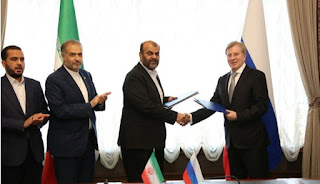
Iranian Minister of Roads Rostam Qasemi, who led a delegation to Moscow, concluded a comprehensive agreement on railway cooperation between Iran and Russia, at the conclusion of his talks with the Russian Minister of Transport.

During the talks, which were also attended by members of the delegations of the two countries, Russian Transport Minister Vitaly Soliev, referring to the expansion of relations between the two countries, expressed his hope that the signing of the agreement would further expand bilateral cooperation in the field of transportation.

He said that the north-south railway corridor can be the basis for expanding cooperation between Russia, Iran, Central Asia and the Caucasus, and there is a need to sign a contract to implement this huge project, expressing the hope that the Rasht-Astara railway section will be completed with joint cooperation.

Vitaly Soliev said: In addition to joint efforts in the construction of this section, we can cooperate in its use and exploitation, which is of particular importance along the North-South railway.

The Russian Minister of Transport indicated that his country views the Islamic Republic of Iran as a hub for trade and transit in the region, and said: With the completion of the railways, especially the Rasht-Astara section, northern Europe will be linked to the Indian subcontinent, which will lead to huge transit revenues for the countries. Located along the route, including Iran and Russia.

The Iranian Minister of Roads also said that Iran is interested in developing and expanding cooperation with its neighbors, explaining that Iran shares its borders with 15 countries, and in the meantime, Russia is important to us as an important neighbor with historical ties.

Qassemi added: If Iran and Russia work closely together, the US and Western sanctions against the two countries will have no effect, explaining that every trade needs to develop the transportation field, and it is possible that any agreement between the two countries will be signed in the transportation field.

The Minister of Roads said: The exports between the two countries and Russian exports to other countries via Iran can be agreed upon and implemented in the shortest possible time, explaining that among the railways, the Rasht-Astara railway is very short and economical, and if the two countries cooperate in completing this section. The volume of exchange and transit of goods between the two countries will increase significantly.

In conclusion, Rostami stressed the possibility of increasing cooperation between Tehran and Moscow in both Chabahar and Shahid Rajaei port.


Tuesday, April 12, 2022

India: "Our purchases in a whole month may be less than what Europe buys in one afternoon"; US: "an increase in human rights violations by some officials in India"

    Tuesday, April 12, 2022   No comments

US President Joe Biden and Indian Prime Minister Narendra Modi held "frank" video talks, which did not seem to succeed in bringing the two countries closer together on the Russian military operation in Ukraine, which is destabilizing their relationship.

At the beginning of the virtual meeting, the US president praised the "deep relationship" between the two countries, expressing his desire to "continue close consultations" in light of the military operation in Ukraine.

For his part, the Indian Prime Minister described the situation in Ukraine as "extremely worrying", noting that India supports negotiations between Ukraine and Russia, which Washington views with much pessimism.

After the meeting, US Secretary of State Anthony Blinken told reporters that "it is important to urge all countries, especially those that have influence on Russian President Vladimir Putin, to stop military operations."

"It is also important that democracies speak with one voice to defend the values ​​we share," he added.

On the other hand, Indian External Affairs Minister S. Jaishankar to a journalist who asked him why his country did not condemn the Russian military operation, saying: "Thank you for your advice and suggestion, but I prefer to do it my way."

After the White House said Biden had warned Modi that it would not be "in India's interest to speed up" its purchases of Russian energy exports—something that would partly offset the decline in Western purchases of these exports—the Indian foreign minister's response took a very sharp tone.

"Our purchases in a whole month may be less than what Europe buys in one afternoon," the minister told reporters.

For her part, US presidential spokeswoman Jen Psaki said, later, that "the president has made it clear that he does not believe it is in India's interest to accelerate or increase its imports of Russian energy," which so far represents a very small part of its purchases, or "other raw materials." .

Psaki stressed that Washington is ready to "help" India to "diversify" its energy sources.

The Biden administration wants to strengthen US alliances in the Asia-Pacific region to confront China, especially the re-launch of the so-called "Quad" alliance between the United States, India, Australia and Japan.

The disagreement shifted the conversation to another topic often used as pretext to frame conflict: human rights.

US Secretary of State, Anthony Blinken, announced that the United States is monitoring what he described as "an increase in human rights violations by some officials in India," in a rare direct criticism from Washington of the human rights record in the Asian country.

These statements come after US President Joe Biden's video talks with Indian Prime Minister Narendra Modi yesterday, which did not succeed in bringing the two countries' positions on the war in Ukraine closer, and continue to destabilize their relationship.

In a joint press briefing with US Secretary of Defense Lloyd Austin, Indian Foreign Minister Subramaniam Jaishankar, and Indian Defense Minister Rajnath Singh today, Blinken emphasized: “We communicate regularly with our Indian partners on these shared human rights values, and for that, we are monitoring some developments. Alarming situation in India recently, including the increase in human rights violations by some government, police and prison officials.

Blinken did not elaborate. Singh and Jaishankar, who spoke after Blinken at the press briefing, did not comment on the human rights issue.


Islamic Societies Review WEEKLY updates


ISR+


Now reading...


Frequently Used Labels and Topics


Search for old news

Find Articles by year, month hierarchy


Copyright © Islamic Societies Review. All rights reserved.