All

___________________________________________________________________

Science and Technology

Topics-- find a news story by topic

ISR+

Search... find news stories by keywords

Islamic Societies Review WEEKLY

Find Articles Archived by year, month, and title

Sponsors Space 3

Friday, October 9, 2026

The Nuclear Double Standard: Security for the Powerful, Restrictions for Everyone Else

    Friday, October 09, 2026   No comments

When nuclear weapons guarantee the security of established powers but become intolerable threats in the hands of others, the international order reveals a fundamental contradiction.

The Right to Be Feared

On October 6, 2026, French President Emmanuel Macron attended the test launch of France’s M51.3 submarine-launched ballistic missile, a system capable of carrying nuclear warheads. The missile was launched without a nuclear warhead. Macron used the occasion to reaffirm his country’s nuclear deterrence doctrine, declaring: “To be free, one must be feared. And to be feared, one must be powerful.” The French government described the test as part of its effort to preserve the credibility of its nuclear deterrent.

The statement captures a central assumption of modern strategic thinking: military power, including the capacity to inflict catastrophic destruction, is regarded as a means of protecting national independence. A state must possess sufficient strength to discourage adversaries from attacking it or imposing their will upon it.

Yet this principle raises a fundamental question when applied to international nuclear politics. If nuclear deterrence is a legitimate instrument of French security, why is the prospect of another country acquiring comparable strategic capabilities treated as inherently unacceptable? Macron has repeatedly insisted that Iran must never possess nuclear weapons. The issue, therefore, is not simply whether France has legitimate security concerns or whether Iran’s nuclear activities warrant scrutiny. It is whether the principles invoked to justify one country’s security can be applied consistently to others.

The resulting contradiction lies at the heart of the international nuclear order: established nuclear powers regard their own capacity to inspire fear as a guarantee of peace, while treating the potential acquisition of comparable power by others as a threat to peace.

Deterrence for Us, Danger for Them

Nuclear deterrence rests on a straightforward proposition. A state that can inflict unacceptable damage upon an attacker may discourage that attacker from initiating a war. In this framework, the possession of nuclear weapons is presented not as a desire to wage nuclear war, but as a means of preventing one.

France applies precisely this reasoning to its own arsenal. Its nuclear doctrine presents deterrence as a foundation of national sovereignty, strategic independence, and protection against existential threats. Macron’s March 2026 address explicitly connected the modernization and expansion of France’s nuclear arsenal with the preservation of national security. 

However, the same reasoning cannot simply be dismissed when another state expresses concerns about its security, sovereignty, or vulnerability to military pressure. Countries outside the established nuclear powers’ circle may face regional rivalries, military threats, sanctions, or the possibility of intervention. They may consequently question why the capacity to deter coercion is treated as a legitimate security instrument for some states but as an unacceptable aspiration for others.

This does not establish that every country should acquire nuclear weapons. The proliferation of nuclear arsenals would introduce grave risks, including arms races, miscalculation, accidental escalation, and catastrophic humanitarian consequences. Nor does a state’s experience of insecurity justify any particular weapons program.

The relevant question is more fundamental: Can nuclear deterrence be defended as a universal security principle while the ability to exercise it remains the privilege of a select group of states?

If the answer is that some states are inherently entitled to greater security capabilities than others, then the international system is not operating on the basis of equal security. It is operating on a hierarchy of power.

The Institutionalization of Nuclear Privilege

This hierarchy is not merely a product of inconsistent political rhetoric. It is embedded, in qualified but significant ways, in the international nuclear order.

The Treaty on the Non-Proliferation of Nuclear Weapons (NPT) recognizes five states as nuclear-weapon states under the treaty’s definition: China, France, Russia, the United Kingdom, and the United States. The treaty prohibits other parties from acquiring nuclear weapons, establishes non-proliferation obligations, recognizes the right to peaceful nuclear technology under specified conditions, and commits its parties to pursue negotiations on nuclear disarmament.

The treaty therefore does not simply declare nuclear weapons legitimate for some countries and illegitimate for all others without qualification. It establishes a framework intended to limit proliferation while also advancing disarmament and peaceful nuclear cooperation.

Nevertheless, its structure creates an enduring asymmetry. The five recognized nuclear-weapon states retain their arsenals while other states parties undertake not to acquire such weapons. The distinction was designed as part of an international effort to prevent a world in which nuclear weapons spread indefinitely. Yet it also institutionalizes a difference between states permitted to retain nuclear weapons under the treaty and those prohibited from acquiring them.

That distinction becomes increasingly difficult to defend as a permanent arrangement when nuclear-armed states continue to modernize their arsenals, strengthen deterrence, and present nuclear capability as indispensable to their own freedom and security.

Article VI of the NPT is especially important here. It obliges all parties to pursue negotiations in good faith on effective measures relating to the cessation of the nuclear arms race, nuclear disarmament, and general and complete disarmament. The treaty does not establish a simple timetable for the elimination of every existing arsenal, but it does make disarmament part of the bargain underpinning non-proliferation. 

The resulting question is unavoidable: how sustainable is a system that demands permanent restraint from some states while allowing established nuclear powers to treat their own arsenals as enduring instruments of national security?

Non-proliferation without credible progress toward disarmament risks becoming a mechanism for preserving an unequal distribution of strategic power rather than a transitional framework toward collective security.

Iran and the Difference Between Nuclear Technology and Nuclear Weapons


The debate over Iran illustrates why precision matters.

Iran is a party to the NPT and is entitled, under Article IV, to pursue peaceful nuclear research, production, and use in conformity with its treaty obligations. France itself officially supports the peaceful uses of nuclear energy and recognizes the importance of Article IV.

Civilian nuclear technology and nuclear weapons are not the same thing. Nuclear power generation, medical applications, scientific research, and other peaceful uses do not automatically constitute a weapons program. Uranium enrichment can serve civilian purposes, although enrichment levels, accumulated material, undeclared activities, and restrictions on international verification can raise legitimate proliferation concerns.

In the case of Iran, the International Atomic Energy Agency has identified serious unresolved safeguards issues. Its June 2025 assessment also concluded that certain undeclared locations were associated with an undeclared structured nuclear program carried out until the early 2000s. At the same time, the agency’s findings must be distinguished from a conclusion that Iran had an active nuclear weapons construction program at that time. 

These distinctions matter. The argument against a nuclear double standard does not require dismissing the IAEA’s findings, assuming that every Iranian activity is peaceful, or denying the international community’s interest in preventing proliferation. Verification, transparency, and compliance with international obligations are essential.

But the existence of legitimate non-proliferation concerns does not resolve the broader question of fairness. If peaceful nuclear technology is a recognized right, it should not become a privilege available only to countries enjoying favorable relations with established powers. Restrictions must be grounded in applicable international obligations and credible evidence, rather than in the assumption that a country’s political independence or strategic ambitions make its technological development inherently suspect.

Nor should the right to peaceful nuclear technology be confused with a right to acquire nuclear weapons. The strongest argument for equal treatment is not that Iran must be permitted to build a bomb because France possesses one. It is that peaceful nuclear rights should be respected consistently, proliferation concerns should be assessed through credible and impartial standards, and nuclear-armed states should not exempt themselves indefinitely from the disarmament commitments that underpin the non-proliferation regime.

The Security Dilemma: When One State’s Protection Becomes Another’s Threat

The deeper problem is that the meaning of military power depends on perspective.

When France modernizes a nuclear-capable missile, French officials describe the measure as necessary to preserve deterrence in a dangerous international environment. When a rival state develops military capabilities that could constrain French or allied freedom of action, those capabilities may be interpreted as destabilizing or threatening.

Both perceptions can coexist. A state may sincerely consider its own weapons defensive while regarding another state’s weapons as offensive. Yet the other state may make precisely the same distinction.

This is the classic security dilemma: measures taken by one country to increase its security can make other countries feel less secure, prompting them to strengthen their own defenses. Each side may believe it is responding defensively, while the cumulative effect is an increasingly militarized and unstable international environment.

Nuclear weapons intensify this dilemma because their destructive potential is extraordinary. But they also make the political contradiction particularly visible. The deterrent value claimed by a nuclear-armed state rests on the credibility of its ability to inflict unacceptable damage. That capability is not rendered harmless simply because its owner describes it as defensive.

If the principle is that the capacity to inspire fear preserves freedom, other states can reasonably ask why their own pursuit of security should be judged according to a fundamentally different standard.

The answer cannot be that all security concerns are identical. Geography, military doctrine, treaty obligations, regional conflicts, and patterns of international conduct differ. Such differences matter when assessing specific threats. But they do not justify a blanket assumption that the security interests of powerful states deserve greater recognition simply because those states already possess the means to enforce them.

Who Gets to Define a Threat?

The nuclear order also involves a question of political authority: who determines which states can be trusted with strategic power and which must be prevented from acquiring it?

Established nuclear powers possess not only formidable arsenals but also considerable influence over international institutions, sanctions, diplomatic negotiations, and the interpretation of security threats. Their assessments can shape the consequences faced by states seeking to develop military or civilian nuclear capabilities.

There are legitimate reasons for international institutions to assess proliferation risks and enforce treaty obligations. The problem arises when the standards applied to different states appear to depend less on consistent principles than on strategic alignment, historical privilege, or political convenience.

A credible non-proliferation regime must distinguish between demonstrable violations and generalized suspicion, between peaceful technological development and weapons acquisition, and between legitimate verification requirements and political efforts to restrict another state’s independent development.

It must also confront the question of existing arsenals. If nuclear weapons are inherently dangerous when held by adversaries, their possession by allies does not make them inherently safe. If their existence creates unacceptable risks in one region, the risks they create elsewhere cannot be dismissed merely because their owners are considered responsible members of the international order.

The issue is not whether every state behaves identically or whether all nuclear programs present equal risks. It is whether international rules are applied according to transparent criteria that can be defended independently of the identity of the state concerned.

Without that consistency, non-proliferation risks losing legitimacy among the very countries whose cooperation is necessary for its success.

Beyond a Monopoly of Fear

There is an alternative to a system in which security depends on preserving a permanent hierarchy of military power.

Such an alternative would not require every state to acquire nuclear weapons. On the contrary, a world with fewer nuclear arsenals and more credible guarantees of security would reduce the incentive for proliferation. But reaching that objective requires addressing the conditions that make nuclear weapons attractive in the first place.

It would mean strengthening verification mechanisms, protecting the right to peaceful nuclear technology under international law, pursuing meaningful arms-control agreements, and advancing the disarmament commitments accepted by nuclear-armed states. It would also require addressing regional conflicts and security arrangements that leave some countries convinced that their sovereignty depends on developing capabilities that others already possess.

Most importantly, it would mean recognizing that security cannot be made universal simply by declaring certain countries dangerous and others responsible. A sustainable order must offer credible protections against coercion to states that lack the military power to impose their will on others.

The legitimacy of such an order would depend not on whether all countries possess identical capabilities, but on whether they are subject to consistent rules and have meaningful access to peaceful means of protecting their independence.

Conclusion: Security Cannot Be a Privilege of the Powerful

Macron’s declaration that freedom requires being feared expresses a conception of security grounded in the possession of power. France’s nuclear deterrent is presented as a guarantee of sovereignty and independence. Yet when nuclear-armed states insist that their own arsenals are indispensable while demanding that other states permanently renounce comparable capabilities, they confront a fundamental problem of international legitimacy.

The contradiction is not resolved by claiming that every country has the same intentions, that all nuclear programs pose equal risks, or that every state should be free to acquire nuclear weapons. None of those propositions is necessary to the argument.

The deeper issue is whether the rules governing international security can remain legitimate when those who benefit most from the existing distribution of power are also those with the greatest influence over the limits imposed on everyone else.

A world in which nuclear weapons are considered legitimate instruments of security for established powers but unacceptable sources of security for others is not a world in which security is equally shared. It is a world in which the powerful retain the authority to define the boundaries of everyone else’s security.

True collective security requires something more than preventing additional states from acquiring nuclear weapons. It requires confronting the risks posed by existing arsenals, fulfilling disarmament commitments, applying non-proliferation standards consistently, and respecting the sovereign rights of states to pursue peaceful technological development.

The objective should not be to distribute the capacity to inspire fear more widely. It should be to build an international order in which countries do not have to rely on the capacity to threaten catastrophic destruction to secure respect for their independence.

Until that objective is pursued consistently, the promise of a peaceful nuclear order will remain burdened by a contradiction: the insistence that some states must give up the very instrument of power that others continue to describe as the foundation of their freedom.

 Badr Alani

Monday, November 17, 2025

How Western Ambiguity on Palestine Enables a One-State Reality of Apartheid

    Monday, November 17, 2025   No comments

 A Choice of Illusions

For decades, the international community has treated the Israeli-Palestinian conflict as a puzzle with two possible solutions: two states or one. But while diplomats debate these theoretical endpoints, a brutal, concrete reality is being cemented on the ground. Israel, with the complicit ambiguity of its Western allies, is systematically foreclosing both options, creating a fait accompli of permanent occupation and disenfranchisement. The West must now come clean: it must either use its considerable leverage to impose a viable two-state solution or admit that its policies are enabling a single, undemocratic state where millions live without rights.


The recent diplomatic scramble at the United Nations Security Council (UNSC) is a case study in this dangerous charade. The United States, under pressure from regional allies, drafted a resolution that included a seemingly anodyne phrase: a “credible pathway” to Palestinian statehood. The Israeli reaction was not merely disagreement; it was a frantic, full-court press to have it removed. Prime Minister Benjamin Netanyahu declared his opposition “has not changed one bit,” while his far-right ministers were even more blunt. War Minister Israel Katz and Foreign Minister Gideon Saar vowed that “no Palestinian state will be established,” and Itamar Ben-Gvir dismissed Palestinian identity itself as an “invention.”


These are not isolated remarks. They are the logical extension of a long-standing policy: the relentless expansion of illegal settlements in the West Bank, the carving up of Palestinian territory, and the explicit calls by senior Israeli officials for the "voluntary migration"—a euphemism for the forced displacement—of Gazans. In word and deed, the current Israeli government is demonstrating that its goal is not security alongside a Palestinian state, but the erasure of any meaningful Palestinian political presence in the region.


Meanwhile, the Palestinian people are caught between the hammer of Israeli expansionism and the anvil of international indecision. The same US-drafted resolution that hints at future statehood also proposes an "international stabilization force" for Gaza, a plan Palestinian factions rightly condemn as an attempt to impose “another form of occupation” under an international cover. On the ground, the horrific reality continues. In the West Bank, settler violence surges and children are killed by Israeli fire. In Gaza, a fragile ceasefire is repeatedly breached, and displaced families huddle in rain-flooded tents, a stark symbol of a deepening humanitarian crisis that no resolution has yet alleviated.

This is the context in which the West’s position has become not just ineffective, but intellectually dishonest and morally complicit. The United States and European powers continue to rhetorically endorse a "two-state solution" while simultaneously arming Israel, shielding it from diplomatic consequences at the UN, and refusing to confront the single greatest obstacle to that solution: the settlement project. This duality sends a clear message: Israeli impunity is unconditional, and Palestinian statehood is a talking point, not a policy objective.

The time for this ambiguity is over. The two-state solution, in any geographically contiguous and politically viable form, is being bulldozed into obsolescence. If the West is serious about preserving it, it must move beyond draft resolutions with vague pathways and take concrete, coercive measures. This means leveraging aid and diplomatic support to demand a full settlement freeze, recognizing Palestinian statehood within pre-1967 borders, and treating moves toward annexation as what they are—a violation of international law that warrants severe sanctions.

If, however, the political will to confront Israel does not exist—as decades of evidence suggest—then the West must be honest about the alternative it is enabling. By allowing Israel to veto Palestinian statehood while continuing to control the land, resources, and lives of millions of Palestinians, the international community is acquiescing to a single state. This is not the single, democratic state that human rights advocates envision, where all citizens have equal rights. It is an apartheid state, where one ethnic group rules over another without citizenship or voting rights.

The path forward requires moral and political clarity. The West must declare, unequivocally, which of the only two just solutions it will actively support: a sovereign Palestinian state alongside Israel, or a single, democratic state with equal rights for all who live in it. To continue funding and diplomatically shielding a status quo that makes both impossible is to be an active participant in the creation of a 21st-century bantustan. The choice is no longer between two states or one; it is between justice and perpetual conflict. The world, and most urgently the Palestinian people, can no longer afford the comfort of Western illusions.


Wednesday, October 5, 2022

The Decisive Decade Of The American Century

    Wednesday, October 05, 2022   No comments

Before becoming the center of gravity of the modern civilization along with its broad Western coalition, Europe’s history became different from the rest of the world in that it was home to the deadliest armed conflicts in recorded history. The speed and rate of killing was matched only by the speed of American ascent to power and the rate of exploitation of human and natural resources. The weapons of mass destruction some Western states still store and their ability to unleash mercilessly crushing blows should make every reasonable person skeptical of the virtues of the civilization of superlatives.

Between the so-called world wars one and two, European countries killed between 40 to 60 million people of their own. During the first five years of the 1940’s alone, another 60 million European civilians were uprooted from their homes—27 million of them had left their own countries or had been driven out by force. Out of all this carnage, emerged the leading powers of the world with the United States representing and leading the so-called “free world”. In post-war world order, the Western bloc wielded two unmatchable weapons that ensured the subordination of the rest of the world: (1) The largest military force armed with the most destructive weapons humanity ever invented—nuclear weapons; and (2) a tightly controlled financial system tethered to the US dollar. The Western bloc used both the brute force of the military, including invasions, missile strikes from afar, and covert and overt coups to removed undesired regimes; and the soft power of sanctions that chokes the economies of unfriendly nation states. The deployment of these cruel weapons took place outside Europe and allied nation states. In this context, Europe did not suffer another war since the end of the second war and all Western states enjoyed the accumulation and concentration of wealth—making them home to about 80% of the global wealth. That streak of peace and prosperity came to an end when Russia launched its military operation in Ukraine.

As grave as the consequences of the European wars of the first half of the 20th century, the outbreak of a direct war between Russia and any NATO nation-state, especially one of NATO’s nuclear armed nations, will be catastrophic. Such a war in Europe, given the history of cruelty inflicted on each other by these warring factions, will be catastrophic because any one of the four declared nuclear-armed nations will not hesitate to use the weapons against the other, which will have repercussions not only in Europe but around the world.

Let’ s be specific despite the risks that come with predicting the outcome of an insanely fluid and ongoing event in which so many powerful actors are involved and are working to control its outcomes. These predictions are not privileged by any inside information that people in power or people connected to people in power possess. These predictions are based on an understanding of active and inactive, determinant and contributory systems whose outcomes are often beyond the control of anyone side. First, we will start with the facts and then list the systems that will determine the outcome of this conflict.

Fact 1: If Russia did not have nuclear weapons, the Western world would have invaded it before it invaded Ukraine. Moreover, the fact that Western nations are supplying weapons without involving themselves directly into the conflict makes it clear that they are aware of the consequences of an armed confrontation with a nuclear power. Russia, too, wanted to establish that balance of power when it put its strategic arsenal on alert and clearly defined the set of circumstances under which it would use the nuclear option: Being attacked at home or being attacked in Ukraine by another nuclear power or using arms supplied by another nuclear power. This is good news: It established red lines that cannot or should not be crossed without triggering a catastrophic consequence.

Fact 2: The West has used its most powerful non-military tools to push Russia out of Ukraine: Sanctions. The sanctions were so swift and broad that they surpassed all sanction regimes ever imposed on a non-compliant nation-state including Cuba and Iran. Combined the two countries have been under sanctions for nearly a century–Cuba has been sanctioned for nearly 50 years and Iran has been under some Western sanctions for more than 40 years. Since sanctions have been used before against non-friendly nation-states, including against Russia most recently when it reclaimed Crimea, Russian leaders must have anticipated them. This is important because it helps in understanding the distance the Russian leaders are willing to go in pursuit of their objectives.

Together, from the above facts and the events explained below, it is not unrea-sonable or hard to predict that Russia will achieve its declared objectives in-cluding:

    • Block Ukraine from joining NATO or any other military alliance that Russia would deem a threat to Russian national security;
    • Annex large Ukrainian territories to autonomous republics that will become part of the Russian Federation; and
    • Normalize the status of Crimea as permanent Russian territory.

These are the obvious and stated objectives. However, Russian leaders were well-aware that these achievements alone will not be enough because none of the political and economic ramifications of the initial incursion can be erased just by ending the armed conflict. Russian leaders know that the world will be transformed in ways similar to when it was transformed after the European wars of the early 20th century. This is evident from the systems that the Russian leaders have established over the last ten years and activated immediately after the start of the military operation. We cannot account for all systems in this limited space. However, we can provide a representative list of some of the most determinant systems that might help understand the nature of the new century and the forces that will drive its events.


READ FULL ARTICLE 

Sunday, August 28, 2022

Tebboune: I agreed with Macron to establish a full partnership with mutual respect

    Sunday, August 28, 2022   No comments


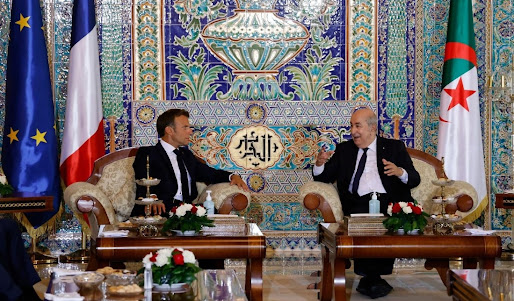
Algerian President Abdelmadjid Tebboune announced that he had agreed with his French counterpart, Emmanuel Macron, to "establish a full partnership between their two countries in the light of mutual respect."


During a joint press conference with Macron, who arrived in Algeria today for a 3-day official visit, Tebboune said: "I agreed with Macron to establish a full partnership in light of the principles of respect and a balance of trust between the two countries... We aspire to enhance trade exchange between Algeria and France."


"I discussed with Macron the situation in Libya, Mali, the Sahel and Western Sahara," he added.


For his part, Macron told his Algerian counterpart: "We have a common, complex and painful past, which contributed somewhat to not looking at the future... We have to look at this past with the will of truth... Let's open the archives from the beginning of the (French) occupation to independence without taboos... And this in order to build the future.


The French president considered that "we did not choose the past, but rather we inherited it, and we have the responsibility to build the future for ourselves and for future generations."


French President Macron arrived in Algeria today, Thursday, "hoping to build trade relations and turn the page on a diplomatic dispute," and was received by Algerian President Abdelmadjid Tebboune.

Relations with Algeria became more important for France, because the Russian special military operation in Ukraine led to an increase in Europe's demand for North African gas, and because of the increased migration across the Mediterranean.

 It is noteworthy that Algeria canceled, today also, the entry visa of the chief rabbi of France, "Haim Corsia" because of his support for "Israel", according to what a reliable source told "Al-Mayadeen", who stressed that "Algeria will not be drawn towards normalization and rejects it in all its forms, and it is firm on the Supporting just causes, most notably Palestine and Western Sahara.


Last July, Tebboune sent a congratulatory message to his French counterpart Emmanuel Macron, on the occasion of his re-election for a second presidential term, in which he expressed his "satisfaction with the quality of our personal relationship characterized by trust and affection, and with the developments achieved, albeit relatively, by the Algerian-French partnership."


In it, Macron called for a visit to Algeria "soon, to launch together a dynamic that pushes forward in dealing with major issues, and to intensify and expand Algerian-French relations."

Last March, the Algerian president declared that the "crimes of French colonialism" in Algeria will not be subject to a statute of limitations, calling for a "fair treatment of the file of memory and history in an atmosphere of frankness and trust."


This came after relations between the two countries fell to their lowest level, when Macron said he doubted the existence of an "Algerian nation" before French colonialism.


Damascus breaks its silence: This is our plan for normalization with Ankara

    Sunday, August 28, 2022   No comments

 by Alaa Halabi

Damascus broke its silence over the “slithering” messages coming to it from Ankara, declaring from the pulpit of Moscow, which is engaged in a difficult mediation with Tehran, between the Turkish and Syrian neighbors, that it does not mind restoring relations with Turkey on a solid and clear basis, which guarantees it the restoration of its control over its entire territory, and paves the way for the start of a real Syrian-Syrian dialogue. Despite the diplomatic and media rush shown by Turkey towards Syria, the normalization path, which is currently managed by the intelligence agencies in both countries, seems to take time, unless Ankara takes dramatic steps, through which it can accelerate this path, in which investment seems a priority. For Recep Tayyip Erdogan


Following a long meeting in Moscow, the day before yesterday, Syrian Foreign Minister Faisal Miqdad and his Russian counterpart, Sergei Lavrov, made compatible statements focused on the two issues of Syrian refugees and the US presence in Syria. The last title, with its accompanying emphasis on the necessity of the exit of US forces as a necessary condition for resolving the Syrian crisis, has become the backbone of the efforts of the guarantor states of the “Astana track” (Russia, Iran and Turkey), in addition to forming a suitable ground to open the closed doors between Ankara and Damascus. From here, the two ministers recalled the sabotage role of the American forces that seize most of the Syrian oil regions, as well as their support for the Kurdish separatist project, which represents one of the most prominent obstacles to reaching a political settlement in accordance with United Nations resolutions, as well as threatening the territorial integrity of Syria, and impeding the return process. Refugees return to their homes due to the living and economic pressures imposed by Washington on Damascus. This position, and before it the statements of Turkish President Recep Tayyip Erdogan against the policies of the United States, foretells the existence of a preliminary agreement between Turkey and Syria from which to proceed towards political talks that are working to develop those currently being waged by Syrian and Turkish intelligence services, according to what Ankara announced.

In what could be considered the first official Syrian statement in this regard, after a long period of silence, which seems to have been deliberate, Miqdad, in his response to journalists, denied the existence of conditions for normalizing relations, adding that there are fundamental issues that must be addressed “on the basis of respect for the sovereignty of states,” adding The first entitlements before the two countries are “ending the occupation, stopping support for terrorism, non-interference in internal affairs, and solving water problems.” Reiterating that Damascus does not trust “those who sponsor and support terrorism,” he considered that “when we reach such a solution, it will be in the interest of Syria and Turkey, and it will be a prelude to restoring relations to what they were before the war began.” Al-Miqdad’s words draw clear signs of what Syria aspires to, whether in terms of ending the Turkish military presence on its lands, or in terms of stopping Ankara’s support for the opposition groups, which Damascus sees as emptying the “Syrian solution” project of its content. It appears that Syria is receiving support, in this vision, from its Russian and Iranian allies, especially in light of the latter's continued rejection of any new Turkish military attack on Syrian regions, which was explicitly expressed by Lavrov at the same conference, recalling the existence of agreements between Damascus and Ankara (Adana Agreement). Security Treaty signed in 1998) through which Turkish security concerns can be removed through diplomatic means.


As a result, the current situation can be summarized as the beginning of a Turkish turn towards Syria, through which Ankara is rushing to achieve gains, whether in the form of finding a solution to the refugee problem, or by reaping field and political gains that Erdogan can spend in the presidential election race in Turkey, which will intensify as the date approaches. In June of next year. On the other hand, Damascus wants a clear road map, which guarantees the restoration of its control over all parts of the country, and the transformation of Turkey from a party to the conflict to an auxiliary element in the solution. Both demands represent part of a long path that requires consensus on many overlapping and intertwined points, in light of the complex situation in northern Syria, where Ankara, through its affiliated factions, controls the countryside of Aleppo and Raqqa, at a time when Hayat Tahrir al-Sham (Al-Nusra Front) is unique. , which has also become affiliated with Turkey, by controlling Idlib, which is the largest stronghold of the "jihadist" groups.

In the face of the field, political and even economic equation (in view of the increasing pressure on Ankara, its desire to play a greater role in energy-related projects in the region, and the conditions that must be present to ensure the return of Syrian refugees), it seems that Russian and Iranian efforts have managed, so far, to open a window of During which, continuous security talks were held between Syria and Turkey, aimed at finding solutions to field issues in a sequential manner, and paving the ground for the transition to political action. This means that the normalization process will take a long time, unless Ankara, which wants to speed up its pace, takes the initiative to translate its diplomatic rush into similar operational steps on the ground.


Thursday, August 25, 2022

Dmitry Medvedev predicts the outcome of the war in Ukraine: Victory or military coup--Tertium non datur

    Thursday, August 25, 2022   No comments

Deputy Chairman of the Russian Security Council Dmitry Medvedev said that the scenarios for the development of the situation in Ukraine are no more than "one and a half".

Medvedev noted that this includes the achievement of all the objectives of the special military operation and the recognition of its results by the Kyiv authorities or the occurrence of a military coup in Ukraine and the subsequent recognition of the results of the military operation.

"Analysts of all stripes are competing in preparing forecasts for the Ukrainian conflict," Medvedev wrote on his Telegram channel, and the Kyiv authorities and Western pro-Ukrainian countries are preparing "predictions of victory."

“But in reality, it is all lies and demagogy to deceive voters. Everyone understands it all. They are just executing roles. There is only one and a half scenarios. The first is the achievement of all the goals of the special military operation and the unequivocal recognition of its results in Kyiv. The second is the military coup in Ukraine, and only after that the recognition of the results of the special operation.”


The statement:


Analysts of all stripes are practicing forecasting the Ukrainian conflict. Here The Guardian came up with five pieces. Forecasts of victory are being built in Kyiv and in the Ukrainian-affiliated countries of the West.

In fact, all this is pure lies and demagogy for the treatment of the electorate. Everyone understands everything. But they work out the roles.


There are only one and a half scripts.

The first is the achievement of all the goals of the [operation] and the unequivocal recognition of its results in Kyiv.

The second is a military coup in Ukraine, and only then the recognition of the results of the special operation.


That's all the options.

Tertium non datur!


Meanwhile, today, Thursday, Russian President Vladimir Putin signed a decree to increase the number of members of the Russian Armed Forces by 137,000, bringing the total number of soldiers to 1,150,628.


The presidential decree stated: "The number of the Russian Armed Forces has been set at 2,039,758, including 1,150,628 soldiers."


On Monday, Russian President Vladimir Putin stressed that Russia is a superpower that pursues a policy that meets its interests.


On the occasion of the Russian Flag Day, Putin said that "Russia is a great power that will not pursue any policy in the international arena that contradicts its basic interests," noting that his country "will always follow traditional values."


Tuesday, August 23, 2022

"Tasnim": Assad and Erdogan may meet at the Shanghai summit in Uzbekistan

    Tuesday, August 23, 2022   No comments

The Iranian "Tasnim" news agency reported, quoting informed sources, that Turkish President Recep Tayyip Erdogan and Syrian President Bashar al-Assad "may meet at the Shanghai Cooperation Organization summit, which is expected to be held next September in Uzbekistan."

The agency quoted the sources as saying that Russian President Vladimir Putin "invited Erdogan to participate in the meeting of the Shanghai Cooperation Organization in Uzbekistan, and Putin also asked Assad to participate in this meeting."


Earlier, Erdogan said that his Russian counterpart, Vladimir Putin, invited him to attend the summit meeting of the Shanghai Cooperation Organization in Uzbekistan in September.


Meanwhile, Turkish media revealed that President Erdogan and his Syrian counterpart, Bashar al-Assad, may hold a phone call, during the coming period, at the suggestion of Putin.


In the context of the Turkish-Syrian rapprochement, the agency indicated that the leader of the Turkish "Homeland" party, Dogu Perincek, "will soon head to Syria as part of a political and diplomatic delegation, where he will meet and hold talks with Syrian President Bashar al-Assad."


She added, "Berncik will be accompanied on this trip by a number of former ministers and veterans of Turkish diplomacy, and a report on the results of this trip will be submitted to the Turkish authorities."


In this context, it was pointed out that the Turkish delegation's trip to Syria will be the first from a Turkish airport to Damascus in about 10 years, as direct flights between the two countries have not been operated since 2011.


The Iranian agency stated that "the focus of this trip will be on ways to restore relations, the joint struggle against terrorism in northern Syria, and the return of Syrian refugees," as it put it.


It is noteworthy that the Kremlin announced on August 9 that the two Russian Presidents, Vladimir Putin, and his Turkish counterpart, Recep Tayyip Erdogan, discussed the situation in Syria.


It is noteworthy that the regular summit of the leaders of the Shanghai Cooperation Organization will be held next September in the city of Samarkand in Uzbekistan, which is currently the head of the organization.


Mevlut Cavusoglu : A dialogue is taking place between the Syrian and Turkish intelligence services

Today, Tuesday, Turkish Foreign Minister Mevlut Cavusoglu said that "there is a dialogue taking place between the Syrian and Turkish intelligence services."


Cavusoglu stressed that "Turkey does not have preconditions for dialogue with Syria," noting that "dialogue with the Syrian government must have specific goals."


The Turkish minister said: "A meeting was not planned between the Turkish and Syrian presidents in Shanghai, because Assad will not participate in the summit," as he put it.


Earlier today, the Iranian "Tasnim" news agency reported that Turkish President Recep Tayyip Erdogan and Syrian President Bashar al-Assad "may meet at the Shanghai Cooperation Organization summit, which is expected to be held next September in Uzbekistan."


The agency quoted sources as saying that Russian President Vladimir Putin "invited Erdogan to participate in the meeting of the Shanghai Cooperation Organization in Uzbekistan, and Putin also asked Assad to participate in this meeting."


It is noteworthy that the regular summit of the leaders of the Shanghai Cooperation Organization will be held next September in the city of Samarkand in Uzbekistan, which is currently the head of the organization.


Islamic Societies Review WEEKLY updates

AdSpace - 2

AdSpace - 2
Books

ISR+


Now reading...


Frequently Used Labels and Topics


Search for old news

AdSpace-1

AdSpace-1
Buy Books

Find Articles by year, month hierarchy


Copyright © Islamic Societies Review. All rights reserved.