Showing posts with label Syria. Show all posts

Sunday, August 28, 2022

Damascus breaks its silence: This is our plan for normalization with Ankara

    Sunday, August 28, 2022   No comments

 by Alaa Halabi

Damascus broke its silence over the “slithering” messages coming to it from Ankara, declaring from the pulpit of Moscow, which is engaged in a difficult mediation with Tehran, between the Turkish and Syrian neighbors, that it does not mind restoring relations with Turkey on a solid and clear basis, which guarantees it the restoration of its control over its entire territory, and paves the way for the start of a real Syrian-Syrian dialogue. Despite the diplomatic and media rush shown by Turkey towards Syria, the normalization path, which is currently managed by the intelligence agencies in both countries, seems to take time, unless Ankara takes dramatic steps, through which it can accelerate this path, in which investment seems a priority. For Recep Tayyip Erdogan


Following a long meeting in Moscow, the day before yesterday, Syrian Foreign Minister Faisal Miqdad and his Russian counterpart, Sergei Lavrov, made compatible statements focused on the two issues of Syrian refugees and the US presence in Syria. The last title, with its accompanying emphasis on the necessity of the exit of US forces as a necessary condition for resolving the Syrian crisis, has become the backbone of the efforts of the guarantor states of the “Astana track” (RussiaIran and Turkey), in addition to forming a suitable ground to open the closed doors between Ankara and Damascus. From here, the two ministers recalled the sabotage role of the American forces that seize most of the Syrian oil regions, as well as their support for the Kurdish separatist project, which represents one of the most prominent obstacles to reaching a political settlement in accordance with United Nations resolutions, as well as threatening the territorial integrity of Syria, and impeding the return process. Refugees return to their homes due to the living and economic pressures imposed by Washington on Damascus. This position, and before it the statements of Turkish President Recep Tayyip Erdogan against the policies of the United States, foretells the existence of a preliminary agreement between Turkey and Syria from which to proceed towards political talks that are working to develop those currently being waged by Syrian and Turkish intelligence services, according to what Ankara announced.

In what could be considered the first official Syrian statement in this regard, after a long period of silence, which seems to have been deliberate, Miqdad, in his response to journalists, denied the existence of conditions for normalizing relations, adding that there are fundamental issues that must be addressed “on the basis of respect for the sovereignty of states,” adding The first entitlements before the two countries are “ending the occupation, stopping support for terrorism, non-interference in internal affairs, and solving water problems.” Reiterating that Damascus does not trust “those who sponsor and support terrorism,” he considered that “when we reach such a solution, it will be in the interest of Syria and Turkey, and it will be a prelude to restoring relations to what they were before the war began.” Al-Miqdad’s words draw clear signs of what Syria aspires to, whether in terms of ending the Turkish military presence on its lands, or in terms of stopping Ankara’s support for the opposition groups, which Damascus sees as emptying the “Syrian solution” project of its content. It appears that Syria is receiving support, in this vision, from its Russian and Iranian allies, especially in light of the latter's continued rejection of any new Turkish military attack on Syrian regions, which was explicitly expressed by Lavrov at the same conference, recalling the existence of agreements between Damascus and Ankara (Adana Agreement). Security Treaty signed in 1998) through which Turkish security concerns can be removed through diplomatic means.


As a result, the current situation can be summarized as the beginning of a Turkish turn towards Syria, through which Ankara is rushing to achieve gains, whether in the form of finding a solution to the refugee problem, or by reaping field and political gains that Erdogan can spend in the presidential election race in Turkey, which will intensify as the date approaches. In June of next year. On the other hand, Damascus wants a clear road map, which guarantees the restoration of its control over all parts of the country, and the transformation of Turkey from a party to the conflict to an auxiliary element in the solution. Both demands represent part of a long path that requires consensus on many overlapping and intertwined points, in light of the complex situation in northern Syria, where Ankara, through its affiliated factions, controls the countryside of Aleppo and Raqqa, at a time when Hayat Tahrir al-Sham (Al-Nusra Front) is unique. , which has also become affiliated with Turkey, by controlling Idlib, which is the largest stronghold of the "jihadist" groups.

In the face of the field, political and even economic equation (in view of the increasing pressure on Ankara, its desire to play a greater role in energy-related projects in the region, and the conditions that must be present to ensure the return of Syrian refugees), it seems that Russian and Iranian efforts have managed, so far, to open a window of During which, continuous security talks were held between Syria and Turkey, aimed at finding solutions to field issues in a sequential manner, and paving the ground for the transition to political action. This means that the normalization process will take a long time, unless Ankara, which wants to speed up its pace, takes the initiative to translate its diplomatic rush into similar operational steps on the ground.


Tuesday, August 23, 2022

"Tasnim": Assad and Erdogan may meet at the Shanghai summit in Uzbekistan

    Tuesday, August 23, 2022   No comments

The Iranian "Tasnim" news agency reported, quoting informed sources, that Turkish President Recep Tayyip Erdogan and Syrian President Bashar al-Assad "may meet at the Shanghai Cooperation Organization summit, which is expected to be held next September in Uzbekistan."

The agency quoted the sources as saying that Russian President Vladimir Putin "invited Erdogan to participate in the meeting of the Shanghai Cooperation Organization in Uzbekistan, and Putin also asked Assad to participate in this meeting."


Earlier, Erdogan said that his Russian counterpart, Vladimir Putin, invited him to attend the summit meeting of the Shanghai Cooperation Organization in Uzbekistan in September.


Meanwhile, Turkish media revealed that President Erdogan and his Syrian counterpart, Bashar al-Assad, may hold a phone call, during the coming period, at the suggestion of Putin.


In the context of the Turkish-Syrian rapprochement, the agency indicated that the leader of the Turkish "Homeland" party, Dogu Perincek, "will soon head to Syria as part of a political and diplomatic delegation, where he will meet and hold talks with Syrian President Bashar al-Assad."


She added, "Berncik will be accompanied on this trip by a number of former ministers and veterans of Turkish diplomacy, and a report on the results of this trip will be submitted to the Turkish authorities."


In this context, it was pointed out that the Turkish delegation's trip to Syria will be the first from a Turkish airport to Damascus in about 10 years, as direct flights between the two countries have not been operated since 2011.


The Iranian agency stated that "the focus of this trip will be on ways to restore relations, the joint struggle against terrorism in northern Syria, and the return of Syrian refugees," as it put it.


It is noteworthy that the Kremlin announced on August 9 that the two Russian Presidents, Vladimir Putin, and his Turkish counterpart, Recep Tayyip Erdogan, discussed the situation in Syria.


It is noteworthy that the regular summit of the leaders of the Shanghai Cooperation Organization will be held next September in the city of Samarkand in Uzbekistan, which is currently the head of the organization.


Mevlut Cavusoglu : A dialogue is taking place between the Syrian and Turkish intelligence services

Today, Tuesday, Turkish Foreign Minister Mevlut Cavusoglu said that "there is a dialogue taking place between the Syrian and Turkish intelligence services."


Cavusoglu stressed that "Turkey does not have preconditions for dialogue with Syria," noting that "dialogue with the Syrian government must have specific goals."


The Turkish minister said: "A meeting was not planned between the Turkish and Syrian presidents in Shanghai, because Assad will not participate in the summit," as he put it.


Earlier today, the Iranian "Tasnim" news agency reported that Turkish President Recep Tayyip Erdogan and Syrian President Bashar al-Assad "may meet at the Shanghai Cooperation Organization summit, which is expected to be held next September in Uzbekistan."


The agency quoted sources as saying that Russian President Vladimir Putin "invited Erdogan to participate in the meeting of the Shanghai Cooperation Organization in Uzbekistan, and Putin also asked Assad to participate in this meeting."


It is noteworthy that the regular summit of the leaders of the Shanghai Cooperation Organization will be held next September in the city of Samarkand in Uzbekistan, which is currently the head of the organization.


Monday, August 22, 2022

Who is Alexander Dugin, who is described as Putin's brain, and whose daughter Daria was killed by Car Bomb in Moscow?

    Monday, August 22, 2022   No comments

Aleksandr Gelyevich Dugin is said to have great influence on Russian politicians including the current president, Vladimir Putin. His daughter killed by a car bomb. The Russian authorities announced the killing by detonating her car with an explosive device planted under the driver’s seat in a suburb of the capital, Moscow. Daria Dugin worked as a press secretary for her father, who is described as "Putin's brain", a nationalist and one of the most prominent theorists of the Kremlin's ideology who predicted the end of the era of Western liberalism.

To learn more about Dugin, we provide a summary of his ideas that he shared with Aljazeera network in an extended set of interviews (See interview1, and interview 2; Arabic) in which he talked about Russia, the West, Christianity, Islam, Chechnya, Sunnism, and other topics.


Russian identity and change

On the other hand, Dugin spoke to Al Jazeera about the Russian identity and the radical change that he said had affected it over the course of one century, as the country was an empire with its faith and perception, and after the Bolshevik Revolution, perceptions changed dramatically, and in 1991 the Russian identity changed again and Russia became part of The Western world, then Putin, changed identity again and Russia became a powerful country that defends its own conservative values, according to what the Russian philosopher says.


On Russian identity, "Putin's mind" says that his country is changing its position and "we are in a spiritual search for ourselves", and it is sensitive to changes.


However, Dugin confirms - in the first part of his meeting in the episode (14/11/2021) of the "The Interview" program - that Western tendency is still largely present within Russia, and there is a liberal elite and strong resistance to President Putin's reforms on the part of liberal intellectuals, and that This Western tendency hinders the special orientation of Russia.


He also believes that other civilizations have the right to rely on their own political teachings that are based on their own values, not on Western values.


He indicated in the context of his review of his identical vision with his president's on the Chechen issue, which he said Putin had found a solution for, as well as with regard to Georgia and Ukraine and the annexation of the Crimea in 2014.


Fourth political theory

The Russian thinker Alexander Dugin focused in the second part of his interview with the "The Interview" program on the fourth political theory, which he said is an anti-capitalist tendency, and talked about his vision of terrorism and its relations with Iran and Turkey.


Dugin described the fourth political theory as the theory of revolution and decolonization for Russian society, and it defends the originality of Russian civilization and human rights, but not according to Western values, which he said are not totalitarian and are unacceptable neither in Russia, nor in the Islamic world, nor in China.


Definition of terrorism

In the interview, Ali Al-Dhafiri's guest linked the issue of defining terrorism to the interests of states, and gave an example of Russian President Vladimir Putin, who said that he supported Washington's position after the September 11, 2001 attacks, and in return was waiting for the US administration to classify those he called the Chechen separatists in the category of Terrorists, which did not happen, and the Russian thinker says that Putin understood at that time the meaning of geopolitical considerations.


In another context, Dugin - one of the most prominent political theorists in Russia - saw that Iran is an ally of Russia and is one of the opponents of globalization and American leadership, and that radical Sunni Islam in the Arab world had supported the American strategy in the MiddleEast, but the new generation of leaders - continues the speaker - In SaudiArabia, Qatar and Egypt, he is looking for a new approach to Arab Sunni Islam, and he believes that staying in the orbit of American policy is bad for the Islamic world.


He also talked about his ideas, and said that he is a supporter of Islamic traditional values ​​in Iran, but nevertheless he has strong relations with Turkey, noting in his touch on Russia's future that Russia is Putin and he determines everything in politics, to conclude his speech by saying that in his country "the law does not something and rule everything."


It is noteworthy that after Putin took power in Russia, a new phase began in Dugin's political activity when he moved from the radical opposition camp to the pro-power camp.


Friday, August 19, 2022

Erdogan: America and the coalition are fueling terrorism in Syria, and dialogue with Damascus is not excluded

    Friday, August 19, 2022   No comments

Turkish President Recep Tayyip Erdogan said on possible talks with Syria that "states can never rule out political dialogue and diplomacy."

The Turkish TRT channel quoted Erdogan as saying that "his country has no ambitions in Syrian territory," and said that "the Syrian people are our brothers, and their territorial integrity is important to us."

He added, "The United States of America and the coalition forces are the feeders of terrorism in Syria in the first place. They have done so relentlessly and continue to do so."


Pointing out that "we must take advanced steps with Syria, through which we can spoil many schemes in this region of the Islamic world."


Erdogan stressed, according to Anatolia, that Turkey "has no ambitions in Syrian territory, and Damascus must understand this well," noting also that Ankara "has always been supportive of a political solution and dialogue in Syria."


The Anatolia news agency quoted Erdogan as saying, "We do not care about the issue of Assad's defeat or not being defeated," expressing a position in this context, saying: "We have always been part of the solution in Syria."


This comes at a time when the northern countryside of Aleppo is witnessing a remarkable military escalation, through an exchange of shelling between the Turkish army and the "Syrian Democratic Forces", which led to the martyrdom of civilians and members of the Syrian army deployed in the area, as a result of a raid by a Turkish fighter on Tel Jarqali. , west of the city of Ayn al-Arab.


Cities and towns in the border strip are witnessing frequent Turkish bombardment, under the pretext that the SDF did not withdraw to a distance of 30 km, according to the Sochi Agreement, which led to the deaths and injuries, and the displacement of dozens of families from their villages and towns.


On the other hand, the Turkish president said regarding relations with Egypt: "We are united by the Egyptian people as brothers. There can be no disagreement with the Egyptian people. For this reason, we need to establish this peace there as soon as possible."


It is noteworthy that Erdogan's statements came during his one-day visit to Lvov, during which he met with Ukrainian President Volodymyr Zelensky, at the Potochki Palace, in the presence of United Nations Secretary-General Antonio Guterres.


Monday, August 15, 2022

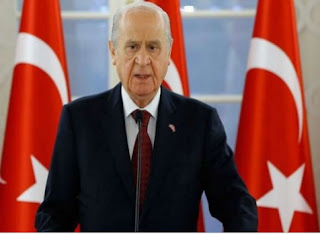
The reconciliatory comments issued by Turkish officials towards Damascus continue; The head of the Turkish "National Movement" Party Devlet Bahçeli announces his support for the foreign minister's statements on Syria and calls for raising the level of dialogue with Damascus

    Monday, August 15, 2022   No comments

After statements by Turkish Foreign Minister Mawad ÇavuÅŸoÄŸlu about his meeting with the Syrian Foreign Minister and his announcement of Turkey's support for reconciliation in Syria, and after leaks by a Turkish newspaper about communication between Damascus and Ankara. Today came the statement of the head of the Turkish Nationalist Movement Party, Devlet Bahçeli, who welcomed the dialogue with Damascus and supported the statements of Foreign Minister ÇavuÅŸoÄŸlu Bahçeli, an ally of the Justice and Development Party in the “People” coalition, which includes the “Great Union” party. In an official statement issued The party expressed its support for the recent statements of the Turkish Foreign Minister, Mevlut Cavusoglu, regarding the Syrian issue.

“Turkey’s steps in Syria are valuable and accurate, and the constructive and realistic statements of our foreign minister on bringing peace between the Syrian opposition and the Assad regime are a strong outlet for the search for a permanent solution,” the statement said.

The statement, signed on behalf of Dovlet Bahceli, added, "No one should be disturbed by this," and explained that raising Turkey's talks with the Syrian regime to the level of political dialogue, in the context of removing "terrorist organizations" from every region in which they are located, is one of the most important issues on the agenda. politics in the future.

Bahlachi expressed his desire for an atmosphere of normalization to prevail in every region and with every neighbor of Turkey by 2023, with reference to the brotherhood relationship and the strong ties based on history, culture and faith between the Turks and the Syrians. Bahceli added: “There is a really independent people.. There are also regimes and the opposition.. 11 years ago many people died. Many people left their country. These people should be able to return, including those in Turkey.”

Devlet Bahceli is described as a man behind the scenes who drives the politics of governance in Turkey, in alliance with the Justice and Development Party. He had lined up behind Erdogan in the project to overthrow the regime in Syria, declaring that Assad was a president who had lost his legitimacy, and now he is forming a national cover for the expected transformation of President Erdogan in his policies toward Syria.

In light of the continuation of positive signals from Ankara towards Damascus, and what appears to be a Turkish review of the hostility relationship with it, silence remained prevailing in Syria, and no Syrian official body commented on these statements or press leaks. Perhaps Damascus prefers to wait for some space for Iranian-Russian mediation. The two sides are making great efforts to reach results in reformulating the relationship between Turkey and Syria.


Friday, August 12, 2022

Mass demonstrations in northern Syria condemning Ankara's call for "reconciliation" between the government and the opposition

    Friday, August 12, 2022   No comments

Thousands protested across parts of rebel-held northern Syria [See locations in attached pam] on Friday after Turkey's foreign minister called for reconciliation between Ankara-backed Syrian opposition groups and the government of President Bashar al-Assad.

More than 11 years after the outbreak of the civil war in Syria, the northwestern region near the Turkish border is the last stronghold still under the control of fighters seeking to overthrow Assad, with control divided between militant groups and other fighters backed by Turkey.

The Turkish government maintains thousands of troops in the area and supports an alliance of anti-Assad armed groups under the banner of the Syrian National Army.

"We need to bring the opposition and the regime together in order to somehow reconcile, otherwise there will be no lasting peace," Turkish Foreign Minister Mevlut Cavusoglu told reporters in Ankara on Thursday.

After he spoke, protests began in areas of Syria controlled by opposition forces, with people waving opposition flags in the streets on Thursday night and pulling Turkish flags from buildings including police stations and local administration offices.

"We have suffered from this criminal for 11 years and we will continue our revolution," teacher Mahmoud Salo, 45, told Reuters during a protest in Azaz, Idlib, on Friday.

About three thousand people gathered in Azaz on Friday, while protests erupted in other areas of the northwestern Idlib province and in the northern areas of the neighboring province of Aleppo.

A Reuters reporter in the region said many Turkish consultants who work in a number of local institutions did not come to work on Friday.

Ahmet Shobak, a refugee from Aleppo who works as an engineer in Azaz, said Cavusoglu's comments were unacceptable.

"If Turkey wants to stand with the world that is already against us, so be it, it won't change anything much," he added. But we hope that Turkey's position will become more positive."


Yesterday, the cities and towns under the control of the Syrian opposition, in the north of the country, witnessed protests against ÇavuÅŸoÄŸlu’s statements. The cities and towns of Al-Bab, Azaz, Sego, Jarabulus, Al-Ra’i and Marea in the countryside of Aleppo, Salqin and Idlib witnessed demonstrations during which protesters burned the Turkish flag and raised slogans condemning the statements of the Turkish Foreign Minister, calling To the continuation of the protests, the reactions of the Syrian opposition, through its statements and the positions of its leaders, varied, between those who aligned with the demonstrations and denounced the new Turkish position, and the opposition forces that refused to offend Turkey and denounced the burning of the Turkish flag.

Turkish Foreign Minister Mevlut Cavusoglu revealed a meeting he had with Syrian Foreign Minister Faisal Miqdad on the sidelines of the Non-Aligned Conference in Belgrade months ago, declaring that Turkey was seeking reconciliation between the regime and the opposition for the sake of Syria's stability and territorial integrity.

Organizations and figures in the Syrian opposition denounced ÇavuÅŸoÄŸlu’s statements, and the so-called Department of Political Affairs in the opposition Salvation Government in northern Syria, where Turkish influence areas, said, “We followed up with strong condemnation these statements that offended the Syrian people and their great revolution, as well as the positions of the countries that sympathized, supported and supported this blessed revolution, Proceeding from its moral and humanitarian principles, foremost of which is the Republic of Turkey and its generous government, these statements come in a context of interest that is not befitting the principles of Turkish policy that is biased towards the just causes of oppressed peoples.

Fahim Issa, the commander-in-chief of the "Revolutionary" movement, one of the largest armed groups in the north, said, "There is no reconciliation with Assad, no reconciliation with terrorism and killers. There is no place for Assad or the regime in the future of Syria." "We will not betray the blood of our martyrs, and we will not betray the country's revolution," he added.

Meanwhile, the Defense Minister of the so-called Syrian Interim Government, Hassan Hamadeh, said: “At the first cry of the people wanting to overthrow the regime, it was the point of no return. It's over, there is no alternative to toppling Assad."

Opposition figures praised the movements and demonstrations denouncing the statements of the Turkish Foreign Minister. While others denounced the demonstration and burning of the Turkish flag.

The so-called Syrian National Army confirmed in a statement that “the flag of the Turkish Republic, as the flag of the Syrian revolution, is a source of pride, a title for victory, and a emblem for a great people, and its place is above the heads of the brave and the bodies of the martyrs.”

The statement stressed the need to hold accountable those who crossed their borders by insulting the Turkish flag.

As for the Ministry of Defense in the opposition’s interim government, it retracted in a statement, describing the Turkish flag as “sacred for the people for those who shed their blood on Syrian lands from the Turkish army and people.”

She vowed to hold accountable those she called "ignorant people" who do not represent the constants of the revolution.

She explained that some parties in Syria aim to "destabilize the relations of brotherhood and blood between the Turkish and Syrian peoples, to serve the enemies."

As for the National Coalition of Revolutionary and Opposition Forces, it stressed its refusal to burn the flag of the Turkish people, which hosts 4 million Syrians, and indicated that the blood of the Turkish people was mixed with the blood of the Syrians.

The Turkish Foreign Ministry clarified the Turkish position on the situation in Syria, and said in a statement issued by the ministry’s spokesman: “Turkey, since the beginning of the crisis in Syria, has been the country that has worked the most to support solutions to the crisis based on achieving the legitimate demands of the people.”

He added: “In this context, Turkey was at the forefront of the parties that worked to consolidate the ceasefire on the ground, and contributed to the Astana and Geneva tracks, building the Constitutional Committee and providing full support to the opposition and the negotiating body. And it is working on a solution in Syria in accordance with Security Council Resolution 2254.


Tuesday, August 9, 2022

Turkish media: Erdogan and Assad may hold talks at the suggestion of Putin; US Media: Turkey builds "Bayraktar" aircraft factory in Ukraine

    Tuesday, August 09, 2022   No comments

The Kremlin announced today, Tuesday, that Russian President Vladimir Putin and his Turkish counterpart, Recep Tayyip Erdogan, discussed the situation in Syria.

Turkish media revealed that President Erdogan and his Syrian counterpart, Bashar al-Assad, may hold a phone call, during the coming period, at the suggestion of Putin.

And the newspaper "Turkey" published a report, in which it was based on private sources, that Erdogan, who recently visited Sochi, Russia, exchanged views on Syria with President Putin, and the Russian President suggested that he meet Assad and Erdogan, in order to solve the problem of terrorism in Syria.

But Ankara made it clear that it is "too early" for a meeting between the two presidents, while a phone call is still possible.

The newspaper pointed out that there are diplomatic contacts from a Gulf country and an African one with Syria and Turkey, in order to arrange a meeting between Presidents Assad and Erdogan.

During their bilateral summit in Sochi, Putin and Erdogan confirmed their support for preserving the unity of Syria. 

During this meeting in Sochi, Putin was accompanied by the president of the Chechen Republic, R. Kadyrov, who might be called upon to nudge Turkey further in the direction of Russia.


Erdogan announced, earlier, that his country intends to launch a military operation inside Syrian territory to combat “terrorism” and establish what he described as a “safe zone,” noting that his country “will not ask permission before launching a military operation in Syria.”


While Ankara says that its military presence in Syria aims to prevent the threat from the Kurdish factions, Damascus considers the Turkish military presence in the country an occupation and a threat to regional and international peace.


In a letter sent by the Ministry of Foreign Affairs to both United Nations Secretary-General Antonio Guterres and the Security Council, Syria protested Turkey's intention to launch a military operation inside its territory.


Last May, an official source at the Ministry of Foreign Affairs and Expatriates confirmed that "Syria's sovereignty, independence, and territorial integrity will not be the object of blackmail or bargaining by the Turkish regime."


Reacting to the latest media report about possible talks between the Syrian President Bashar al-Assad and his Turkish counterpart, Recep Tayyip Erdogan, is Syrian sources, off the record, rejected the the idea of such event happening, characterizing it as "totally incorrect."

...

Meanwhile, US media sources highlight another aspect of Turkish involment in matters of concern to Russia.

The American "Newsweek" magazine said today, Tuesday, that the Turkish company "Baykar", which produces the "Bayraktar" unmanned combat aircraft, is currently building a factory on Ukrainian soil.


The magazine quoted Ukraine's ambassador to Turkey, Vasyl Bodnar, as saying that the Turkish company had already purchased a plot of land in Ukraine and developed the station project. Bodnar added that "Baykar" intends to build the plant in fulfillment of the personal commitment of the company's owners to make this production in Ukraine.


The magazine pointed out that the Bayraktar TB2 drones were considered one of the most valuable weapons for Ukraine in the first months of the war, especially before the arrival of the American "HIMARS" missiles.


She noted that Ukraine had more than 20 unmanned aircraft produced by the "Baykar" company when the war began, and acquired them during the past two years.


Because Kyiv currently has a limited supply of these planes, and given that Russia has learned a lesson from weakness during the first phase of the war, it is unlikely that Ukrainian forces would risk losing their TB2s from unmanned aerial vehicles, by pushing them forward in areas where Russian air defenses could easily fall."


She added that "a TP2 aircraft factory can fundamentally change the situation in Ukraine," noting that the time required for the construction of the factory is still unclear.

...

Editors' Note: This story was updated to include the Syrian government's rection to the news about the phone call between the two presidents.


Saturday, August 6, 2022

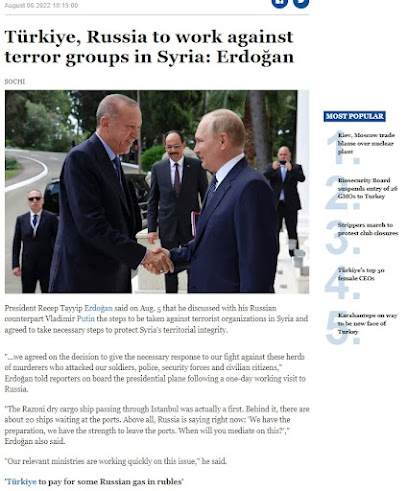
Türkiye, Russia to work against terror groups in Syria; Erdoğan confirms the payment of Russian natural gas in rubles

    Saturday, August 06, 2022   No comments

President Recep Tayyip ErdoÄŸan said on Aug. 5 that he discussed with his Russian counterpart Vladimir Putin the steps to be taken against terrorist organizations in Syria and agreed to take necessary steps to protect Syria’s territorial integrity.

Erdoğan has also confirmed that Türkiye will start paying for some of its Russian natural gas imports in rubles.

"As Türkiye, our door is open to everyone. One good thing about this Sochi visit is that we agreed on the ruble with Mr. Putin," Erdoğan said.

"Since we will conduct this trade in rubles, it will of course bring money to Türkiye and Russia."


Neither ErdoÄŸan nor Russian officials have said what portion of the gas will be covered by ruble payments.


Putin and ErdoÄŸan on Aug. 5 adopted a statement pledging to boost political and economic cooperation including in energy and trade.


At the start of the talks Putin also praised the TurkStream natural gas pipeline project, saying Europe should be grateful to Türkiye for uninterrupted supplies of Russian gas.


"I believe that (today’s meeting) will open a whole different page in Turkish-Russian relations," ErdoÄŸan said.


Putin and ErdoÄŸan last met for a three-way summit in Iran in July.


Read original story.

Tuesday, July 12, 2022

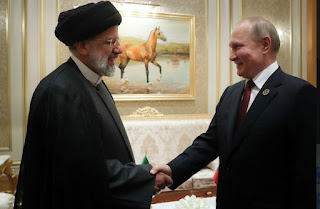
Putin visits Iran to participate in a summit with Erdogan and President

    Tuesday, July 12, 2022   No comments

Kremlin spokesman Dmitry Peskov confirmed today, Tuesday, that Russian President Vladimir Putin will visit Tehran on July 19.

Peskov said that President Putin will hold talks with his Iranian counterpart, Ibrahim Raisi, and Turkish President Recep Tayyip Erdogan, within the framework of the meeting of leaders of the guarantor states of the Astana Process on the Syrian settlement.

He continued, "The president's trip to Tehran is already being prepared. There will be a meeting of the heads of the guarantor states of the Astana process to promote the Syrian settlement. In addition to the tripartite meeting, of course there will also be bilateral meetings and separate talks with the Turkish president," adding: "Yesterday we announced high-level contacts. The level between Putin and Erdogan, and the meeting will take place there."

The Iranian Mehr news agency had earlier quoted the head of the Iranian Parliament's Economy Committee, Mohammad Pour Ibrahimi, that President Putin would visit Iran next week.

"Potential consultations between Putin and my president are likely to focus on developing economic cooperation between Iran and Russia," Ebrahimi said.

The announcement of the visit coincides with US National Security Adviser Jake Sullivan saying that his country has information that Tehran is preparing to provide Moscow with hundreds of drones, and train Russian soldiers to use them.

In a meeting with his Iranian counterpart, on June 29, on the sidelines of the sixth summit meeting of the countries bordering the Caspian Sea, Putin confirmed that both countries are in constant communication on security issues, and that they have many things to talk about.

Raisi said, at the time, that Russian-Iranian trade relations are developing, and nothing will stop this development, commenting: "The agreements we reached are under implementation, and this indicates that the will of our two countries aims to develop trade and economic relations."


Saturday, June 25, 2022

How is the war in Ukraine being fought?

    Saturday, June 25, 2022   No comments

To understand why the conflict in Ukraine will drag on for years, not months, a look at the tactics used in battles by both sides could help.

Over the past 8 years, Ukrainian forces in the east have worked continuously to establish fighting positions and defensive positions against the forces fighting for autonomy in the east. With Russia now directly involved, on the ground, those tactical measures are falling apart.

Russian forces are using modern technologies to dismantle these military positions. To do that, they are turning to highly mobile units to move quickly, eliminate the threat, and move on to the next target. 

These methods have been used in Syria, and Russia’s experience in that war is being used to fight this war. 

This means that the war will go on for years.

Tuesday, April 5, 2022

Paper: Turkish government exploring plans to "initiate a dialogue with the Syrian government"

    Tuesday, April 05, 2022   No comments

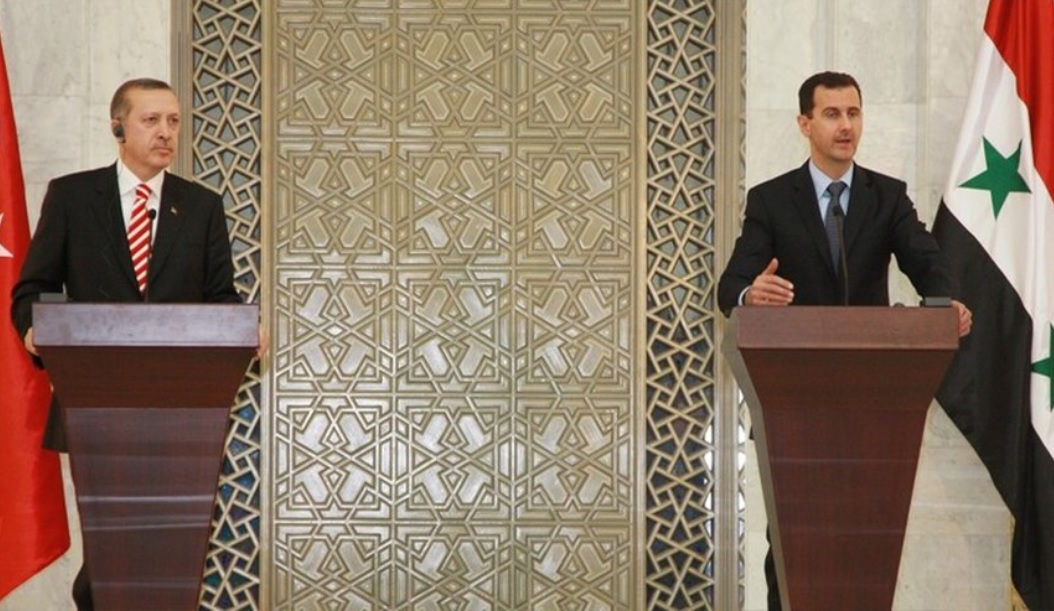
Erdogan and Assad, archive picture
 The Turkish newspaper, Hurriyet, reported on Monday that the Turkish authorities are currently in discussions to initiate a dialogue with the Syrian government, which would restore relations between the two countries to normal.

The newspaper quoted informed sources as saying that "the policy of balance recently adopted by Turkey, and the role that Ankara has played in recent months, especially toward resolving the war in Ukraine"... makes the current timing good for resolving Turkey's crisis in Syria.

The sources pointed out that Turkey, "in all its contacts with the Syrian administration," emphasizes 3 indispensable things, namely "preserving the unitary structure and the unity of the Syrian territories, and ensuring the security of refugees returning to their country," in addition to "the activity of the Kurdistan Workers' Party."

According to the newspaper, Ankara conveyed these important messages to Damascus, especially before the visit of Syrian President Bashar al-Assad to the UAE.

This development is one in many initiated by Erdogan's government to stablaize the economy before the elections. Turkish economy suffered due the the Syrian war, which Erdogan assumed would end fast. That did not. Now the Turkish economy is under stress due the war in Ukraine.

A Reuters poll showed, Monday, that "the annual inflation rate in Turkey is expected to rise to 61.5% in April, and only decrease to 52.2% by the end of the year, due to the country's impact on the crisis in Ukraine and the rise in commodity prices."

The average estimate of 17 institutions for annual inflation in April was 61.5%, with expectations ranging between 58.25% and 62.7%, and the decline of the lira and the rise in food and energy prices pushed inflation in February to its highest level in 20 years, recording 54.4% This is despite tax cuts on basic goods and government support for some electricity bills to ease the burden on household budgets.

Turkey's consumer price index has risen since last fall, with the lira weakening after the central bank in September began the 500 basis point cut cycle that Turkish President Recep Tayyip Erdogan had long sought.

Economists pointed to "expectations of global consumer price inflation, in the wake of the Russian military operation, with energy prices reaching their highest levels in several years after the West imposed sanctions on Moscow," explaining that "Turkey imports almost all of its energy needs."


Friday, March 18, 2022

On the anniversary of the outbreak of the events that led to his islation by Gulf States, President Assad of Syria visits the UAE

    Friday, March 18, 2022   No comments

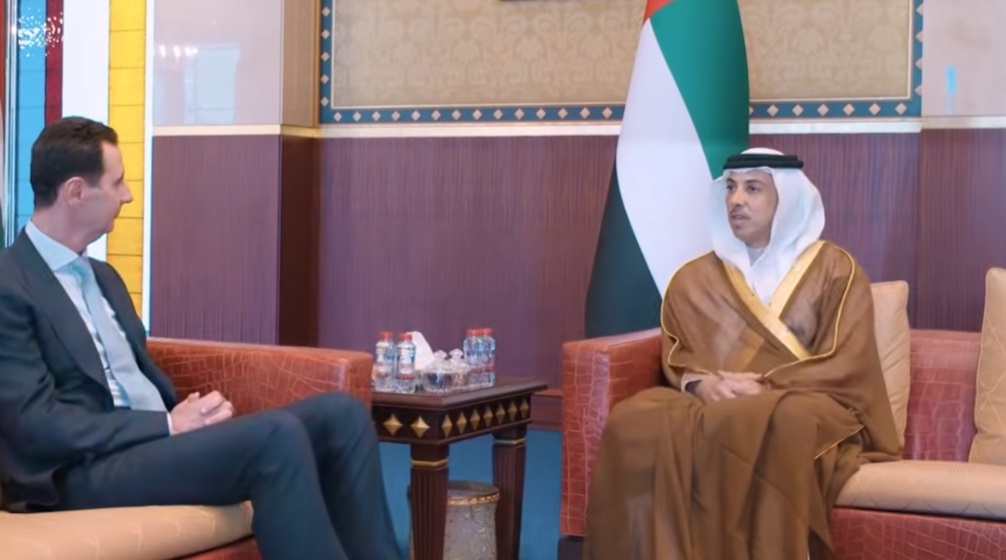
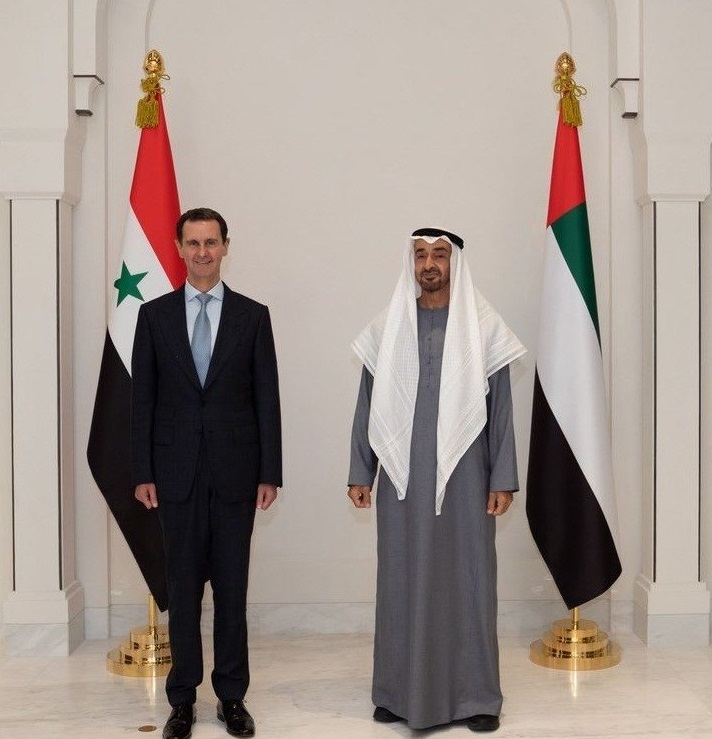
Syrian President Bashar al-Assad visited UAE, where he met Abu Dhabi Crown Prince Sheikh Mohammed bin Zayed and Prime Minister Sheikh Mohammed bin Rashid, Friday. 

The Emirates News Agency said that the Crown Prince of Abu Dhabi received the Syrian President, and discussed with him "brotherly relations, cooperation and joint coordination."

The agency added that the UAE Prime Minister affirmed his country's keenness to "discover new paths for constructive cooperation with Syria, and to monitor opportunities through which various aspects of cooperation can be pushed forward."

The agency indicated that Assad left the UAE after meeting with senior officials.

The UAE has been at the fore in the efforts of some Arab countries to normalize relations with Syria in recent times.

Al-Assad received in Damascus the UAE Foreign Minister, Abdullah bin Zayed, last November, and this was the first visit of a high-ranking Gulf official since several Gulf countries cut diplomatic relations with the Syrian government following the outbreak of violence in Syria in 2011. The United States expressed its dissatisfaction with the visit.

Other Gulf States, especially, Qatar, is holding back normalization with the Syrian government given their initial support of the armed groups that wanted to overthrow the Syrian government. In 2012, Qatar hosted the Arab League Summit, its leader, Hamad, offered Syria's seat to an opposition figure, which they recognized as the only legitimate representative of the Syrian people. Saudi Arabia, too, held the position that "Assad must go--peacefully or violently." 

It is not clear if UAE will try to mend relations between Syria and Saudi Arabia, though it is unlikely that it will advocate for the warming of relations between Qatar and Syria goven that UAE still has frosty relations with its neighbor.


Friday, November 12, 2021

Ford: Assad won the war and Washington failed to unite the opposition

    Friday, November 12, 2021   No comments

The former US ambassador to Syria, Robert Ford, admits the failure of US policy there, and the unification of the Syrian opposition, considering that the recent visit of the UAE Foreign Minister to Damascus confirms Assad's victory in the war.


The former US ambassador to Syria, Robert Ford, said that "US policy has failed to establish a Syrian government through negotiations."

Ford added in an exclusive interview with "France 24" that "there are many divisions within the ranks of the Syrian opposition, from the beginning, and US policy has failed to unite the ranks of the opposition groups."

Noting that "the government of Syrian President Bashar al-Assad is present, and controls 70 percent of the Syrian territory, including major cities, the armed opposition is unable to remove al-Assad," he stressed that "despite the destruction of the Syrian economy, but in the end al-Assad won the war." eligibility.”

He continued, "I think that the Arab countries, not only the UAE, but also Egypt and Jordan, have recognized that the Syrian government is staying and continues to be in power."

The former US ambassador to Syria acknowledged that "the Syrian government will remain, and the Arab countries must find a way to coexist with it."

While he revealed that "there is no American politician who supports the idea of ​​restoring diplomatic relations with Damascus," he considered that "the United States has circumstances that differ with the Arab countries, Syria's neighbors."

He also admitted that "Washington understood that it would be difficult for it to oppose Arab efforts to find a way of coexistence with the Syrian government that continues in power in Damascus. This does not mean that Washington is happy with Arab efforts to coexist with Damascus," stressing that "Washington is unable to offer an alternative to the Arab strategy." That we saw with UAE Foreign Minister Abdullah bin Zayed Al Nahyan."


Ford also ruled out imposing sanctions on Arab regimes that restore relations with Damascus, noting that "President Biden's administration is currently focusing on the Asia file."

Ford's position came after the UAE Foreign Minister's visit to the Syrian capital, Damascus, last Tuesday, where he met President Assad, and said from there that "Syria, led by Assad, is capable of overcoming challenges."

And the UAE foreign minister said last March that "Syria's return to its Arab surroundings is inevitable, and it is in the interest of Syria and the region."

In conclusion, the former US ambassador to Syria also acknowledged that “the United States bears responsibility for what happened in Syria,” and said, “We sent arms to groups open to the idea of ​​finding a negotiated solution,” referring to the opposition, which he had assured in the year 2019 to "expect nothing from Washington."


On June 17, 2017, Ford admitted that the Americans had given the Syrian opposition false hope, contrary to American expectations and ambitions.

And the former US ambassador admitted last May that "Washington cannot remove Assad, and the elections are a failure of its policy," and that "the Americans are convinced that Assad will remain president of Syria until the next elections."

In a similar position to Ford, former US official Jeffrey Feltman said last January that "Washington's policy in Syria in the past two eras failed to achieve any tangible results, and that President Assad is now militarily stronger."

Two days ago, Algerian Foreign Minister Ramtane Lamamra confirmed that "the time has come for Syria to return to the Arab League."

In the context of these developments, the Israeli newspaper "Jerusalem Post" commented on the visit of the UAE Foreign Minister to Damascus, and asked: Does the UAE's openness to Syria indicate a major transformation in the region? It said that "the UAE and other countries made quiet initiatives to Damascus for years, and there is consensus emerging between the UAE, Jordan, Egypt, Saudi Arabia and its partners, that the time has come to bring Syria and its regime out of isolation.

"The visit is widely seen as an indication of regional efforts to end the diplomatic isolation of President Assad," France 24 said.


____


Friday, October 29, 2021

To limit Iran's influence in Syria, US should lift sanctions on Syria, Putin tells Bennett

    Friday, October 29, 2021   No comments

Reporting by Axios suggested that Russia's Putin sought Israel's help in easing U.S. sanctions on Syria. Here is our summary of the hypothetical exchange presumed to have happened between the two:

  • Bennett: I want Iran to have less influence in Syria.
  • Putin: who do you think should help Syria recover from the 10 year war so that it would not seek help from Iran for it?
  • Bennett: Russia and Russian companies. You are already there. 
  • Putin: Russian government is there. But Russian companies are afraid to go there because of US sanctions. 
  • Bennett: Why aren't Iranian government and Iranian companies afraid to do business in Syria?
  • Putin: Because they are already under US sanctions. What are they going to be afraid of? Maximum-maximum pressure?
  • Bennett: Oh, S&^%!  That sucks! What can be done then?
  • Putin: Ask your friends in the US to lift the sanctions on Syria so that Russian, and possibly Western companies, can take away business from the Iranians, which will diminish their influence, which you are seeking.
  • Bennett: I guess we will have to. We will also call on our Gulf allies, especially those who signed on the Abraham Accord, to go back to doing business in Syria then. 


The original reporting by Axios:  

Tuesday, October 22, 2019

Full text of the Sochi Memorandum on Northern Syria signed by Putin and Erdogan

    Tuesday, October 22, 2019   No comments
The full text of the memorandum of understanding reached by the two countries, Russia and Turkey, related to Northern Syria. This version of the memorandum was provided to the media by the Turkish foreign ministry.
________________
 "President of the Republic of Turkey, Recep Tayyip Erdogan and President of the Russian Federation, Vladimir Putin agreed on the following points:

Friday, October 18, 2019

Full text of Turkey, US statement on northeast Syria

    Friday, October 18, 2019   No comments
U.S.-Turkey statement on pausing Syria incursion – full text

  1.     The US and Turkey reaffirm their relationship as fellow members of NATO. The US understands Turkey's legitimate security concerns on Turkey's southern border.
  2.     Turkey and the US agree that the conditions on the ground, northeast Syria in particular, necessitate closer coordination on the basis of common interests.

Wednesday, July 11, 2018

Is the the presence of and military operations of Russia, the United States and Israel in Syria Legal?

    Wednesday, July 11, 2018   No comments

That question was asked The scientific in the German Bundestag. The answer was released and found that, while Russia's presence may be legal because it was operating per request of the Syrian government, the presence of and operations carried out by others is illegal. 

The 13-page report was released Tuesday as reported by Germany based AWDNEWS. The summary and the report are made available below.


English summary as provided by AWDNEWS:

Tuesday, January 30, 2018

Final communiqué of the Syrian National Dialogue Congress (Full Text)

    Tuesday, January 30, 2018   No comments
[Rough draft, unofficial translation]

We, the participants in the Syrian National Dialogue Congress, representatives of all segments of Syrian society, its political and civil forces, and its ethnic, religious and social groups. We met at the invitation of the friendly Russian Federation in Sochi, with the aim of putting an

Friday, December 15, 2017

Media reports: Chinese special forces, Dark Night Tiger, deployed in Syria

    Friday, December 15, 2017   No comments
Day after the leader of "Islamic Party of Turkestan" in Syria, Sheikh Abdul Haq, threatened China during a military parade showcasing dozens of armored vehicles, multiple reports have revealed that Chinese Ministry of Defense sent China's elite counter-terrorism "Dark Night Tiger" and "Tigers of Siberia" special forces to Syria to fight the group there.

Thursday, December 14, 2017

Who armed ISIS? A three year study provides some answers

    Thursday, December 14, 2017   No comments

Supplies of materiel, including advanced light weapons systems the U.S. military, from foreign parties — notably the United States and Saudi Arabia, ended up in the hands of ISIS fighters.

Islamic Societies Review WEEKLY updates


ISR+


Now reading...


Frequently Used Labels and Topics


Search for old news

Find Articles by year, month hierarchy


Copyright © Islamic Societies Review. All rights reserved.