Sunday, September 9, 2012

Philosophy v science: which can answer the big questions of life?

    Sunday, September 09, 2012   No comments

Philosopher Julian Baggini fears that, as we learn more and more about the universe, scientists are becoming increasingly determined to stamp their mark on other disciplines. Here, he challenges theoretical physicist Lawrence Krauss over 'mission creep' among his peers

by Julian Baggini and Lawrence Krauss

Julian Baggini No one who has understood even a fraction of what science has told us about the universe can fail to be in awe of both the cosmos and of science. When physics is compared with the humanities and social sciences, it is easy for the scientists to feel smug and the rest of us to feel somewhat envious. Philosophers in particular can suffer from lab-coat envy. If only our achievements were so clear and indisputable! How wonderful it would be to be free from the duty of constantly justifying the value of your discipline.

However – and I'm sure you could see a "but" coming – I do wonder whether science hasn't suffered from a little mission creep of late. Not content with having achieved so much, some scientists want to take over the domain of other disciplines.

I don't feel proprietorial about the problems of philosophy. History has taught us that many philosophical issues can grow up, leave home and live elsewhere. Science was once natural philosophy and psychology sat alongside metaphysics. But there are some issues of human existence that just aren't scientific. I cannot see how mere facts could ever settle the issue of what is morally right or wrong, for example.

Some of the things you have said and written suggest that you share some of science's imperialist ambitions. So tell me, how far do you think science can and should offer answers to the questions that are still considered the domain of philosophy?

Lawrence Krauss Thanks for the kind words about science and your generous attitude. As for your "but" and your sense of my imperialist ambitions, I don't see it as imperialism at all. It's merely distinguishing between questions that are answerable and those that aren't. To first approximation, all the answerable ones end up moving into the domain of empirical knowledge, aka science.

Getting to your question of morality, for example, science provides the basis for moral decisions, which are sensible only if they are based on reason, which is itself based on empirical evidence. Without some knowledge of the consequences of actions, which must be based on empirical evidence, then I think "reason" alone is impotent. If I don't know what my actions will produce, then I cannot make a sensible decision about whether they are moral or not. Ultimately, I think our understanding of neurobiology and evolutionary biology and psychology will reduce our understanding of morality to some well-defined biological constructs.

The chief philosophical questions that do grow up are those that leave home. This is particularly relevant in physics and cosmology. Vague philosophical debates about cause and effect, and something and nothing, for example – which I have had to deal with since my new book appeared – are very good examples of this. One can debate until one is blue in the face what the meaning of "non-existence" is, but while that may be an interesting philosophical question, it is really quite impotent, I would argue. It doesn't give any insight into how things actually might arise and evolve, which is really what interests me.


Wednesday, September 5, 2012

US secretary of state meets Chinese president but talks with his successor cancelled as visit fails to narrow gaps over divisions

    Wednesday, September 05, 2012   No comments

Talks between US secretary of state, Hillary Clinton, and Chinese leaders have failed to come to agreement over how to end the crisis in Syria and resolve Beijing's territorial disputes with its neighbours in the South China Sea.

Clinton, who met President Hu Jintao, the foreign minister, Yang Jiechi, and other top officials – but not leader-in-waiting Xi Jinping – wants China to stop backing the regime of Syria's President Bashar Assad, and has been pushing for it to be more flexible in lowering tensions over the potentially oil-rich South China Seas.

But comments from Clinton and Yang on Wednesday showed the countries remain deeply divided on those issues, although both maintained they are committed to working together despite their differences.

The US and other countries are upset that China and Russia have repeatedly used their veto powers in the UN security council to block actions that could have led to sanctions against Assad's regime. China says Syria's civil war needs to be resolved through negotiations and not outside pressure.

"I think history will judge that China's position on the Syria question is a promotion of the appropriate handling of the situation," Yang told a news conference with Clinton. "For what we have in mind is the interests of the people of Syria and the region and the interests of peace, stability and development in the region and throughout the world."


Sunday, September 2, 2012

Syria's road from jihad to prison: For the first time, a Western journalist has been granted access to Assad's military prisoners

    Sunday, September 02, 2012   No comments

by ROBERT FISK

They came into the room one by one, heads bowed, wrists crossed in front of them as if they were used to wearing handcuffs. In one of Syria's most feared military prisons, they told their extraordinary story of helping the armed opponents of Bashar al-Assad's regime. One was French-Algerian, a small, stooped man in his forties with a long beard; another Turkish, with what looked like a black eye, who spoke of his training at a Taliban camp on the Afghan-Pakistan border. A Syrian prisoner described helping two suicide bombers set off a bloody explosion in central Damascus, while a mufti spoke of his vain efforts to unite the warring factions against the Syrian government.

Given the unprecedented nature of our access to the high-security Syrian prison, our meetings with the four men – their jailers had other inmates for us to interview – were a chilling, sobering experience. Two gave unmistakable hints of brutal treatment after their first arrest. It took 10 minutes to persuade the prison's military governor – a grey-haired, middle-aged general in military fatigues – and his shirt-sleeved intelligence officer to leave the room during our conversations. Incredibly, they abandoned their office so that we could speak alone to their captives. We refused later requests by the Syrian authorities for access to our tapes of the interviews.

Two of the men spoke of their recruitment by Islamist preachers, another of how Arab satellite channels had persuaded him to travel to Syria to make jihad. These were stories that the Syrian authorities obviously wanted us to hear, but the prisoners – who must have given their interrogators the same accounts – were clearly anxious to talk to us, if only to meet Westerners and alert us to their presence after months in captivity. The French-Algerian wolfed down a box of chicken and chips we gave him. One of the Syrians admitted he was kept in constant solitary confinement. We promised all four that we would give their names and details to the International Red Cross.


Why I had no choice but to spurn Tony Blair: I couldn't sit with someone who justified the invasion of Iraq with a lie

    Sunday, September 02, 2012   No comments

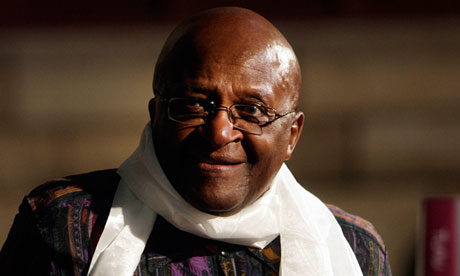
by Desmond Tutu

The immorality of the United States and Great Britain's decision to invade Iraq in 2003, premised on the lie that Iraq possessed weapons of mass destruction, has destabilised and polarised the world to a greater extent than any other conflict in history.

Instead of recognising that the world we lived in, with increasingly sophisticated communications, transportations and weapons systems necessitated sophisticated leadership that would bring the global family together, the then-leaders of the US and UK fabricated the grounds to behave like playground bullies and drive us further apart. They have driven us to the edge of a precipice where we now stand – with the spectre of Syria and Iran before us.

If leaders may lie, then who should tell the truth? Days before George W Bush and Tony Blair ordered the invasion of Iraq, I called the White House and spoke to Condoleezza Rice, who was then national security adviser, to urge that United Nations weapons inspectors be given more time to confirm or deny the existence of weapons of mass destruction in Iraq. Should they be able to confirm finding such weapons, I argued, dismantling the threat would have the support of virtually the entire world. Ms Rice demurred, saying there was too much risk and the president would not postpone any longer.

Friday, August 31, 2012

Texas loses latest voter ID battle after judges strike down 'retrogressive' law

    Friday, August 31, 2012   No comments

A federal court has struck down a Texas law requiring voters to present photo identification at the ballot box in the second ruling this week to effectively accuse the state of racial discrimination and attempting to manipulate elections.

In an escalating legal battle between mostly Republican-controlled states and the Obama administration over voter ID and other election laws, a panel of three judges in Washington DC found that the Texas legislation imposed "strict, unforgiving burdens on the poor" because of the cost and process involved in obtaining identification.

The US justice department told the court that voters would have to pay for birth certificates and travel up to 250 miles to obtain ID cards. The court said this imposed a "heavy burden" on any voter and would be "especially daunting for the working poor" who are more likely to be racial minorities.

The court concluded that if the law was implemented it "will likely have a retrogressive effect" by limiting access to the ballot box. It said that evidence submitted by Texas in support of its claim that the law was not discriminatory – and was necessary to combat voter fraud – was "unpersuasive, invalid, or both".

The US justice department told the court there are 600,000 people registered to vote in Texas whose names are not on driving licence or state identification databases. It said the voter ID laws in Texas and other states is a blatant attempt to disenfranchise African American and Hispanic voters.

On Tuesday another federal court ruled that an attempt by Texas to redraw its electoral maps was illegal because it was intended to diminish the impact of the Latino vote.

Wednesday, August 29, 2012

Inside Daraya - how a failed prisoner swap turned into a massacre

    Wednesday, August 29, 2012   No comments
by Robert Fisk

The massacre town of Daraya is a place of ghosts and questions. It echoed with the roar of mortar explosions and the crackle of gunfire yesterday, its few returning citizens talking of death, assault, foreign "terrorists", and its cemetery of slaughter haunted by snipers.

The men and women to whom we could talk, two of whom had lost loved ones on Daraya's day of infamy four days ago, told a story different from the version that has been repeated around the world: theirs was a tale of hostage-taking by the Free Syria Army and desperate prisoner-exchange negotiations between the armed opponents of the regime and the Syrian army, before President Bashar al-Assad's government forces stormed into the town to seize it back from rebel control.

Officially, no word of such talks between the enemies has been mentioned. But senior Syrian officers told The Independent how they had "exhausted all possibilities of reconciliation" with those holding the town, while residents of Daraya said there had been an attempt by both sides to arrange a swap of civilians and off-duty soldiers – apparently kidnapped by rebels because of their family ties to the government army – with prisoners in the army's custody. When these talks broke down, the army advanced into Daraya, six miles from the centre of Damascus.


Sunday, August 26, 2012

In the Shadow of Wounded Knee

    Sunday, August 26, 2012   No comments

By Alexandra Fuller
Photograph by Aaron Huey


After 150 years of broken promises, the Oglala Lakota people of the Pine Ridge Reservation in South Dakota are nurturing their tribal customs, language, and beliefs. A rare, intimate portrait shows their resilience in the face of hardship.

Almost every historical atrocity has a geographically symbolic core, a place whose name conjures up the trauma of a whole people: Auschwitz, Robben Island, Nanjing. For the Oglala Lakota of the Pine Ridge Indian Reservation that place is a site near Wounded Knee Creek, 16 miles northeast of the town of Pine Ridge. From a distance the hill is unremarkable, another picturesque tree-spotted mound in the creased prairie. But here at the mass grave of all those who were killed on a winter morning more than a century ago, it’s easy to believe that certain energies—acts of tremendous violence and of transcendent love—hang in the air forever and possess a forever half-life.

Alex White Plume, a 60-year-old Oglala Lakota activist, lives with his family and extended family on a 2,000-acre ranch near Wounded Knee Creek. White Plume’s land is lovely beyond any singing, rolling out from sage-covered knolls to creeks bruised with late summer lushness. From certain aspects, you can see the Badlands, all sun-bleached spires and scoured pinnacles. And looking another way, you can see the horizon-crowning darkness of the Black Hills of South Dakota.

One hot and humid day in early August, I drove out to interview White Plume in a screened outdoor kitchen he had just built for his wife. Hemp plants sprouted thickly all over their garden. “Go ahead and smoke as much as you like,” White Plume offered. “I always tell people that: Smoke as much as you want, but you won’t get very high.” The plants are remnants from a plantation of industrial hemp—low-tetrahydrocannabinol (THC) Cannabis sativa—cultivated by the White Plume family in 2000.


AdSpace - 2

AdSpace - 2
Books

Islamic Societies Review WEEKLY updates


ISR+


Now reading...


Frequently Used Labels and Topics


Search for old news

AdSpace-1

AdSpace-1
Buy Books

Find Articles by year, month hierarchy


Copyright © Islamic Societies Review. All rights reserved.