Tuesday, September 25, 2012

Remarks by the President to the UN General Assembly

    Tuesday, September 25, 2012   No comments


United Nations Headquarters
New York, New York 

10:22 A.M. EDT
THE PRESIDENT:  Mr. President, Mr. Secretary General, fellow delegates, ladies and gentleman:  I would like to begin today by telling you about an American named Chris Stevens.
Chris was born in a town called Grass Valley, California, the son of a lawyer and a musician.  As a young man, Chris joined the Peace Corps, and taught English in Morocco.  And he came to love and respect the people of North Africa and the Middle East. He would carry that commitment throughout his life.  As a diplomat, he worked from Egypt to Syria, from Saudi Arabia to Libya.  He was known for walking the streets of the cities where he worked -- tasting the local food, meeting as many people as he could, speaking Arabic, listening with a broad smile. 
Chris went to Benghazi in the early days of the Libyan revolution, arriving on a cargo ship.  As America’s representative, he helped the Libyan people as they coped with violent conflict, cared for the wounded, and crafted a vision for the future in which the rights of all Libyans would be respected. And after the revolution, he supported the birth of a new democracy, as Libyans held elections, and built new institutions, and began to move forward after decades of dictatorship.
Chris Stevens loved his work.  He took pride in the country he served, and he saw dignity in the people that he met.  And two weeks ago, he traveled to Benghazi to review plans to establish a new cultural center and modernize a hospital.  That’s when America’s compound came under attack.  Along with three of his colleagues, Chris was killed in the city that he helped to save. He was 52 years old. 

Monday, September 24, 2012

Muslim Protests: Has Obama Helped Bring On an Anti-U.S. 'Islamist Spring'?

    Monday, September 24, 2012   No comments

As the demonstrations over a American-made anti-Islam film continue, Michael Rubin and Aaron David Miller review the president's record in the Arab world.
In 2009, just five months into his presidency, Barack Obama gave a speech in Cairo to signal what he hoped would be a fresh start with the Muslim world.  "I've come here to Cairo to seek a new beginning between the United States and Muslims around the world -- one based on mutual interest and mutual respect, and one based upon the truth that America and Islam are not exclusive, and need not be in competition," Obama said. "Instead, they overlap and share common principles -- principles of justice, and progress, tolerance, and the dignity of all human beings."

After almost a decade of U.S. military involvement in Iraq and Afghanistan following the terrorist attacks of 9/11, Obama was seeking to turn the page on years of mutual distrust and suspicion.

That attempt largely failed, says Michael Rubin, a scholar at the American Enterprise Institute. But Rubin also says that's not because of anything Obama did or didn't do after he gave that speech. "I'm not sure we can really say that the Middle East revolves around the White House or [whoever] the occupant of the White House happens to be," Rubin says. "Oftentimes, whether it's under President Obama, or before him, under President Bush, or President Clinton, the U.S. tends to be in reactive mode towards the Middle  East, rather than in proactive mode."

Protests sparked by an obscure U.S.-made video mocking Islam kicked off in Arab countries this month before sweeping across other parts of the Muslim world. And as the often violent protests continue, Obama's post-Arab spring policies are coming up for review in Washington in the midst of a heated election season.


Syria Salvation Conference: An Overview of the New Syria

    Monday, September 24, 2012   No comments

-Syria is a sovereign State, its people are free and in full control of the State and all their territory. The sovereignty of the Syrian territories, State and people are one in the same. The Syrian people have a right to struggle by any means necessary to reclaim their occupied territories.
-The Syrian people are the source of sovereignty and legitimacy; this is enshrined through a civilian multi-party democratic republic, which is constituted by democratic institutions and where the rule of law prevails. Any monopoly of power is illegal, and power cannot be inherited under any circumstance.

Syria Salvation Conference: Our Main Principles

    Monday, September 24, 2012   No comments

The parties, political organisations, and personalities participating in the National Conference for Syria Salvation agree on the following principles as a basis and general foundation for their political position and movement:
1. Toppling the regime with all its figures and facets, which ensures the ability to build a civil democratic State, a state of law, justice and equal citizenship regardless of race, sex and religion.
2. Rejection of sectarianism and everything else that contributes to dividing Syrian society on a pre-civic basis.

Saturday, September 22, 2012

Syria’s Secular and Islamist Rebels: Who Are the Saudis and the Qataris Arming?

    Saturday, September 22, 2012   No comments


Out of Istanbul, the two Gulf states play a game of conflicting favorites that is getting in the way creating a unified rebel force to topple the Assad regime

By RANIA ABOUZEID


Vast swaths of northern Syria, especially in the province of Idlib, have slipped out of the hands of President Bashar Assad, if not quite out of his reach. The area is now a de facto liberated zone, though the daily attacks by Damascus’ air force and the shelling from the handful of checkpoints and bases regime forces have fallen back to are reminders that the rebel hold on the territory remains fluid and fragile.

What is remarkable is that this substantial strip of “free” Syria has been patched together in the past 18 months by military defectors, students, tradesmen, farmers and pharmacists who have not only withstood the Syrian army’s withering fire but in some instances repelled it using a hodgepodge of limited, light weaponry. The feat is even more amazing when one considers the disarray among the outside powers supplying arms to the loosely allied band of rebels.

As TIME reports here, disorder and distrust plague two of the rebels’ international patrons: Saudi Arabia and Qatar. The two Gulf powerhouses are no longer on the same page when it comes to determining who among the plethora of mushrooming Syrian rebel groups should be armed. The rift surfaced in August, with the alleged Saudi and Qatari representatives in charge of funneling free weaponry to the rebels clearly backing different factions among the groups — including various shades of secular and Islamist militias — under the broad umbrella that is the Free Syrian Army (FSA).

The middlemen of the two countries operate out of Turkey, the regional military power. Ankara has been quite public with its denunciation of Assad even as it denies any involvement in shuffling weapons across the border to Syrian rebels. It claims its territory is not being used to do so. And yet, as TIME reported in June, a secretive group operates something like a command center in Istanbul, directing the distribution of vital military supplies believed to be provided by Saudi Arabia and Qatar and transported with the help of Turkish intelligence to the Syrian border and then to the rebels. Further reporting has revealed more details of the operation, the politics and favoritism that undermine the task of creating a unified rebel force out of the wide array of groups trying to topple the Assad regime.

(The FSA is nominally headed by Riad al-As’aad, who is based in Turkey. Neither As’aad nor his chief FSA rival General Mustafa Sheikh are party to the Istanbul control room that supplies and arms rebels who operate under the FSA banner. The two men each have their own sources of funding and are independently distributing money and weapons to selected FSA units.)

According to sources who have dealt with him, Saudi Arabia’s man in the Istanbul control center is a Lebanese politician named Okab Sakr. He belongs to the Future Movement, the organization of former Lebanese Prime Minister Saad Hariri, which has a history of enmity with Damascus. (Syria was accused of complicity in the 2005 assassination of Hariri’s father Rafiq.) The party has not made Sakr available to TIME, denies his involvement in any weapons deals and insists that Sakr is in Belgium “on leave” from his political duties.

However, he apparently was in the southern Turkish city of Antakya in late August. A TIME inquiry with an Antakya hotel confirms Sakr was in the area at the time. According to rebel sources who dealt with him, the Lebanese politician was there overseeing the distribution of batches of supplies — small consignments of 50,000 Kalashnikov bullets and several dozen rocket-propelled grenades — to at least four different FSA groups in Idlib province as well as larger consignments to other areas including Homs. The FSA sources also say he met with some commanders but not others — a selectivity that led to much chagrin.


Friday, September 21, 2012

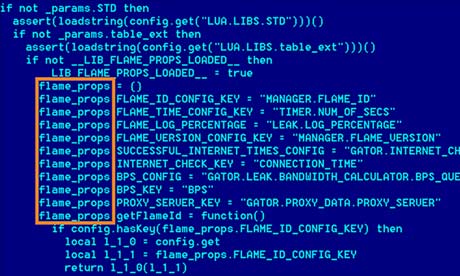
Study of Flame malware used in Middle East and north Africa reveals programmers probably had national backing

    Friday, September 21, 2012   No comments

The covert cyberwar being waged in the Middle East and north Africa – particularly against Iran and its allies – is even more sophisticated and widespread than had previously been understood, according to new research.

Two leading computer security laboratories – Kaspersky Lab and Symantec – have been studying a series of powerful cyberweapons used against targets including the Iranian nuclear programme and Lebanese banks accused of laundering money for Iran and its ally Hezbollah. They are now convinced that all were probably created by a national government or governments working together.

They have also identified key similarities in the weapons' computer coding suggesting some – if not all – were worked on at different times by the same or related groups of programmers.

Suspicion over the most likely culprit has centred on the US and Israel – not least after anonymous briefings to the Washington Post by an unnamed former senior US intelligence official this year.

In June the New York Times disclosed that one of the weapons identified in the last two years – Stuxnet, a sabotage program used to attack Iran's nuclear centrifuge in 2010 – was part of a joint US-Israel cyberwar plan, codenamed Olympic Games, targeting the Islamic republic, which suggests that the other cyber weapons could be part of the same wide operation.


Thursday, September 20, 2012

Frontline: the battle for Syria

    Thursday, September 20, 2012   No comments


Frontline: the battle for Syria

AdSpace - 2

AdSpace - 2
Books

Islamic Societies Review WEEKLY updates


ISR+


Now reading...


Frequently Used Labels and Topics


Search for old news

AdSpace-1

AdSpace-1
Buy Books

Find Articles by year, month hierarchy


Copyright © Islamic Societies Review. All rights reserved.